Spending money is never a math question, but a multiple-choice question: read Hao Hsu-lieh "Spend Money Wisely" to talk about rich thinking
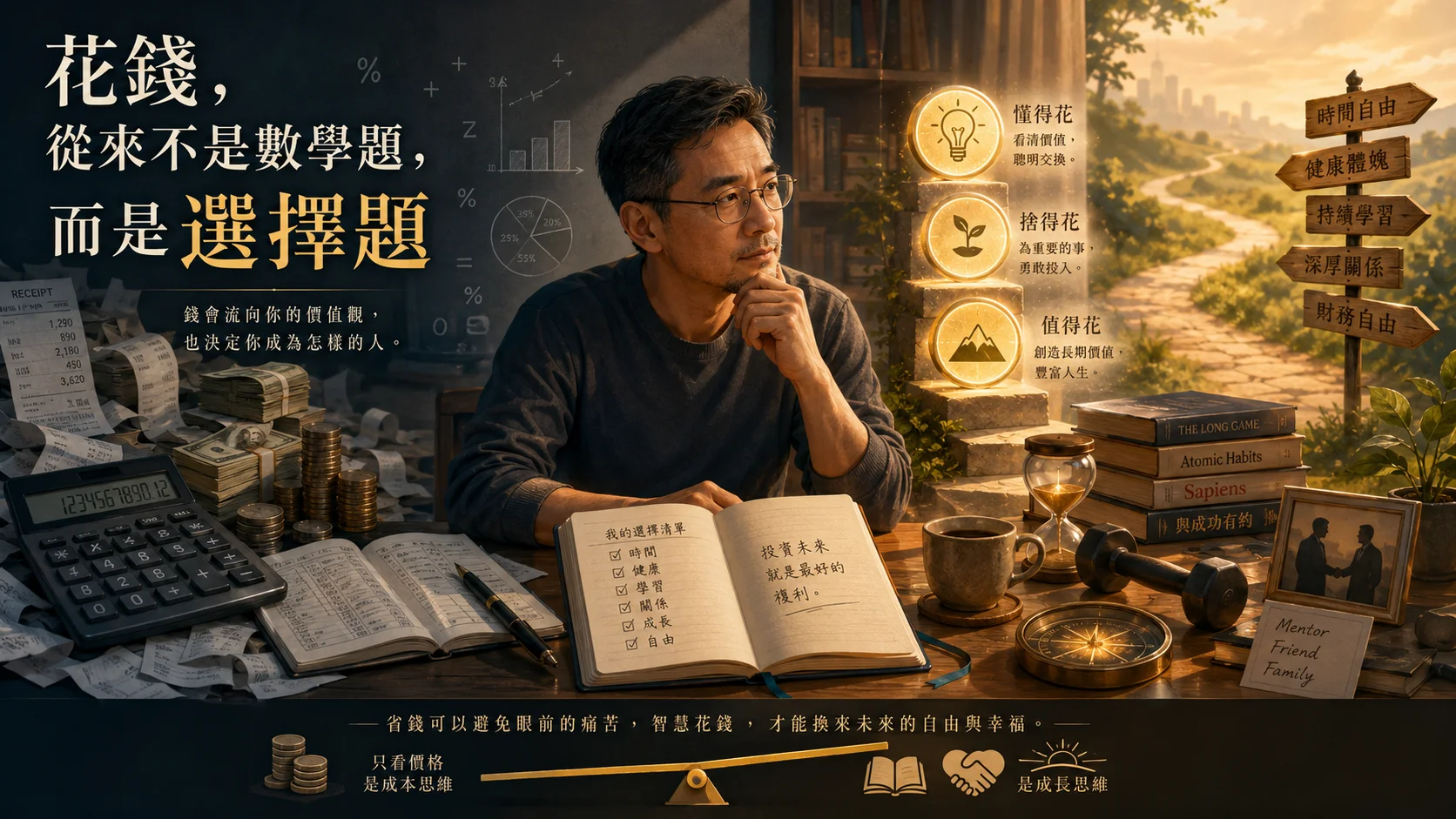
*▲ When it comes to spending money, the final calculation is never a number, but a value; it is not a math question, but a multiple-choice question. *
There are a lot of books on money on the market these years. Most of them teach people how to make money, how to save it, or how to make money? Hao Hsu-lieh’s new book “Spend money wisely (opens in a new tab)” goes in the opposite direction, turning the lens back to an action we do every day but almost never think about seriously - spending money.
Brother Hao and I have a fate that is not coincidental: we are both trained in industrial engineering. Industrial engineering teaches us to look at the world through the eyes of process, cost and benefit, and to try to figure out the best solution for everything. Because of this, what touches me most about this book is that it gently reminds me that when it comes to spending money, what counts in the end is never numbers, but value; it is not a math question, but a multiple-choice question.
The starting point of rich thinking: Ordinary people save money, rich people use money
There is a dialogue in the book that I read several times. Brother Hao asked an entrepreneur: “How often do you read financial statements?” The other person replied that he does not read three statements, but only three books - passbook, accounting book and notepad. The reasons are very real: the passbook is more timely and accurate than the cash flow statement; the account book records who owes me and who I owe, which is enough to control the profit and loss; and the most important notepad records “where I spent my time.”
Reading this passage shocked me. Those of us who are engaged in knowledge work, content production, and teaching are often bound by various professional frameworks and mistakenly believe that only by understanding reports can we be professional. But the entrepreneur pointed out one thing: the report is the result, and the result cannot be changed; what can really change the future is how you spend every day - spend money and time. The dividing line between rich thinking and poor thinking lies not in how much you earn, but in whether you regard money as a stock to be defended or as a flow that can create value. (This also reminds me of my experience when reading “Warren Buffett’s Investment Principles”. I once talked about it in “Theological Value Investing in Stocks” - the real rich never look at the current price, but the long-term value.)
Three things to happiness: know how to spend, be willing to spend, and be worthy of spending
Brother Hao condenses the wisdom of spending money into three levels. I think this is the skeleton of the whole book.
The first level is to understand flowers and learn about communication. He used the embarrassment of being served by a cane while playing “poke fun” in the first grade of elementary school to solve the problem - money can be exchanged for the gifts you want, but if you don’t use it correctly, it will also pay an unimaginable price. This level talks about recognizing what the money is used for, and changing spending from instinct to conscious exchange.
The second level is to be willing to spend, and what you learn is to choose. What moved me the most was the story of his mother who had a back injury but refused to recover in order to save money, and ended up spending more than 200,000 yuan. Brother Hao made a calculation for his mother: hiring a coach for retraining costs more than RMB 100,000 a year, which is far less than the medical and nursing expenses that may be repeatedly spent in the future. “If you don’t take care of your health today, you will take care of a doctor tomorrow; if you don’t take care of your health today, you will take care of a nurse tomorrow.” - This sentence sums up the idea that “the cost of not spending money is sometimes higher than spending money.” Saving money is never free, it just hides the cost where you can’t see it.
The third level is worth spending, what you learn is value. When he graduated from the graduate school, a senior gave Brother Hao a message: “Three hundred and sixty careers, which one is the best? It is best to follow the right person.” Hence, the later golden saying “You have to be able to follow even if you don’t have the talent for wisdom.” The senior told Brother Hao that when you are young, don’t care too much about salary, and spend your money on places that can continuously improve your own value, because value is something that follows you wherever you go.
Decision-making ideas hidden in books
The real brilliance of this book is that Hao quietly sews the concept of behavioral economics into the details of life. For example, if the first half of a stage play is not enjoyable, should you leave in the second half? ——This is the test of sunk costs: what has been paid should not become a reason to continue to spend it. You can’t eat pasta after eating steak – this is opportunity cost: every time you choose, you pay for the path not taken. I lost the movie ticket someone gave me. Do I want to buy another one? ——This is the mental account at work.
I especially like his breakdown of wants and needs: wanting a lot, needing a little. We often think that we are consuming rationally, but in fact what we are buying is anxiety and how we are seen by others. And the sentence “We cannot earn wealth beyond our cognition” is a golden sentence that I will copy into my notebook - your wallet will not be able to hold things beyond the boundaries of your cognition. (As for the relationship between cognition and wealth, I have also talked more completely about it in “Lack of cognition is the real password of wealth”.)

🛰️ Want someone to accompany you to see clearly in the wave of AI changes?
Almost all the public articles you see are finished products after repeated polishing. But what I cherish most are the warm judgments before the finished product - this is exactly why I created Vista AI Inspiration Supply Station (opens in a new tab): a weekly thought note for fellow travelers in the AI era, sharing those Yoshimitsu Kataha that will not appear in formal articles with you who are willing to get closer.
👉 Subscribe now and receive weekly emails → (opens in a new tab)
Inspiration for knowledge workers: The iron rice bowl in the new era
As I read the latter part, I kept thinking of my choices over the years. Brother Hao said that there are three things worth spending money on: increasing knowledge in the brain, applying abilities, and rallying the hearts of partners. These three things are exactly what I have been most willing to invest in over the years and where I have the least regrets.
As for the senior’s statement, “The iron rice bowl of the past was to eat in one place for a lifetime; the iron rice bowl of the future is to be able to eat anywhere for the rest of your life.” Today, when AI is reshuffling the cards, it is even more sharp. When tools are available to everyone overnight, the only things that cannot be copied and can be taken away are the knowledge we have internalized, the abilities we have honed, and the hearts we have gained with our sincerity. (I once talked about this in “AI is not just technology, but a future capability” through a student’s two-year review.) In this sense, spending money to buy books, spend money to study, and spend money to make mentors and friends is never consumption, but turning yourself into a machine that becomes more valuable the more you use it.
Conclusion: What you spend is not money, but wisdom
Closing the book, I remembered Brother Hao’s simple but profound words - spend money not on money, but on wisdom. It reminded me that the true definition of financial freedom is not to have a few zeros at the back of the account, but that every expenditure is spent on making yourself more free.
Understanding, being willing, and being worthy. In the final analysis, these “three gains” are an attitude towards life: only by knowing how to pay can you get what you want; because you spend money wisely, you can get what you want. For friends who are seriously managing their lives at this moment, this may be the most worthy gift of this book. (After all, reading a book is a kind of enjoyment in itself. If you want to make reading a daily routine, you are welcome to refer to the “Build your own reading ritual” I wrote.)
Next step
Bring this topic to your team
Vista Cheng speaks and runs workshops on AI workflows, writing and content systems for companies, schools and public agencies.