
Marketers’ AI superpowers: Use Vibe Coding to turn ideas into online sales pages and brand websites
*▲ When you can use dialogue to create a sales page, the world is different. *
A few days ago, I just finished an in-house training workshop. More than 20 students had never written a procedural program before. Three hours later, everyone left the classroom with a web page work that they had made by themselves and had just been deployed online.
It was a very special atmosphere. It’s not “I learned a new tool”, but “I suddenly realized that I can do something I didn’t dare to think of before.”
If you are also a marketer, if you have ever gritted your teeth because “engineers are needed to schedule”, “designers are scheduled to next month”, “outsourcing budget has been cut again” - then this article is specially written for you.
The invisible ceiling of marketers
I have been in the field of corporate education and training for fifteen years, and I have seen too many outstanding marketing talents trapped in the same dilemma: their heads run faster than their hands.
A senior marketing manager saw the launch of a new campaign for a competing product in the afternoon, and she had already drafted a counterattack proposal in her mind - everything from the main visual, the tone of the copywriting to the changing lines of movement. But what she has to do next is to write a requirements document, discuss it with the designer, wait for the engineer to schedule it, and revise it back and forth for five rounds. By the time the page is actually launched, the activities of competing products may have ended.
This is the invisible ceiling for marketers. It’s not that there’s not enough creativity or inaccurate judgment, it’s that there are too many people, too many processes, and too much waiting between the idea and the realization.
According to HubSpot’s 2025 State of Marketing Report, 72% of marketing professionals already use some form of AI tools in their daily work. But if you look closely, you will find that most people still use auxiliary AI-to write copy, make summaries, and change translations. Of course these are useful, but they solve the problem of “thinking faster” and do not really solve the bottleneck of “doing faster”.
The real bottleneck is never in the ideation stage. The bottleneck is - when you think of it, can you make it yourself?
Vibe Coding: A new era named by Andrej Karpathy
In early 2025, Tesla’s former AI Director Andrej Karpathy threw out a new word on social media: Vibe Coding.
Describing his working style, he said: “I don’t really write programs anymore. I just describe what I want in English and watch the AI make it. If it feels almost right, I accept it.”
This statement sounds like an understatement, but it actually opens a very important door. What it means is that writing programs is no longer the exclusive preserve of engineers. Anyone who can clearly describe what they want can speak up and let AI write a digital work that can be used, run, and online.
Marketers are the best at describing people in the world.
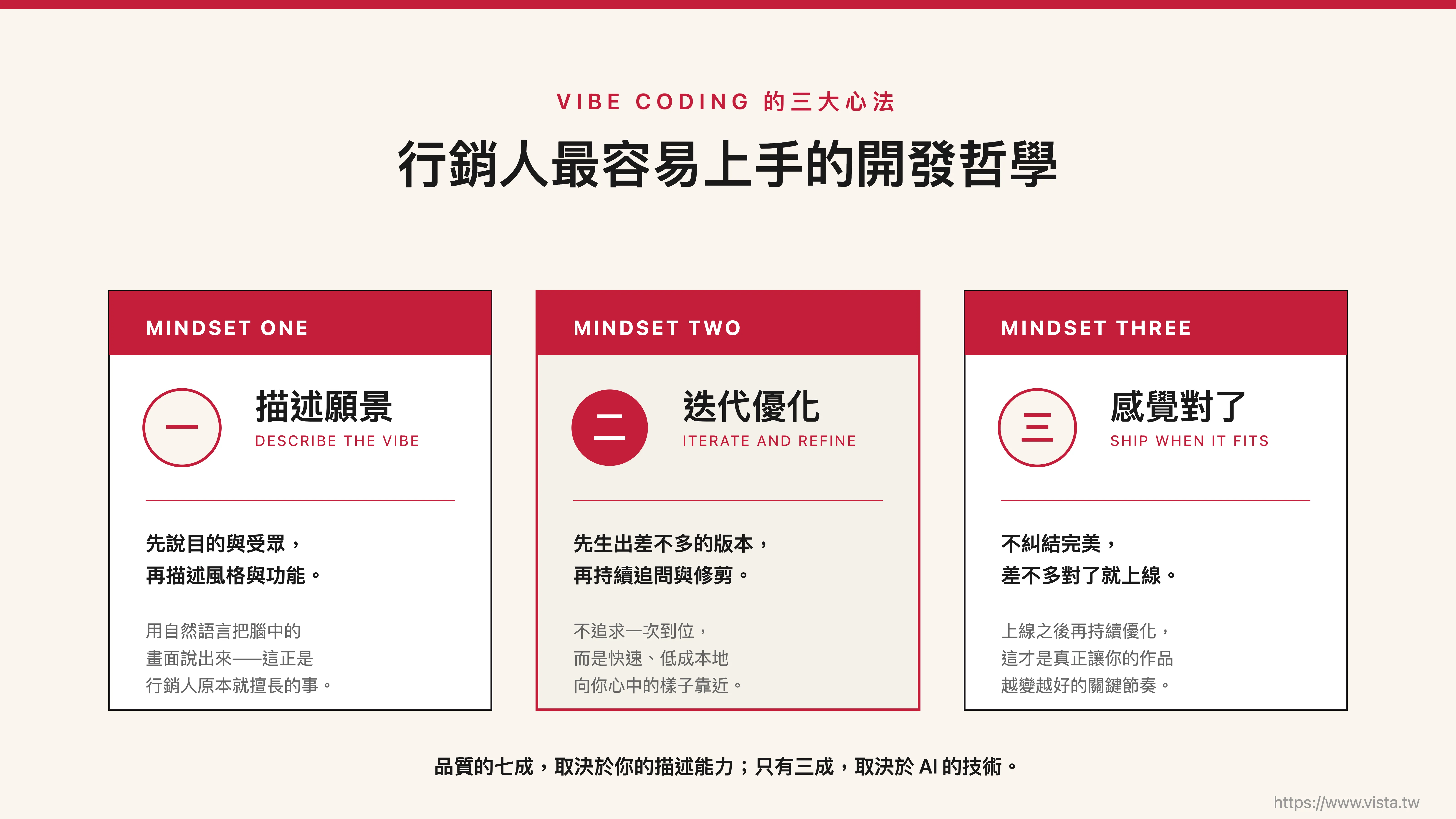 *▲ Marketers are originally doing the thing of “using words to convert the images in their minds into concrete executions.” *
Think about it, what do marketers do every day? Positioning, writing briefs, making proposals, discussing visual direction with designers, explaining functional requirements to engineers - in essence, you have already been doing “using language to convert the pictures in your mind into concrete implementations”. Vibe Coding does not require you to become an engineer, it just connects the abilities you already know to an unprecedented execution pipeline.
I often say something to my students: “The quality of Vibe Coding depends 70% on your description ability, and only 30% depends on AI technology.” What this sentence really means is - as a marketer, you are more suitable to walk through this door than anyone else. This is why I wrote an article before about Intention-Driven Communication: The ability to clearly explain intentions is the most critical workplace ability in the AI era.
Meet Claude Code: Your 24/7 on-call engineer
There are many tools to choose from, but I have actually promoted them in classrooms and on-site corporate training in the past few years. I most recommend that marketers start with Claude Code.
Claude Code is an AI programming assistant launched by Anthropic. But don’t be scared by the words “programming assistant” – what it really looks like is more like a full-end engineer sitting in your computer, ready for callback at any time. You tell him what to do in natural language, and he writes the file and saves it directly into your computer.
Oh, right! The aforementioned Andrej Karpathy, just announced Joining Anthropic on X on May 19th.
Give an example. At the workshop site, I will ask students to open the terminal and enter this sentence:
“Help me create a simple HTML page with the title “Welcome to my brand” and a light blue gradient background.”
Within ten seconds, index.html appeared. Open the browser, and a page with a gradient background and a centered title will immediately appear in front of you. Students usually have two reactions - one is “Uh, that’s it?”, the other is to say softly after a few seconds of silence: “This…changes something.”
Yes, this is where change begins.
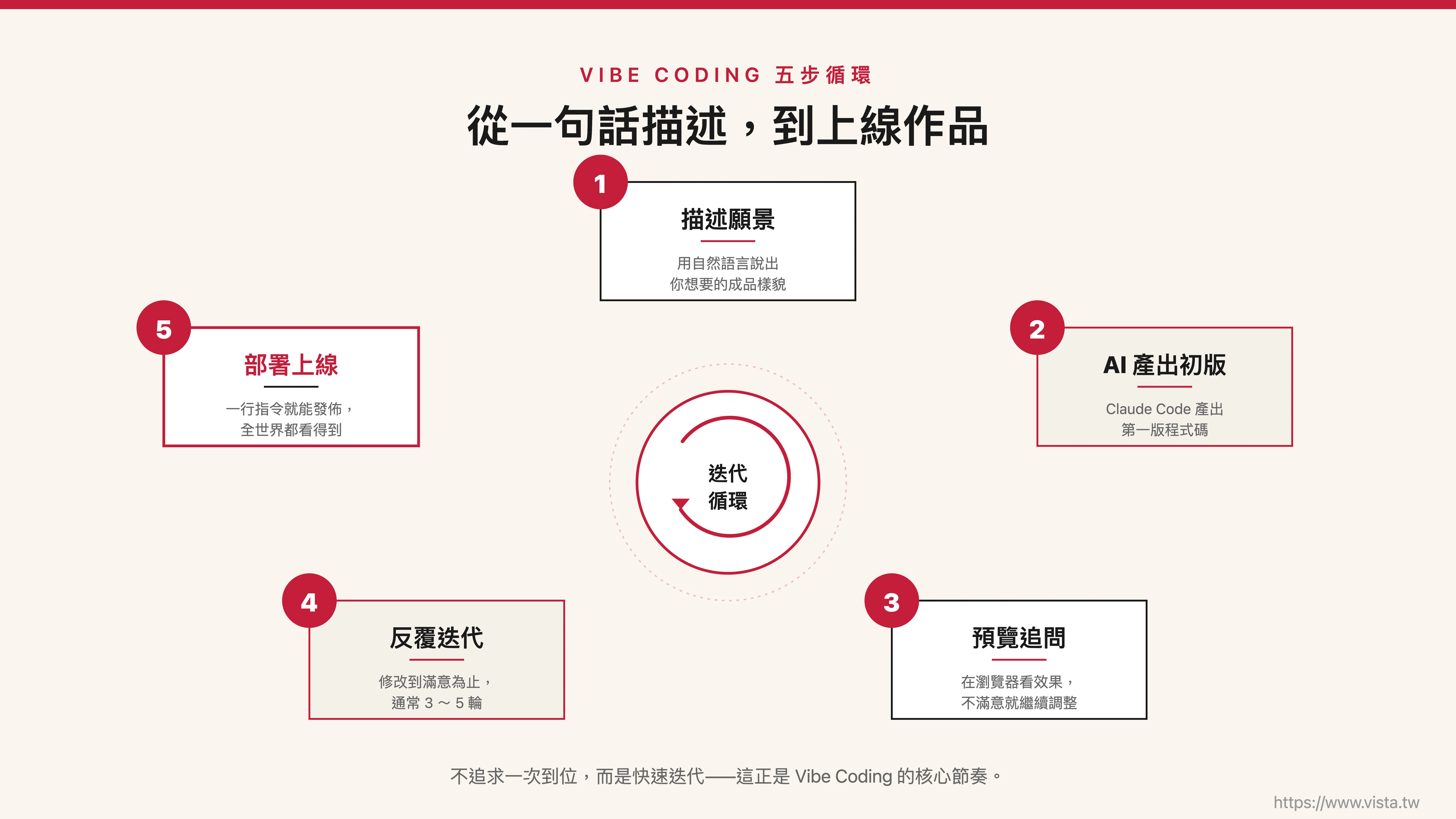 *▲ Don’t pursue getting it right in one go. If you learn this five-step cycle, you can use dialogue to polish any work. *
I especially want to remind you of one concept: you don’t need to understand the code at all. Just like you don’t need to understand how a car engine works to drive, you don’t need to know HTML, CSS, or JavaScript to use Claude Code. All you need to do is speak human words - and as a marketer, that’s exactly what you do.
If you want to make Claude Code more obedient, I would suggest you create a file called CLAUDE.md in the project folder and write in your brand colors, font preferences, target audience, and tone of voice. This file is like a “work instruction for the AI” and will be read automatically every time it starts. Your Brand Guidelines now have an automatically executed version.
Cowork: When AI becomes your virtual team
If Claude Code is your engineer, then Cowork is your entire team.
Cowork is a collaboration function launched by Claude, which allows you to conduct deeper and longer-term cooperation with AI in the same project space. You can upload brand guidelines, past cases, and product information to let AI fully grasp your brand context - whether you want to plan activities, write proposals, or do competitive product analysis, it already knows who you are, what you care about, and what your customers look like.
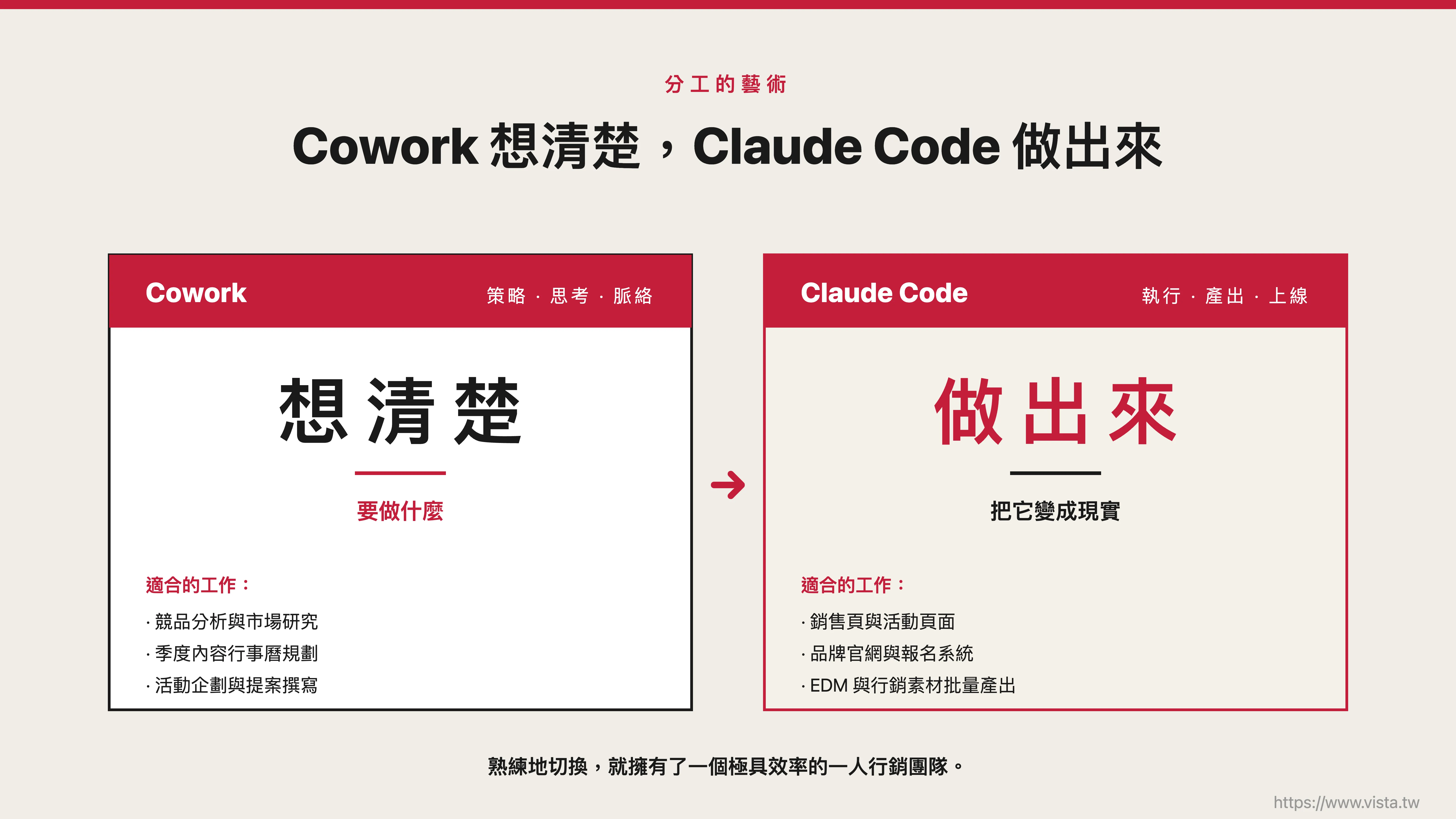 *▲ Figure out what to do and leave it to Cowork; make it and leave it to Claude Code. *
My own work allocation logic is simple: use Cowork to figure out what to do, and use Claude Code to do it.
Cowork is suitable for strategic, thinking, and long-term work. For example, you need to plan the content calendar for the next season, write a new product launch plan, and analyze the market positioning of three competing products - these “need to think” things are left to Cowork.
Claude Code is suitable for production-oriented, execution-oriented tasks that can be directly transformed into works. Sales pages, event pages, registration systems, EDM templates - leave these things to Claude Code.
When you can switch between the two skillfully, you will have an extremely efficient one-person marketing team. This is not an exaggeration - I know several independent consultants and small studio managers who rely on this combination to support the number of clients that would have required a team of five or six people to handle. This is exactly the core spirit of One Person Company: using AI to turn expertise into scalable influence.

🛰️ Want someone to accompany you to see clearly in the wave of AI changes?
Almost all the public articles you see are finished products after repeated polishing. But what I cherish the most is the warm judgment before the finished product - this is the reason why I made [Vista AI Inspiration Supply Station] (https://www.facebook.com/iamvista/subscribe/): a weekly thought note for fellow travelers in the AI era, sharing those Yoshimitsu Kataha that will not appear in official articles with you who are willing to get closer.
The first practical scenario: Let the sales page no longer be a gift from the designer
What digital works are most commonly requested by marketers? I believe 90% of the answers will be: Landing Page.
Whether you are doing e-commerce, running courses, promoting services or selling subscriptions, you definitely need a sales page. The special thing about the sales page is that its “design quality” is closely related to the “conversion rate”. A bad sales page cannot be monetized no matter how much traffic there is; an excellent sales page can more than triple the ROI of the same advertising budget.
According to Unbounce’s Conversion Rate Benchmark Report, the industry average landing page conversion rate is approximately 2.35%, but top sales pages can achieve 11.45%. The difference between this is not “whether there is a sales page”, but “is the sales page well done?”
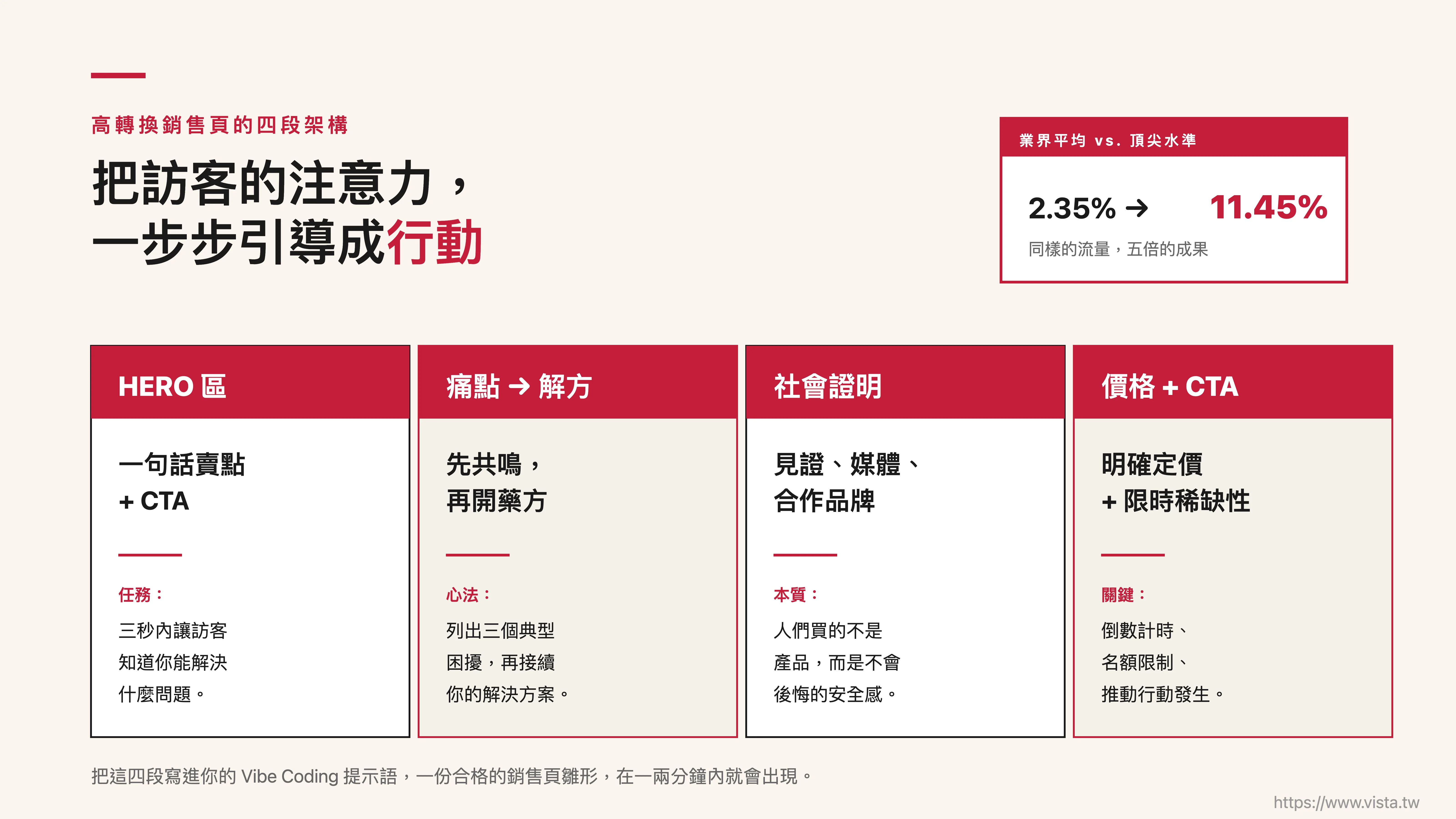 *▲ Give this structure to Vibe Coding, and you can run a complete set of sales pages in one afternoon. *
So, how should a good sales page be structured? In class, I will teach students a simple but effective four-paragraph structure: the first paragraph is the Hero area - a one-sentence selling point on the first screen, plus a clear CTA button. This block has only one task: let the visitor know what problem you can help him solve within three seconds?
The second paragraph is a bridge from pain points to solutions. First list three typical troubles that your target audience encounters every day to arouse resonance; then continue to expand on how your product or service responds to these troubles. This structure is in line with the cognitive inertia of the human brain - if you resonate first and then listen to suggestions, the acceptance will be much higher.
The third paragraph is social proof. Customer testimonials, media coverage, brand partnerships, or cumulative results—anything that can reduce doubts about a decision should go here. Remember, people don’t just buy products, they buy “a sense of security that they won’t regret.”
The fourth paragraph is the price and call to action. Things like clear pricing, limited-time offers, and clear next steps. I am used to adding countdown timers and quota reminders, and make good use of the principle of scarcity to drive action.
Writing this structure as a prompt for Vibe Coding would be a sentence like this:
“Make me a course sales page. Course name: “AI Marketing Practical Class”. Price: NT$4,980 (original price NT$8,800). The structure requires Hero area, pain point cards, course outline, lecturer introduction, student testimonials, FAQ, and finally CTA. The style follows Apple’s simplicity, with dark blue #1a365d as the main color and orange #FF6B35 for the CTA button. Remember to make a responsive design, and the mobile version is preferred.”
Paste this paragraph into Claude Code, and in about a minute or two, the prototype of your sales page will appear. Then you start to iterate - “Change the Hero area to a dark background and change the text to white”, “Add the original price strikethrough to the price area”, “Change the FAQ to an accordion and click to expand” - with each round of questioning, the page will be closer to what you want.
This is the true essence of Vibe Coding. It’s not about getting it right all at once but iterating quickly. You don’t need to figure out all the details in your head before you start. You just need to create a “similar version” first, and then continue to trim, fine-tune and polish on that version.
The second practical scenario: Let the brand have a decent digital appearance
The sales page is a single-page, single-goal sprint work; the brand webpage is a multi-page, multi-purpose long-term investment.
In the past ten years, I have seen too many personal brands and small studios stuck in the problem of “not having a decent official website”. It’s not that I don’t want to do it, but that I don’t have enough budget, or I find a manufacturer that doesn’t look like my own, or I want to change something after it goes online and I have to outsource it and redo it.
Vibe Coding completely changes the game. You can create a complete brand website including homepage, about us, services, portfolio, and contact us in one afternoon. From now on, you can change whatever you want to change yourself - this is the real “owning your own website”. My own personal image website vistacheng.com is built piece by piece with AI in this way, and everything from layout to copywriting is completely at my pace.
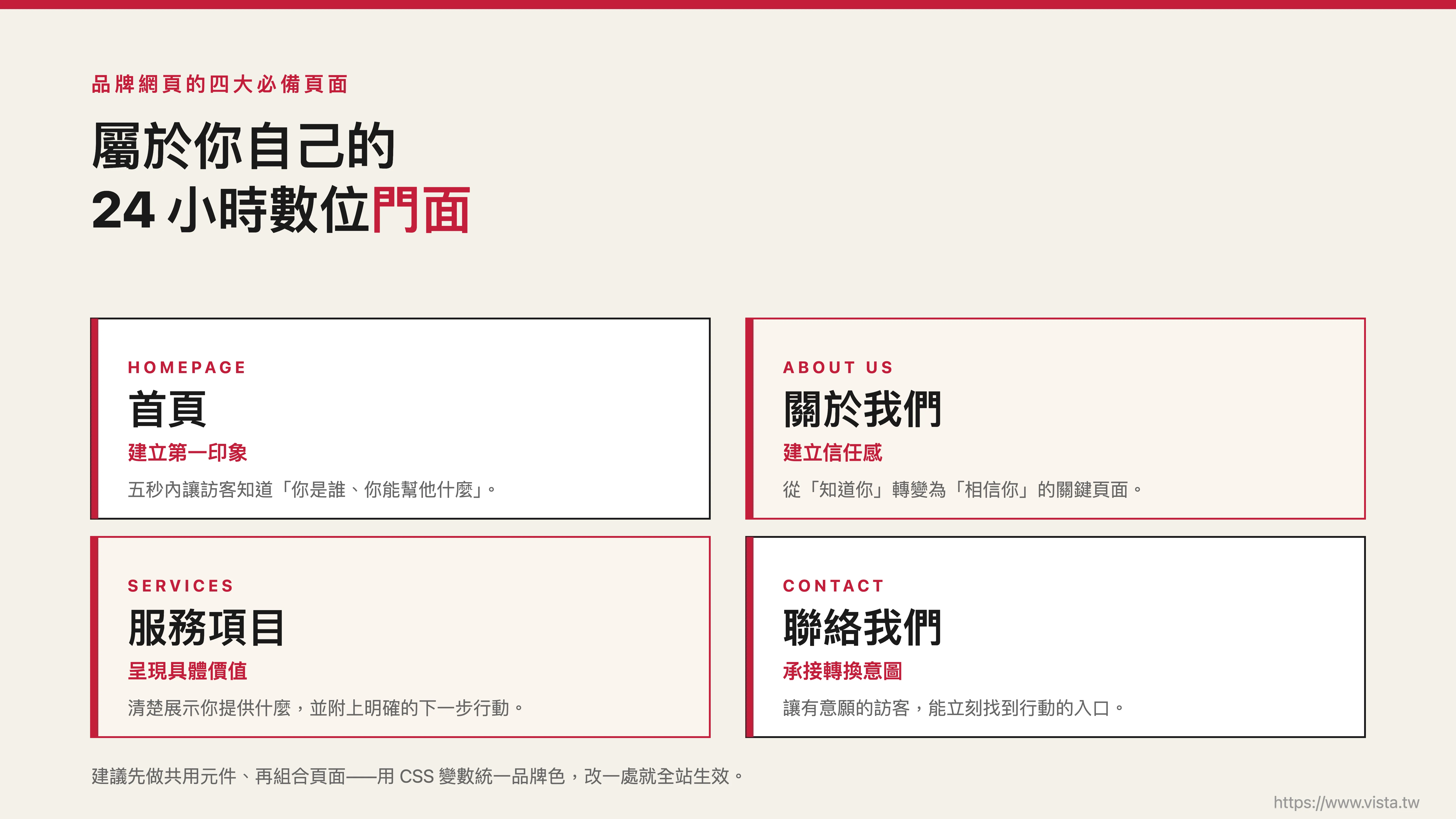 *▲ For the four basic pages, make the components first and then assemble the pages. Any changes in the future will take effect for the entire site. *
There are four key pages for building a brand website, which are the basics. The homepage is responsible for establishing the first impression, letting visitors know who you are and what you can help them within five seconds; the About Us page is responsible for building trust, changing from “knowing you” to “believing you”; the service or product page is responsible for presenting specific value; the Contact Us page is for those who are willing to immediately find the entrance to the next step.
In terms of implementation, I would recommend that you make components first and then assemble the page. In other words, first ask Claude Code to make common components such as the navigation bar, footer or button style, and use CSS variables to uniformly manage brand colors and fonts - so that no matter what you want to change in the future, the change in one place will take effect on the entire site. This is the most useful concept I learned from my engineer friends, and it also makes your brand website truly maintainable and expandable.
Deployment: Let your work truly enter the world
Making the website is only the first step, and making it “online” is complete. This step used to sound complicated, requiring renting a server, setting up DNS, and handling certificates—but now, it really only takes a few minutes.
The ones I most recommend for beginners are Cloudflare Pages and Netlify. Both have adequate free plans, automatic HTTPS, global CDN acceleration, and even support for custom domains. The advantage of Netlify is that it is novice-friendly - drag a folder into a web page and deploy it in a few seconds; Cloudflare Pages is suitable for long-term operation, with more stable performance and more flexible settings.
Deployment is something I would recommend you learn on day one. Don’t push the two phases of “finished” and “online” too far apart. When your work is only on your computer, it is just a file; when it has a URL that can be accessed all over the world, it truly becomes “your digital asset.”
Moreover, there is an implicit benefit to putting your work online quickly: you will start to see your work from the perspective of “actual users.” When you watch it on your own computer, everything feels good; after it goes online, you can open it on your mobile phone, share it with your friends, or post it to the social media to share it - you will immediately find a lot of things that need to be adjusted. This back-and-forth polishing process is the key to truly making your work better.
Integrate AI into your daily workflow
Learning the tools is just the starting point. Real efficiency gains come from systematically embedding AI into your workflow. As I said in my previous article Disassemble Your AI Agent Workflow - the real value of AI is not to superimpose on the old process, but to redesign the entire process.
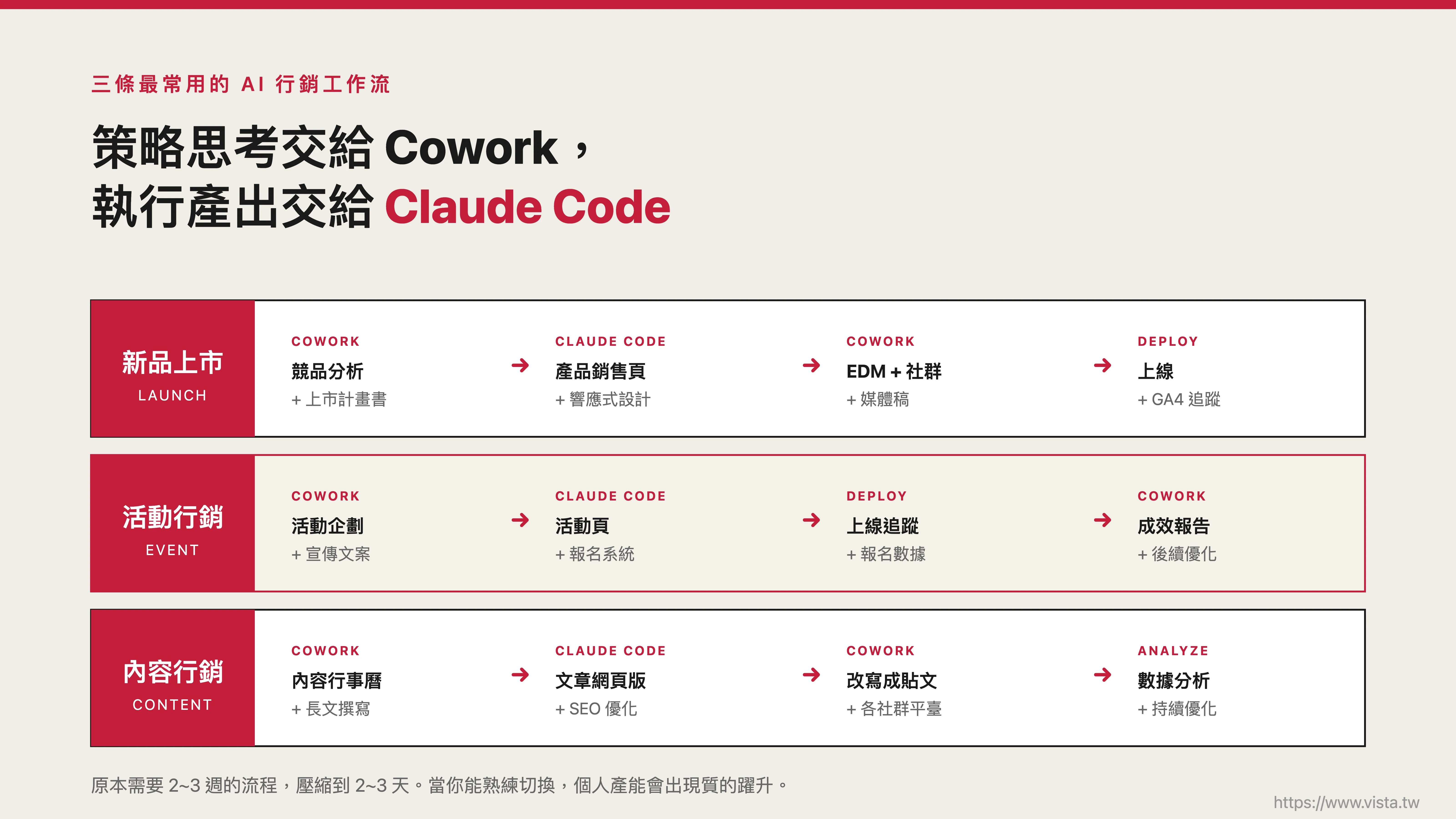 *▲ Leave strategic thinking to Cowork and execution output to Claude Code, and the workflow will run smoothly. *
After using it myself for a long time, I have sorted out the three most commonly used marketing workflows for your reference.
The first is the new product launch process. I will first use Cowork to do competitive product analysis and strategic planning, and produce a complete launch plan; then use Claude Code to create a sales page; then return to Cowork to write EDM, social posts, media releases and other marketing materials; and finally deploy it online and connect GA4 tracking data. The entire process, which used to take two to three weeks, can now be completed in two to three days.
The second item is the entire process of event marketing. Use Cowork for event planning and promotional copywriting, use Claude Code for event pages and registration systems, track registration information after deployment, and use Cowork to organize performance reports after the event - a complete event cycle that can be completed independently from start to finish by one person.
The third item is the daily output of content marketing. Use Cowork for content calendar planning and long article writing, use Claude Code to make important articles into beautiful web versions, and then use Cowork to rewrite them into posts on various social platforms. A core piece of content can be efficiently expanded into more than a dozen application forms.
The common feature of these workflows is that strategic thinking is handed over to Cowork, and execution output is handed over to Claude Code. When you can skillfully switch between these two modes, your personal productivity will experience a qualitative leap.
Written at the end: The era of marketers has just begun
In many corporate internal training or public classes, I am often asked a question: “Will AI replace marketers?”
My answer is – no, but marketers who can use AI will replace marketers who can’t use AI.
This answer may sound cliché, but it’s actually very serious. What we are experiencing is not the disappearance of marketers, but the expansion of the boundaries of marketers’ abilities. In the past, the boundaries of marketers’ capabilities were blocked by technical thresholds; from now on, this wall has collapsed, and your creativity, judgment and insights can be realized directly by your own hands, without waiting for anyone or queuing up.
Well, this is the happiest era for marketers. But it also means that the past working model of “I just have an idea and leave the execution to others” is rapidly failing. While other marketers can turn ideas into online works within three hours, if you are still writing requirement documents, running processes, or stupidly waiting for responses, your competitiveness will be quietly and silently diluted.
I would like to remind you again with Andrej Karpathy’s words: “I don’t really write programs anymore, I just describe what I want in English.” The key to this sentence is not “not to write programs”, but “I describe, and then it appears” - this is the working mode that marketers are most familiar with. After all, Vibe Coding is not a new thing. It just connects what marketers are already doing to a new execution pipeline.
So don’t read this article just as an introduction to a tool or a sales pitch for a course. Well, think of it as an invitation to a new way of working, a new possibility, and a new career chapter.
You don’t need to wait until you are completely ready to start. You only need to open Claude Code and enter the first sentence: “I want to make one…”
The rest is left to time and practice.
We believe that you already have the most important things - an understanding of the market, empathy for users, and the determination to get things done. AI is just wings that make you run faster.
I believe that the next person to take off will be you.
🚀 Want to make your own digital products, but don’t know where to start?
Dan Koe said: The core of a one-person company is to productize knowledge. But if you don’t know how to program, how do you turn your ideas into real products?
The answer is Vibe Coding - use AI to help you write programs. In Vibe Coding × Claude Code Practical Workshop, I will take you step by step to start from scratch and use AI to turn ideas into operational websites, tools and digital products without any programming knowledge.