When AI agents take over execution, marketers rely on these three keys to reshape irreplaceable value
*▲ When execution costs approach zero, the value of marketers shifts from “doing it quickly” to “thinking accurately and seeing through it”. *
This article was originally published in Economic Daily.
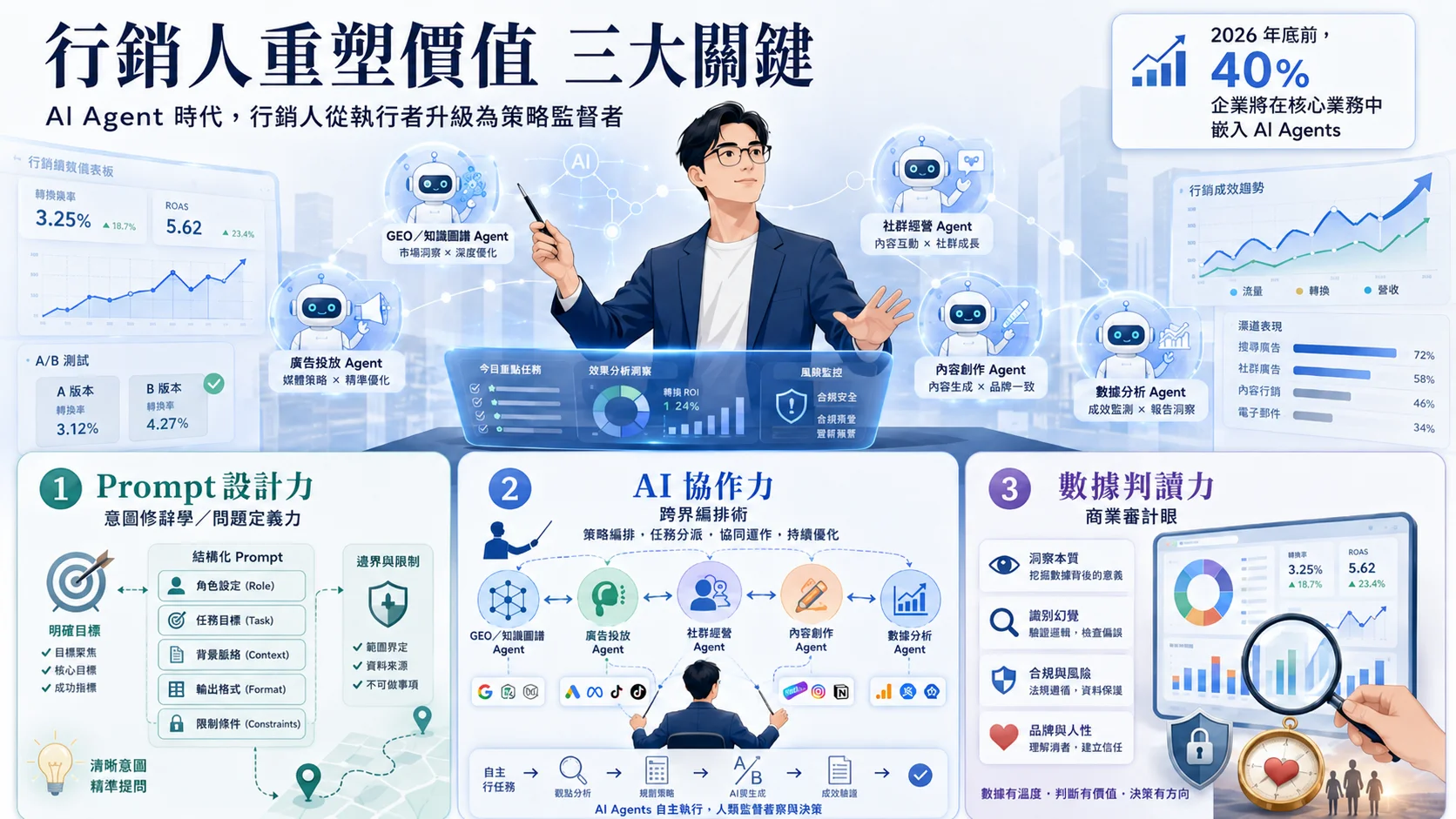
Gartner, an authoritative international market research organization, has made a bold prediction: By the end of 2026, up to 40% of enterprises around the world will have embedded autonomous artificial intelligence agents (AI Agents) in their core businesses. This is not an unreachable technological science fiction, but an ongoing process that is completely reversing the underlying logic of business.
In the past few years, marketers’ application of AI has mostly remained at the level of automation tools. AI is just an obedient but soulless digital soldier, still highly dependent on human beings for fine-tuning and cumbersome operations.
However, just in the past few months, the evolution of technology has reached a decisive breakthrough.
The new type of AI Agent has completely broken the one-way linear model and has the closed-loop capabilities of autonomous planning, cross-system execution and instant reflection and return. When you give a business intention of increasing the conversion rate of a new summer sunscreen product by 15%, the AI Agent will no longer just write a few copies for you, but will actively analyze competitive product data, connect to APIs to dynamically adjust advertising budgets, conduct A/B testing on multiple platforms, and automatically produce decision briefings at key nodes.
This means that marketers are no longer front-line executors, but have become strategic supervisors of the entire AI marketing team. And when the execution cost of technology is compressed to close to zero, what core chips should marketers hold to avoid being marginalized in the torrent of algorithms? In the post-AI agent era, the following three key skills will determine a marketer’s worth and irreplaceability.
Key One: Prompt Design Power - Evolving from Mantra to Rhetoric of Intent
When the AI Agent has strong autonomous execution capabilities, the core competitiveness returns to how you issue the first instruction to it? The future Prompt design power will evolve from the simple spells or keyword stacking in the past to a rigorous rhetoric of intent and problem definition power.
As strategic supervisors, marketers must possess the speculative logic of academic researchers, be able to see through chaotic market noise, and accurately point out business pain points.
Excellent Prompt design no longer just requires AI to write an email, but can set clear role boundaries, objective functions, and permission restrictions for AI Agents. The more structural and strategic the intentions you give, the more amazing the commercial momentum released by autonomous agents will be.
Key 2: AI collaboration—cross-border orchestration like a conductor
The organizational structure of the future marketing department will become extremely streamlined yet highly powerful. A high-level marketer may not manage five marketing assistants, but five AI Agents who perform their own duties: one specializes in GEO (Generation Engine Optimization) and knowledge graphs, one is responsible for dynamic advertising, and the other focuses on creating a community atmosphere.
Therefore, marketers must have strong AI collaboration capabilities, a cross-border orchestration technology. You must understand the underlying logic, advantages, and limitations of different large-scale language models and Agent architectures, know how to connect different digital tools, and establish an efficient and seamless information flow between multiple AI agents. This set of the ability to control AI Agent is the practical starting point for the transformation of small and medium-sized enterprises and individual workers.
Just like a conductor of a symphony orchestra, although he does not play any instruments himself, he can make the entire team play harmonious and majestic movements through perfect coordination.
 ▲ Like this kind of practical perspective on AI × marketing? Subscribe to Vista AI 靈感補給站 and I’ll keep sending you the latest tool tactics and trend reads as soon as they land.
Key Three: Data Interpretation - Business Auditing Eyes to Uncover Illusions
Although AI Agent can autonomously optimize and produce beautiful return data, it lacks a perceptual understanding of real human society, technical regulations, and brand soul. When the platform is flooded with data models generated by AI that may seem perfect but may lack warmth, marketers’ last line of defense is data interpretation.
Marketers need to have a pair of business audit eyes, able to keenly detect potential illusions in the huge data returned by AI agents, examine whether it touches the strict privacy and technology regulations in Europe and the United States (such as the EU AI Act), and evaluate whether the results of these independent optimizations are aligned with the long-term value of the brand. This ability to penetrate the fog of algorithms and gain insight into the human warmth behind the data is an authenticity that machines can never replicate.
Conclusion: The focus of value changes from hands to brain and eyes
From Prompt design capabilities, AI collaboration capabilities to data interpretation capabilities, these three keys actually point to the same thing: when the AI agent takes over the “hands-on work”, the value of the marketer is fully transferred to “accurate thinking, smooth programming, and discernment.” Execution will become cheaper and cheaper, but the judgment to define problems, allocate resources and protect the brand will become more and more valuable.
The sooner you reposition yourself from an executor to a strategic overseer, the less likely you will be marginalized in this changing landscape—and become the one holding the baton.
📖 深入探索相關主題