When wildebeest crosses the Mara River: See how companies can break through difficulties from Liu Run's 2025 annual speech
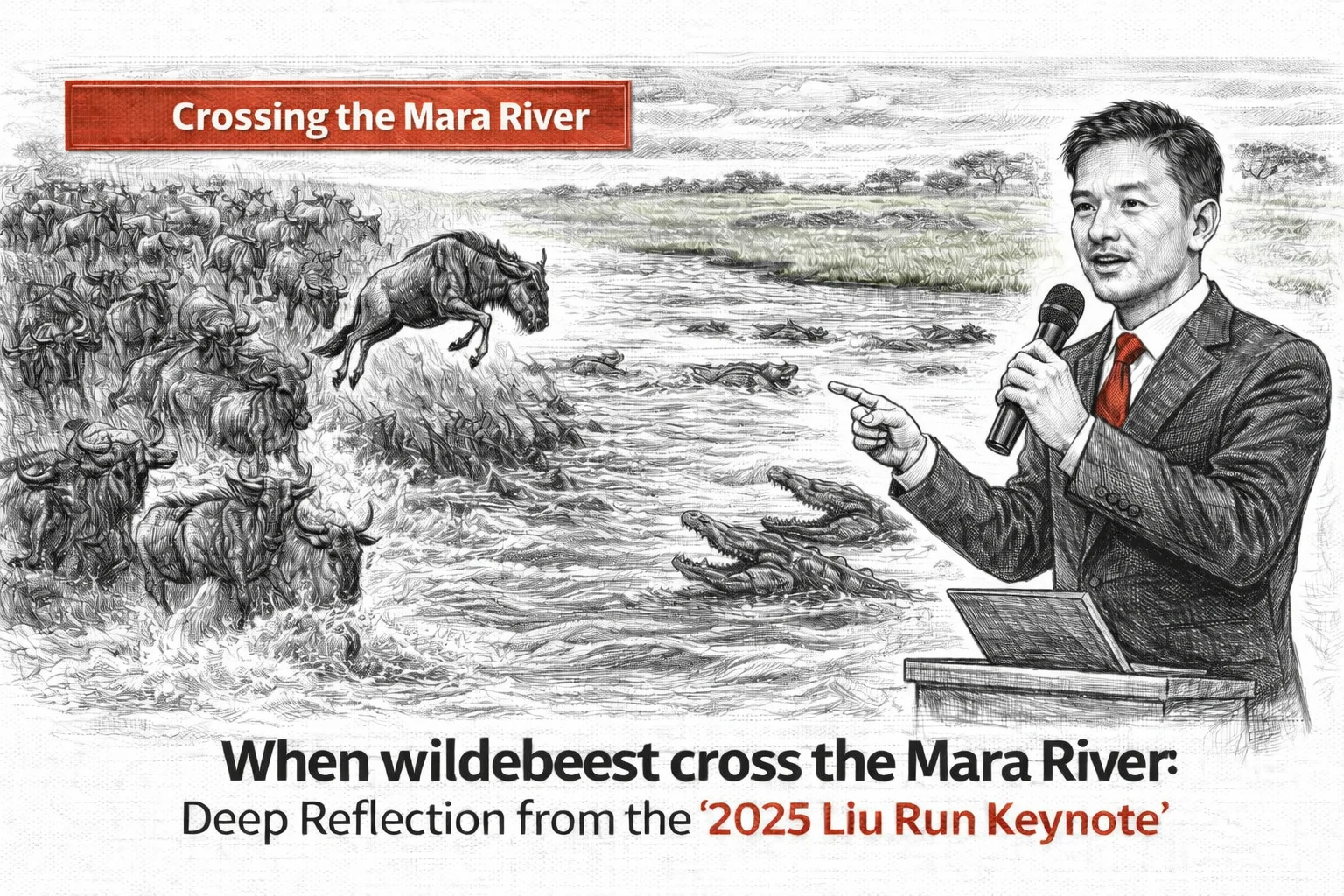
On October 25, 2025, I sat in front of the computer and finished watching Liu Run (opens in a new tab)’s fifth annual speech. When the scene of the wildebeest migration on the African savanna appeared on the screen, I was deeply shocked. This is not a speech about trends, nor a sermon about opportunism, but a profound discussion on “how to survive and grow.”
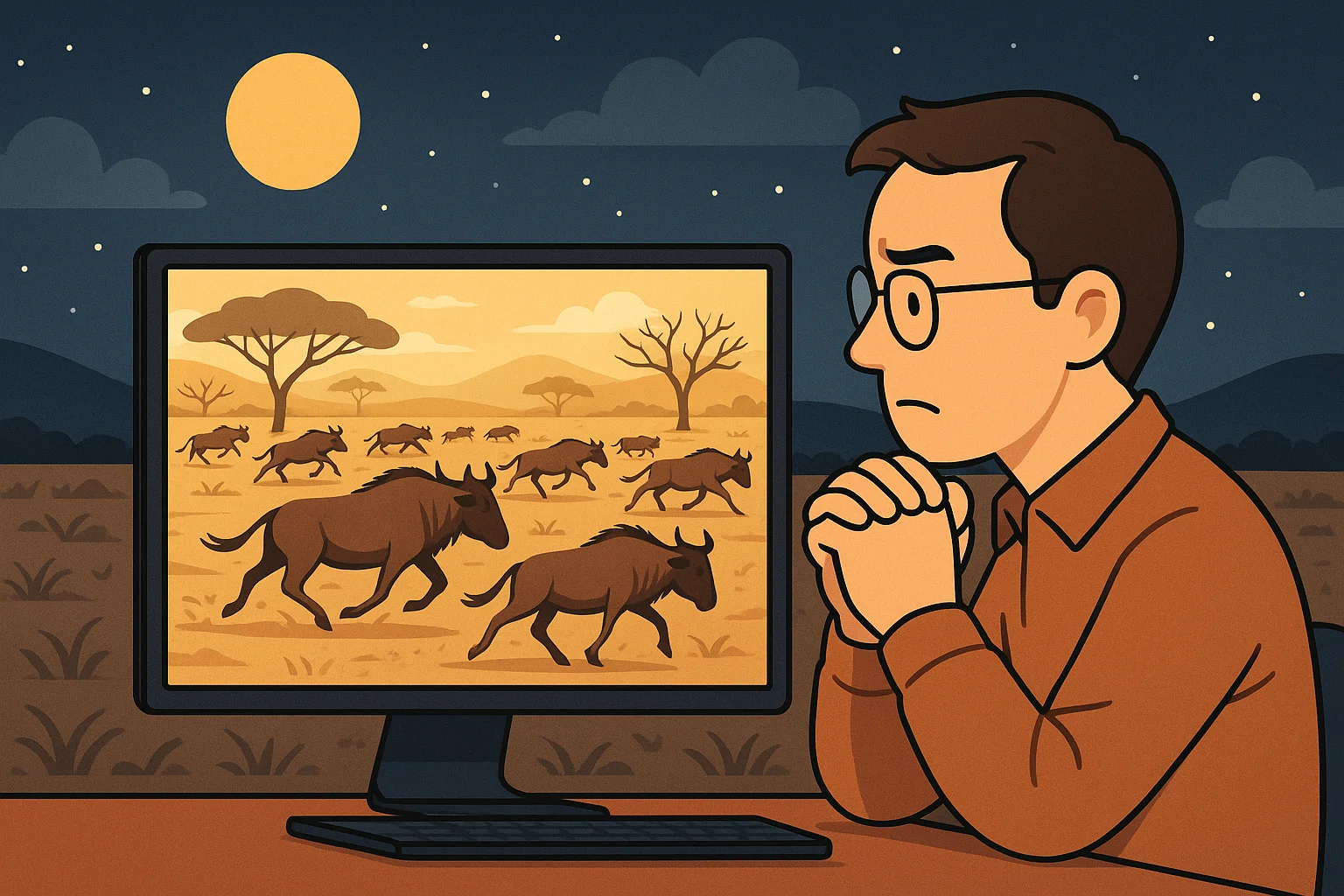
There was a sentence in the speech that particularly impressed me:
“Ignoring suffering hurts more than the suffering itself.”
Yes, the business world in 2025 is no longer the era where “even pigs can fly when standing on the cusp of the storm.” What drives entrepreneurs today is no longer opportunism at the forefront, but long-termism in the mud. This speech is clearly intended for those who trudge through the mud.

Systemic Drought of Ecological Niches
As soon as the speech kicked off, Liu Run revealed a cruel reality: the ecological niche we depend on for survival is experiencing systematic drought.
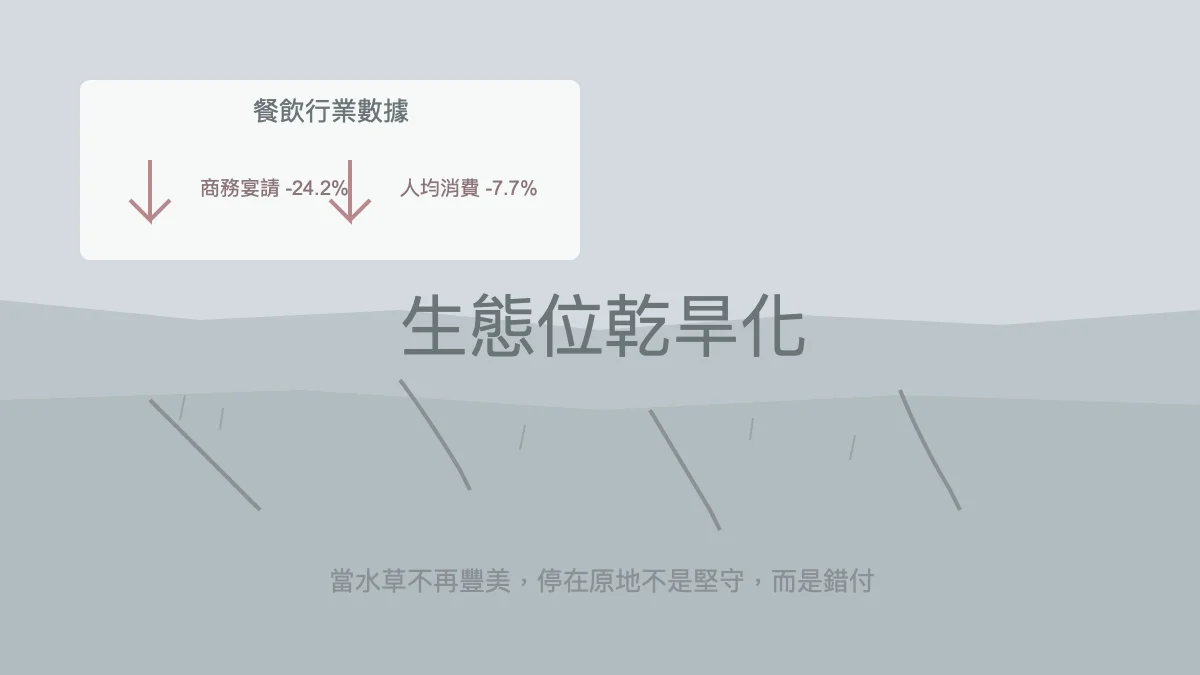
Look at the data of the catering industry: in 2025, China’s business banquets and company team building will decrease by 24.2%, per capita consumption will drop by 7.7%, and the average life span of a restaurant will be shortened from more than 2 years to 15 months, too late to celebrate one’s second birthday. Looking at the maternal and infant industry: From 18.83 million newborns in 2016, the number has dropped to 9.02 million in 2023, a halving in seven years. Behind these data is the bitterness of countless entrepreneurs.
An ecological niche is a species’ occupation in an ecosystem, including its environment (habitat) and its unique living habits, such as food types, foraging locations, activity times, etc. It covers all interactions of the species with the biotic and abiotic environment, and each species should have its own unique niche in ecological equilibrium to reduce competition.
But more importantly, Liu Run put forward a key insight: when so many companies complain about difficulties at the same time, there must be a common reason behind them. The reason is not that we have become lazy or weak, but that the ecological niche we depend on for survival has become systematically arid.
I think so. In the past year, we have seen too many excellent companies with good products and good services, but they are unable to sustain themselves. The problem is not with them, but with changes in the entire ecology. Just like the dilemma faced by wildebeests - it’s not that they don’t work hard to eat the grassland, but that the grassland itself is dry.
Mara River decision: Bravely cross the river or stay where you are and get involuted?
So, what should you do when the water plants are no longer lush? Liu Run gave a shocking answer using the migration of wildebeest on the African savanna.
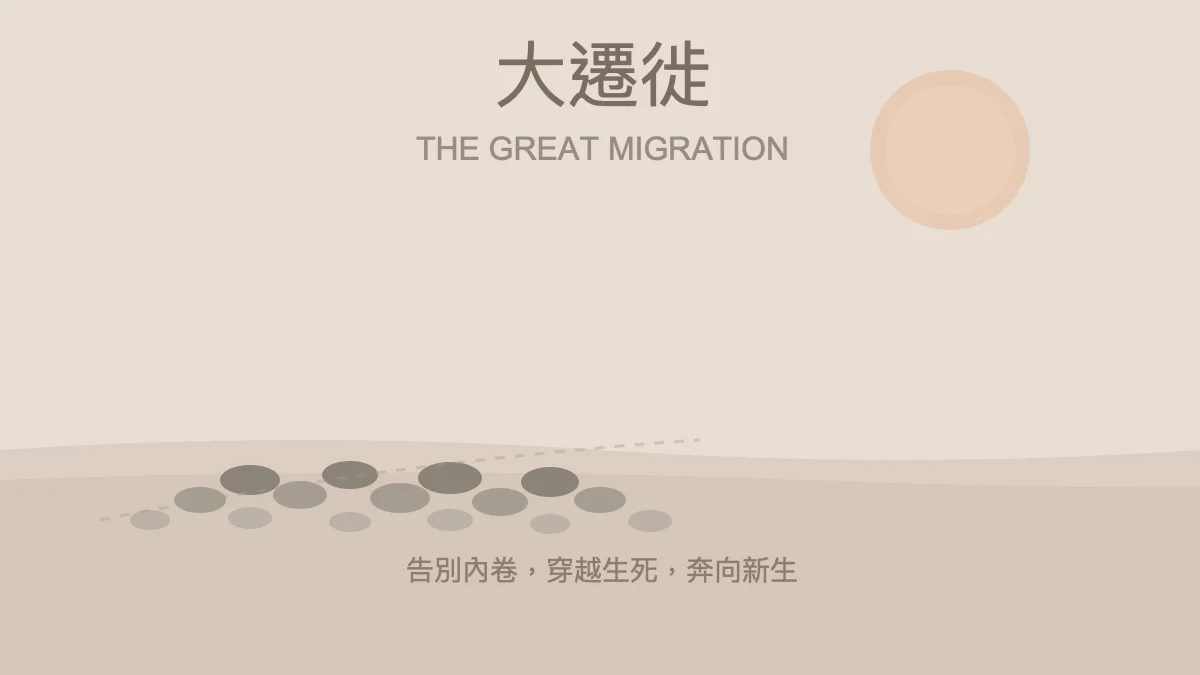
Staying where you are is not holding on, but a wrong payment.
Every year, wildebeest trek 1,000 kilometers from the Serengeti in Tanzania to the Masai Mara in Kenya. There are lions, hyenas and, most dangerous of all, the Mara River, where giant Nile crocodiles lurk.
But the wildebeest had no choice. They have to make a “Mara River decision”: bravely cross the river and risk it, or stay where they are and get swept in? The wildebeest has no other choice but to bravely cross the river! When the boldest or most desperate wildebeest leaps into the river, thousands of wildebeest rush in like a flash flood. Although there were sacrifices, the survivors eventually arrived at their new home with lush water and grass. The wildebeest proves to us with its life that if you want to survive, you must bid farewell to involution, travel through life and death, and rush towards new life.
Just imagine, in order to survive, animals must make a “choice” to cross this river, even if it means facing the threats of river water, crocodiles and predators. So, what about us humans?
As a business consultant and training instructor, this reminds me of the many businesses I have interacted with over the past year. Some companies choose to stick to their original markets and get deeper and deeper into the price war; while other companies bravely start their own “great migration” - some from B2C to B2B, some from domestic to overseas to compete in the World Cup, some from products to SaaS services, and some boldly embrace AI. Those companies that bravely crossed the river, despite the arduous process, eventually found new room for growth.
Six major migration directions
In today’s speech, Liu Run proposed six major migration directions, each of which is worthy of our deep thought.
1. The Great Migration of Categories: Breaking the Rigidity Cage
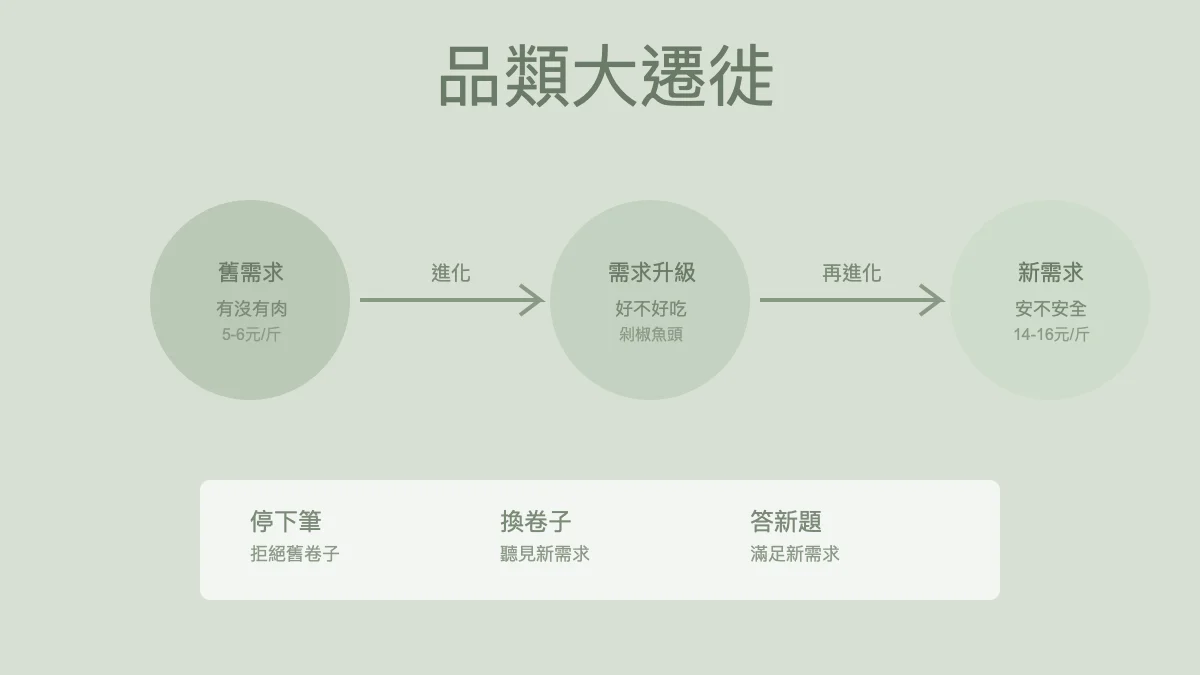
He used a very vivid case: Huang Jinfeng in Wuhan sold silver carp (fat-headed fish) from 5-6 yuan per catty to 14-16 yuan per catty. Why? Because he starved the fish for 20 days to lose weight and keep fit, what he satisfied was no longer the need for meat, but the need for safety.
This case sounds a bit cruel, but the biggest inspiration to me is that the same fish can meet different needs of users. Sold in terms of pounds, it sells protein to satisfy food and clothing; adding chopped peppers sells good taste and satisfies appetite; hungry and slimming sells a sense of security and soothes anxiety.
What is category rigidity? It means pushing too hard on old needs and being slow to respond to new needs. The price of adapting perfectly to yesterday is to lose the ability to embrace tomorrow.
Liu Run proposed a “three-step method for the great migration of categories”: stop writing, change papers, and answer new questions. The first is to stop writing, which is a sober refusal. You realize that getting a higher score on the old paper is meaningless because the subjects on the exam have changed. Then you change the paper, and you start to hear a new voice: users need door locks to collect express delivery, and they need power at the dining table. Every unsatisfied complaint is a new paper quietly thrust into you by the times. Finally, answer new questions. All your wisdom will no longer be used to optimize old answers, but to meet new needs.
The case of Dessmann Smart Door Lock (opens in a new tab) perfectly explains this process. The pursuit of traditional door locks is to “let people in and block outsiders.” For thousands of years, they have been constantly looking for smarter keys. But today’s door locks are facing new demands: the courier boy calls outside the door every day, the cleaning lady comes and you are still on the subway, and the cat owner swoops out when you go out to throw garbage. So Deschman used AI to add eyes, ears, and a mouth to the door lock. The door lock can collect express delivery for you, open the door remotely, monitor children leaving home, and even allow women living alone to use the voice change function to talk to strangers. From guarding a fortress to operating a hub, this is the essence of the great migration of categories.
2. The great migration of value: from tangible products to intangible emotions
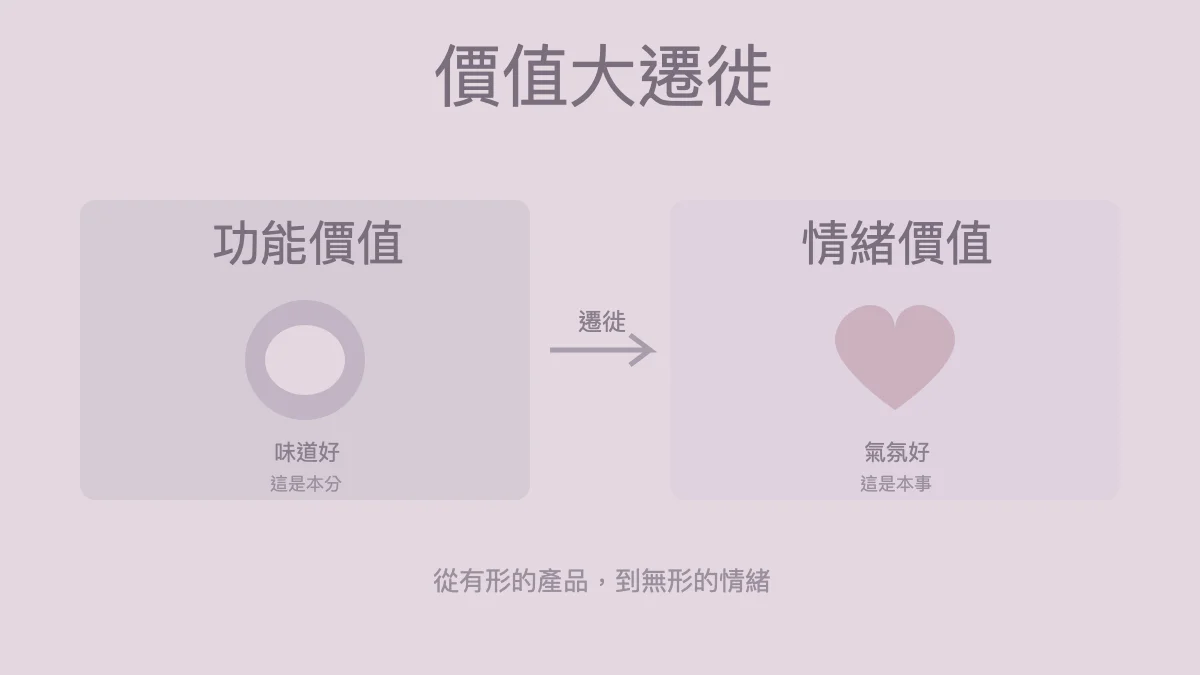
The case of Baojiang Spicy Grilled Fish (opens in a new tab) impressed me deeply. The restaurant industry is so tough in 2025, but roasters still have long lines. Founder Leng Yanjun said: “It’s your duty to have good taste. It’s your duty to have a good atmosphere.” The black gold-style decoration tells young people that “this place is here to reward yourself.” The pepper ice cream makes you can’t help but take photos and post them on friends. The birthday party has a good atmosphere and is not too social at the same time. The roaster is moving from a necessary function to an emotion that exceeds expectations.
Today’s consumers not only want to buy products that are easy to use, but also want to enjoy them. I have observed that more and more products are beginning to value emotional value. Cafes not only sell coffee, but a third space, just like the Starbucks we are familiar with; bookstores not only sell books, but spiritual corners, which reminds me of the sleepless nights at Eslite Bookstore; gyms not only sell exercise, but self-discipline and feelings.
Emotions are becoming the new currency. In other words, in an era when functions are fully satisfied, whoever can give users a better emotional experience is likely to win the market.
3. The Great Migration of Models: From Visible Products to Invisible Capabilities
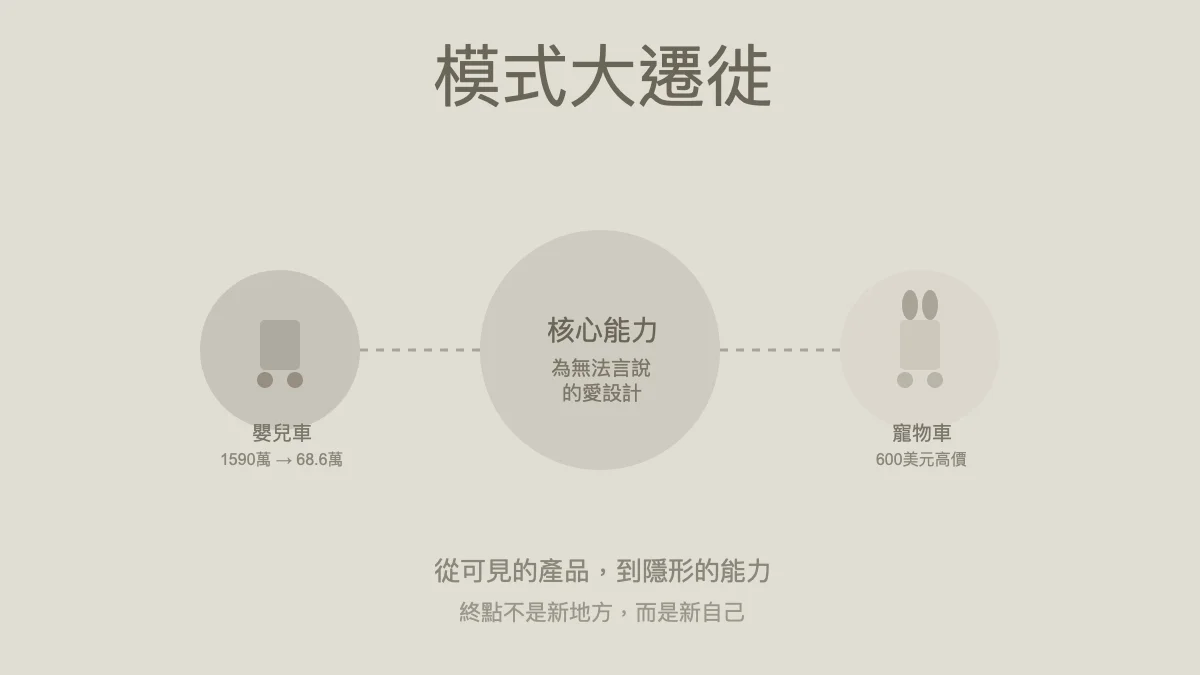
The case of Japanese maternal and infant brand AirBuggy (opens in a new tab) made me think deeply for a long time. When the number of newborn babies in Japan fell below 700,000, and the number of pets reached 15.9 million, AirBuggy did not choose to cut prices and become involved. Instead, it rethought: “What is our core competency?” The answer is: designing the best products for unspeakable love. So they transferred their ability to manufacture strollers to pet strollers, and the high price of $600 is still a hot seller. On Korean e-commerce platforms, their sales of pet strollers even exceed those of baby strollers.
The inspiration of this case is: sometimes the end of the Great Migration is not to let you go to a new place, but to make you a new self.
From visible products to invisible capabilities, this is the core of the great migration of models. When customers are physically disappearing, what we have to think about is not how to retain disappeared customers, but how to apply core capabilities to new scenarios.
4. The Great Migration to the Sea: From Made in China to Made by Chinese
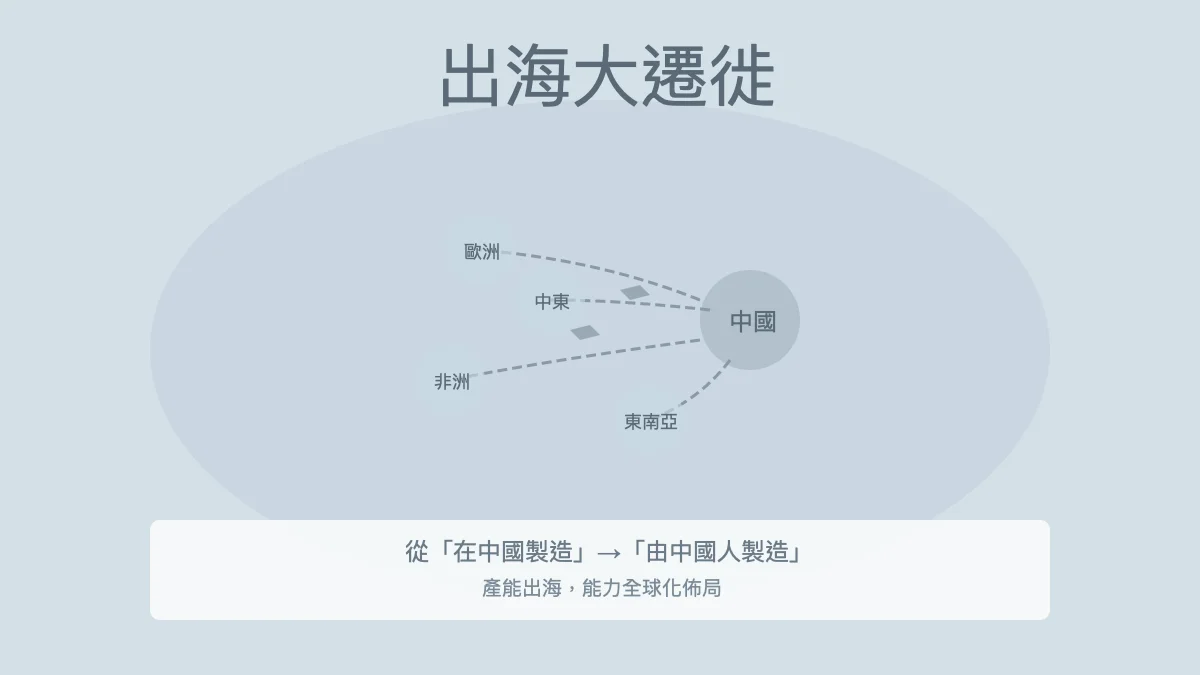
In his speech, Liu Run shared his research experiences in Africa, the Middle East and Southeast Asia. What impressed me most was the Egyptian example. In 2024, China’s exports to Egypt will only be US$17.6 billion, but Egypt’s imports of mechanical and electrical products from China will be as high as US$6.9 billion - which means that many products are actually produced by the Chinese in Egypt and sold to Egyptians. Having said that, this is a big migration from being made in China to being made by the Chinese.
When a market closes the door to imports, do you choose to give up, or choose to bypass the door and build a local factory? There is no doubt that Chinese companies are undergoing a grand migration around the world. It is not a simple product output, but a global layout of capabilities. From manufacturing to manufacturing capabilities, from exporting products to exporting production capacity, this is version 2.0 of the globalization of Chinese enterprises.
5. The Great Migration of Intelligence: How AI restructures the way we work

Liu Run mentioned that today’s AI is no longer a simple tool, but a new type of colleague. It can do a lot of repetitive, boring work - writing reports, making tables or analyzing data. But more importantly, AI allows us to upgrade from doing tasks to making requests. This is a role change from executor to manager.
Over the past year at work, I have relied increasingly on AI tools to aid decision-making. But I am clear: this is not a replacement for thinking, but an enhancement of thinking. AI can certainly provide multiple solutions within a few seconds, but my job is to determine which solution is more in line with strategic goals? This migration of repetitive and boring work from carbon-based people to silicon-based AI is not a threat to unemployment, but an opportunity for liberation.
Having said that, the real threat has never been AI, but those who don’t know how to use AI yet.
6. Great population migration: a new starting point for 300 million people
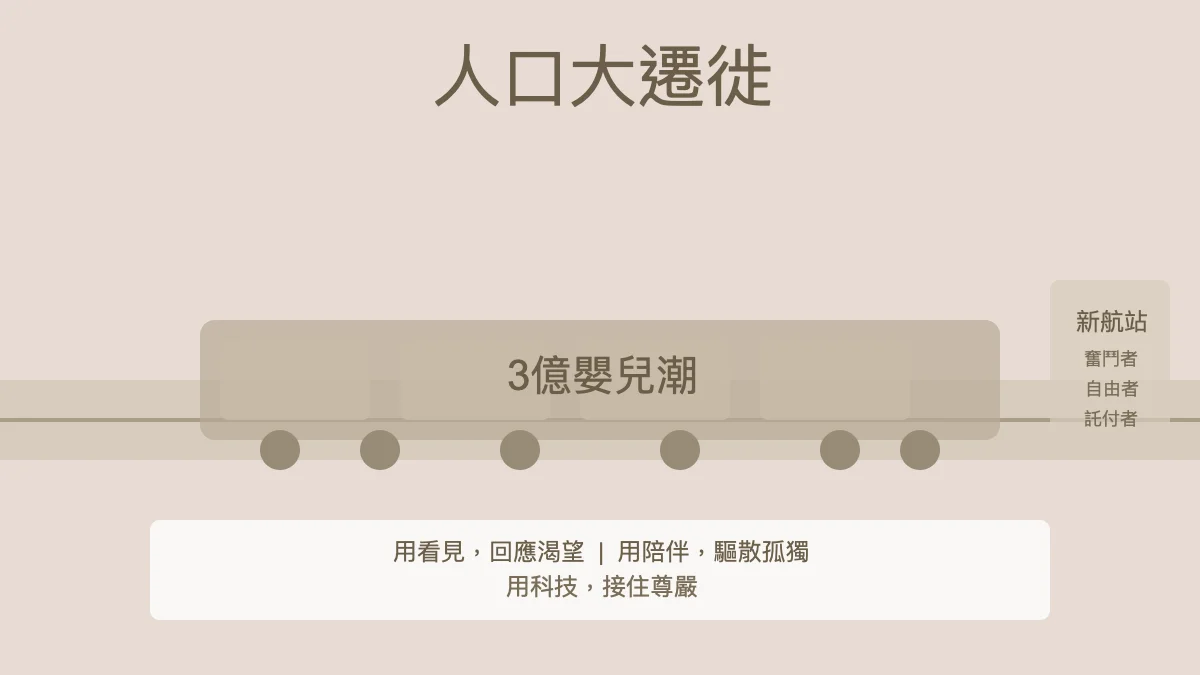
This is the part that touched me the most in today’s speech. Liu Run used a very graphic metaphor: a baby boom train carrying 300 million people is entering the new terminal. This is not the end of the journey, but a new beginning where they can finally live for themselves. He divided these 300 million elderly people into three categories: strivers, free people and entrusted people.
Yes, strivers long to be seen. A 65-year-old retired teacher found that the paper dictionary he had used all his life had been turned into an app, but the font size of the app was too small to be seen clearly. This is not the advancement of technology, but the neglect of those who strive. Free people fear loneliness. Elderly people learn to use smart phones, not to catch up with the times, but to not be abandoned by the times. What they need is companionship, not handouts for aging. Trustees need dignity. The product “Bathing Bath without Leaving the Bed” uses technology to allow disabled elderly people to clean their bodies decently, protecting their last dignity.
Liu Run said:
“These crude, arrogant, and even insulting so-called “aging-friendly products” are the greatest disrespect for the 300 million people who have struggled throughout their lives!”
This sentence hurt me deeply. We often design some self-righteous products in the name of the good of our elders. But we forget that they are just old, not stupid. What they need is not to be treated like children, but to be respected as ordinary adults.
Symbiotic Wisdom: 4 Million Survival Strategies
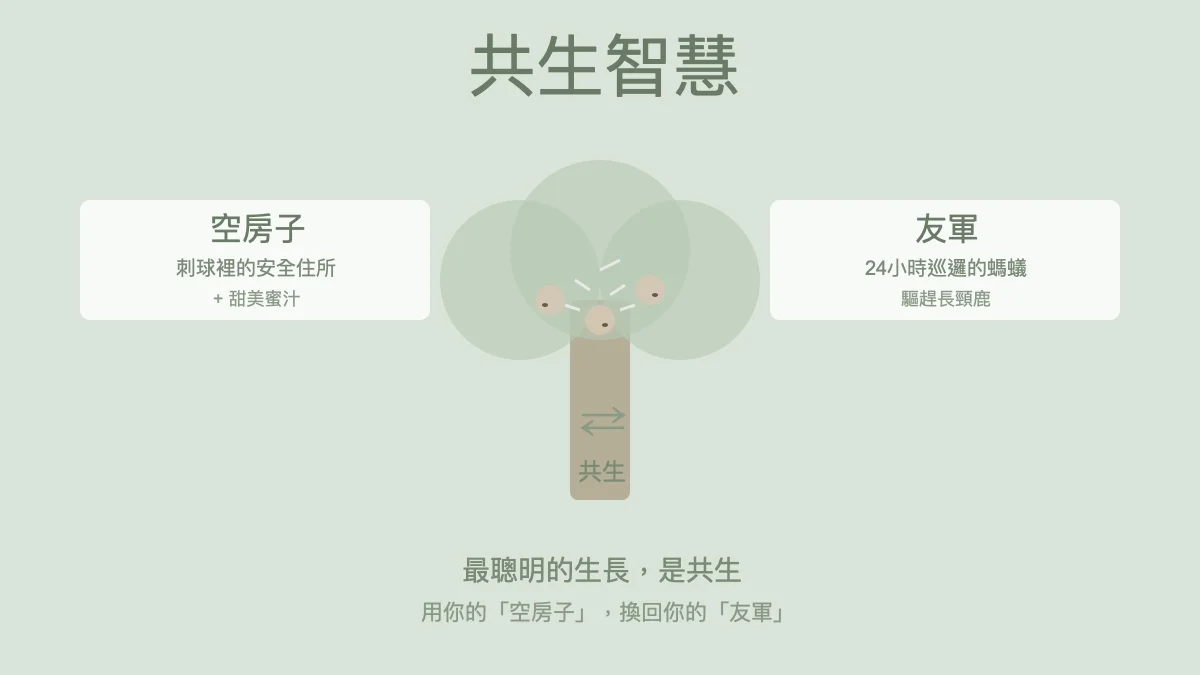
At the end of the speech, Liu Run shared a profound insight: There are 4 million species of animals and plants in the world, so there are 4 million survival strategies. Not everyone has to be a lion, and not everyone has to be a wildebeest.
The whistle-thorn acacia trades an empty house for friendly forces - ants that live in its spiny balls to protect it from giraffes. In the business world, such things are not uncommon. For example, Cudi Coffee (opens in a new tab) has settled in some hotels on the other side of the river. It is this kind of symbiotic wisdom.
Weaver birds use model homes to attract mates—not verbal promises, but end-game experiences that can be tested. Lifesize Plans uses 1:1 projection to allow customers to walk in the home of the future, which is this kind of end-game thinking. Thomson’s gazelle uses showoff to avoid fighting, zebra uses stun to blur the target, and warthog uses compromise to solve shortcomings. Each species has evolved a unique way of survival in its own way.
Evolution is mankind’s best strategic advisor.
The power of persistence

At the end of the speech, Liu Run shared a story about failure—his experience in participating in the “Xuan Zang Road Gobi Challenge” in 2009. The 33-year-old thought that hiking in the Gobi Desert was just about walking. However, on the first day, he was left behind by his classmates from Tsinghua University. Only then did he realize that hiking in the Gobi Desert relies on running. The next day, the female champion from the Cheung Kong Graduate School of Business told him that running was for rest. On the third day, he couldn’t move his ankles and knees at all and could only move forward step by step. After returning to Shanghai, he lay in bed for two weeks. But he also learned two words because of this fiasco: persistence.
Liu Run said:
“The road to rebirth in the Great Migration may not ultimately rely on smart strategies or exquisite patterns. What it may rely on may be this seemingly ‘sick’, almost ‘stupid’, but sparkling ‘persistence’.”

Where is your Masai Mara?
After watching this four-hour speech, the image kept recurring in my mind: hundreds of thousands of wildebeest standing on the edge of the Mara River, facing the crocodiles in the river and the aquatic plants on the other side, making life-or-death decisions.
Isn’t that what the business world will look like in 2025? There are unknowns and risks ahead, and certain involution behind. If you choose to stay where you are, you may survive for a while, but you will eventually die due to depletion of resources. If you choose to cross the river, you may be eaten by crocodiles, but at least you have a chance of reaching the other side. This is not a question of intelligence, but a question of courage.
I think of the companies Liu Run mentioned in his speech: Roaster has migrated from function to emotion, AirBuggy has migrated from strollers to pet cars, and Deschmann has migrated from door locks to smart hubs. They all made their own “Mara River choice.”
And what about us? Should we also stop and think seriously:
- Is our Serengeti already experiencing drought?
- Where is our “Mara River”?
- What does our “Maasai Mara” look like?
- More importantly: Do we have the courage to take the first step?
Liu Run said that he hopes that the last weekend of October every year will become the “annual strategic planning day.” I think this is a great proposition. Not to follow the trend, but to give yourself a chance to stop and think: Where are we going next year?
What moved me most about this speech was not the successful cases, but the people “on the road.” The Shanghai Jiao Tong University classmate who held a cane in both hands and jumped back to the camp step by step in the Gobi, the entrepreneur who said “10,000 per kilometer, I will give you 160,000 after walking”, and the Nanyang Polytechnic representative who has been training for a whole year and carrying sandbags to make up for the exam. They told us from their own experiences:
The path of entrepreneurship is never accomplished by cleverness, but by persistence.
The Mara River is full of crocodiles, and the migration path is full of dangers. But as long as we keep on the road, keep evolving, and keep adjusting the direction, we will definitely find our own piece of water grassland. As Liu Run said at the end of his speech:
May all your persistence bring you to your Maasai Mara!
It is late at night after I finish writing this article. The lights outside the window are still flickering, but I know that behind those lights are countless entrepreneurs who are still struggling. Some of them are still staying up late, some are worrying about the funding gap tomorrow, and some are already thinking about how to survive this cold winter. But they are still persisting, they are still evolving, and they are still looking for their own “Maasai Mara”.
With this article, I would like to pay tribute to all those on the road, to all the wildebeest who choose to cross the river, and more importantly, to the power of evolution!
Further reading:
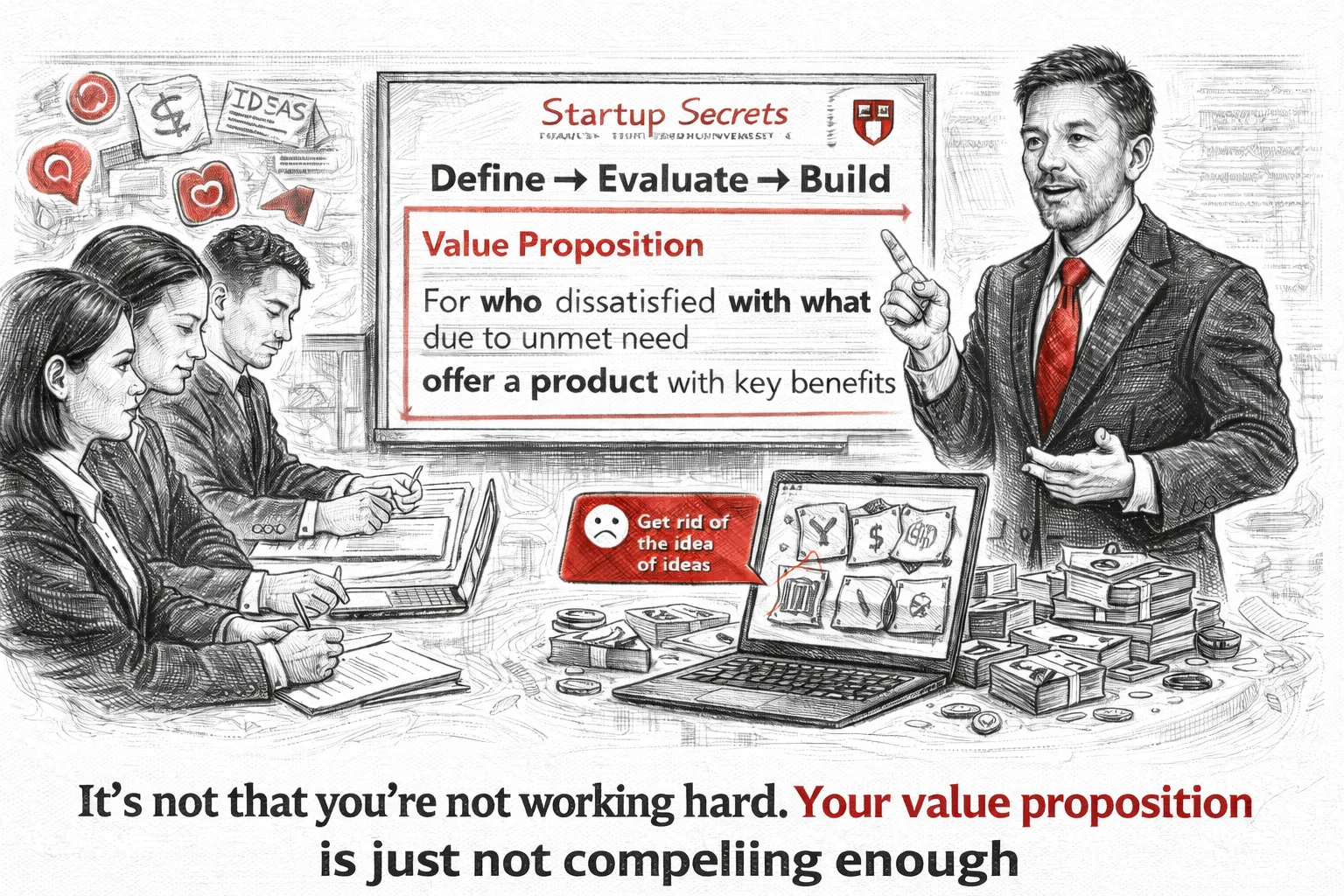
- It’s not that you don’t work hard enough, it’s that the value proposition is not attractive enough
- Copywriting power is your “cashability”: before turning ChatGPT into a godly teammate, you must first make yourself stronger
Next step
Bring this topic to your team
Vista Cheng speaks and runs workshops on AI workflows, writing and content systems for companies, schools and public agencies.