Reading The Land Trap: Rethinking the Underlying Logic of Wealth Distribution in an Era Where Effort Can't Outpace Inheritance
*▲ Mike Bird’s “Wealth from Land”: a pair of glasses that allows people to re-understand the current situation. *
Start with a pre-sale house advertisement
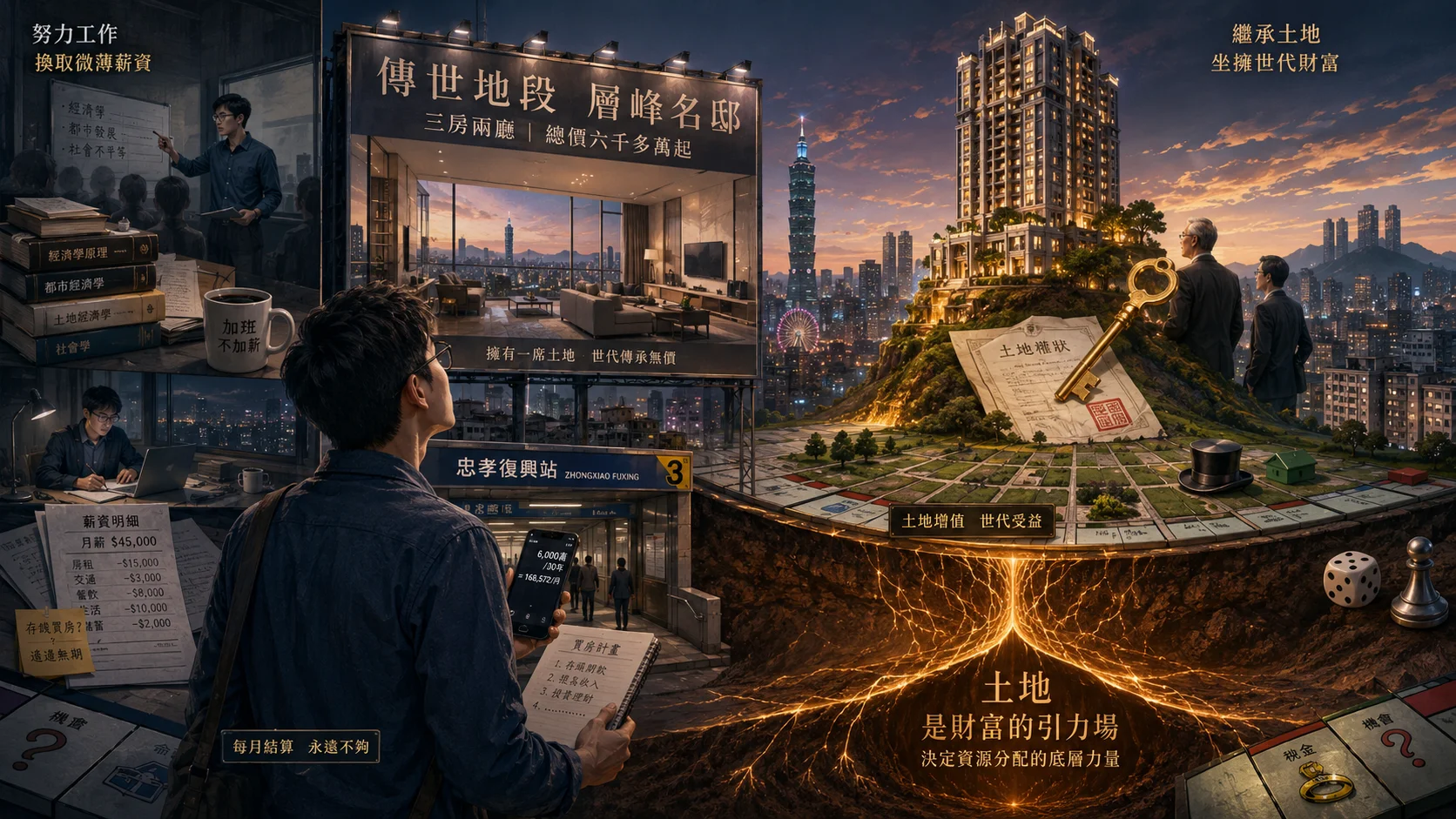
One evening, I walked out of the MRT City Hall Station and looked up to see an advertisement for a pre-sale house - three bedrooms and two living rooms, with a total price of more than 60 million. I subconsciously did a mental calculation and found out that this number is approximately the total salary of a newbie in Taiwanese society who does not have anything to eat or drink in their entire life. We live in an era where wage growth has stagnated and housing prices have continued to rise. The words “starting a family and starting a business” have gone from being a matter of course to a luxury for the young generation.
In the past few years, I have participated in many conversations about AI, Knowledge Realization and Personal Brand. People often ask me: “Teacher, what is the biggest anxiety among young people today?” I used to answer “Can’t find passion” and “I don’t know the future direction.” But now, I will give a more direct answer: They know that no matter how hard they try, they cannot afford a home.
After reading Mike Bird’s book “The Land Trap” (https://www.books.com.tw/exep/assp.php/vista/products/0011050988?utm_source=vista&utm_medium=ap-books&utm_content=recommend&utm_campaign=ap-202605), I truly understood that this anxiety is not a personal fragility, but a global, designed structural problem.
The $180 trillion that no one is looking at
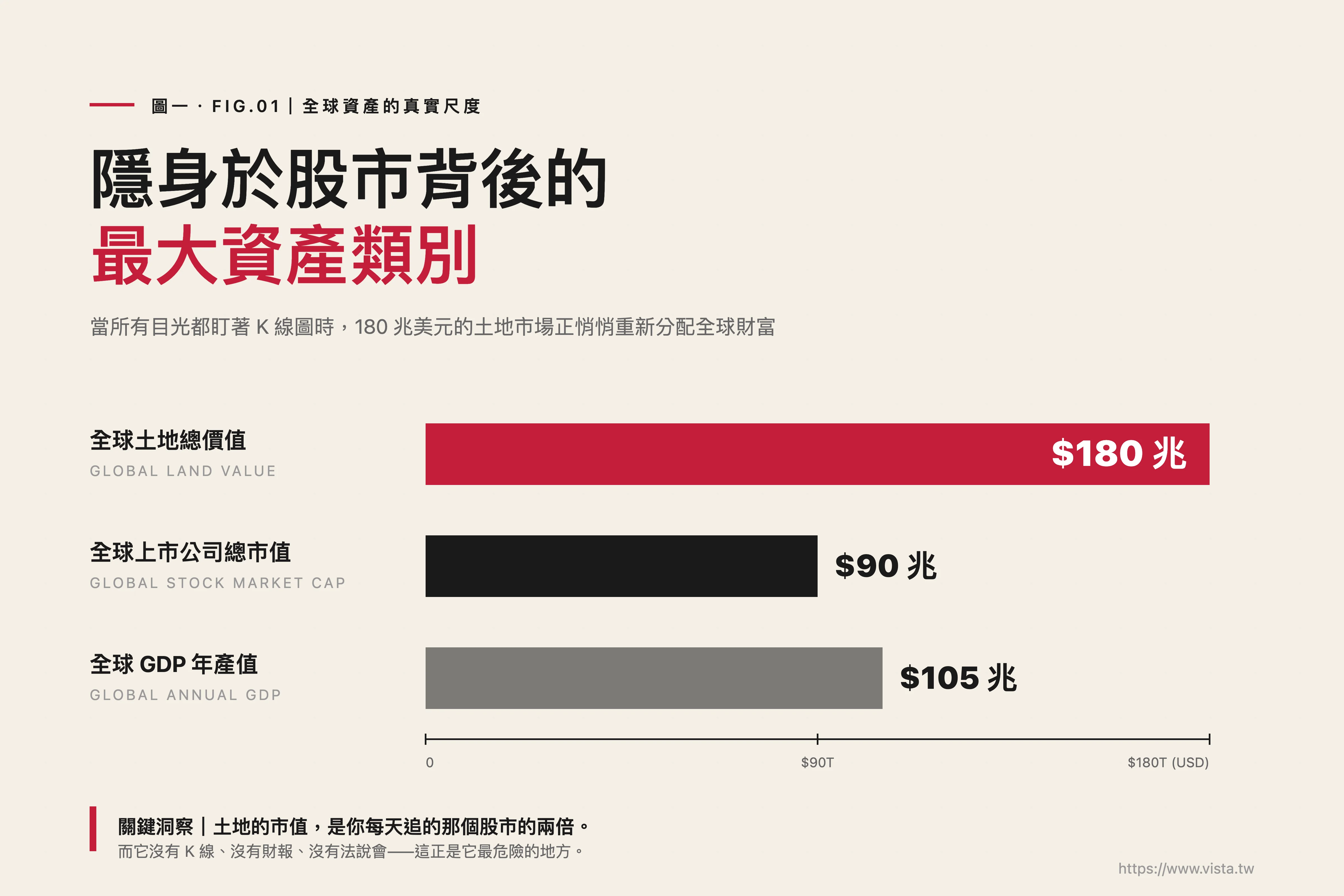
Bird is the Wall Street editor of The Economist and has been based in London, Hong Kong, Singapore and New York. At the beginning of the book, he throws out an unsettling number: the total value of global land is approximately US$180 trillion, which is twice the total market value of all listed companies in the world.
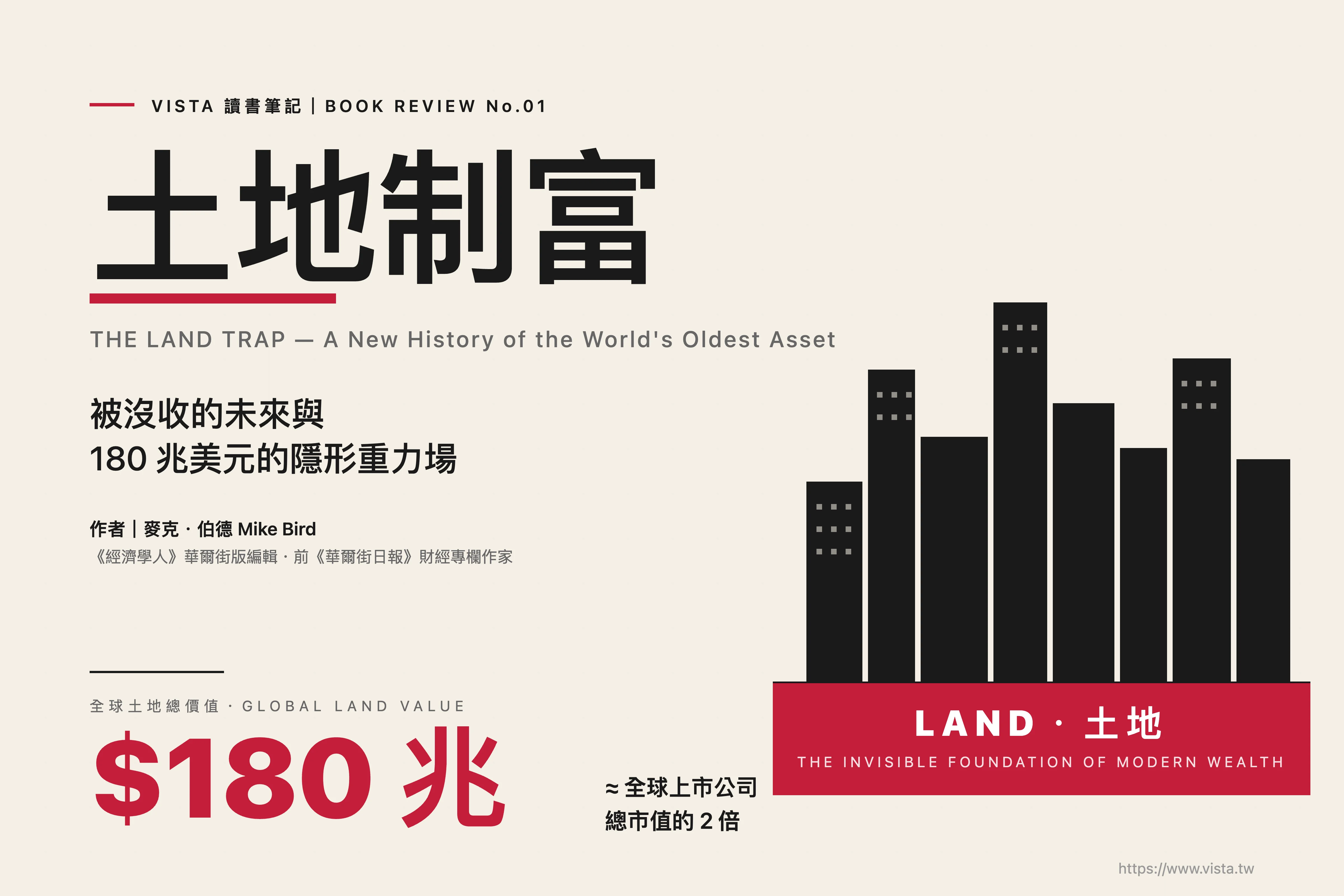 *▲$180 Trillion Invisible Gravity Field: Land is the largest and least quoted asset on the planet. *
What is this concept? When we turn on the financial news every day, we see TSMC’s stock price, Huida’s market capitalization and Bitcoin prices; but what truly quietly dominates global wealth distribution is an asset that we almost never see quoted prices on CNBC – land. It has no K-line charts, no financial reports, and no quarterly meetings, but it is the largest single asset class on the planet.
Bird’s argument is sharp: When we focus on things that fluctuate, such as stocks, cryptocurrencies, or AI concept stocks, that seemingly immovable thing is redistributing the wealth of all mankind in the quietest way. I find this observation particularly illuminating because it reveals a classic obsession with authority—that the most important things are often overlooked because they are so familiar.
Land, a designed zero-sum game
I think the most shocking insight of this book is that it puts land back into the core of economics, allowing us to see a fact that has been downplayed by modern textbooks - land is not an ordinary commodity, but the ultimate source of unearned gain.
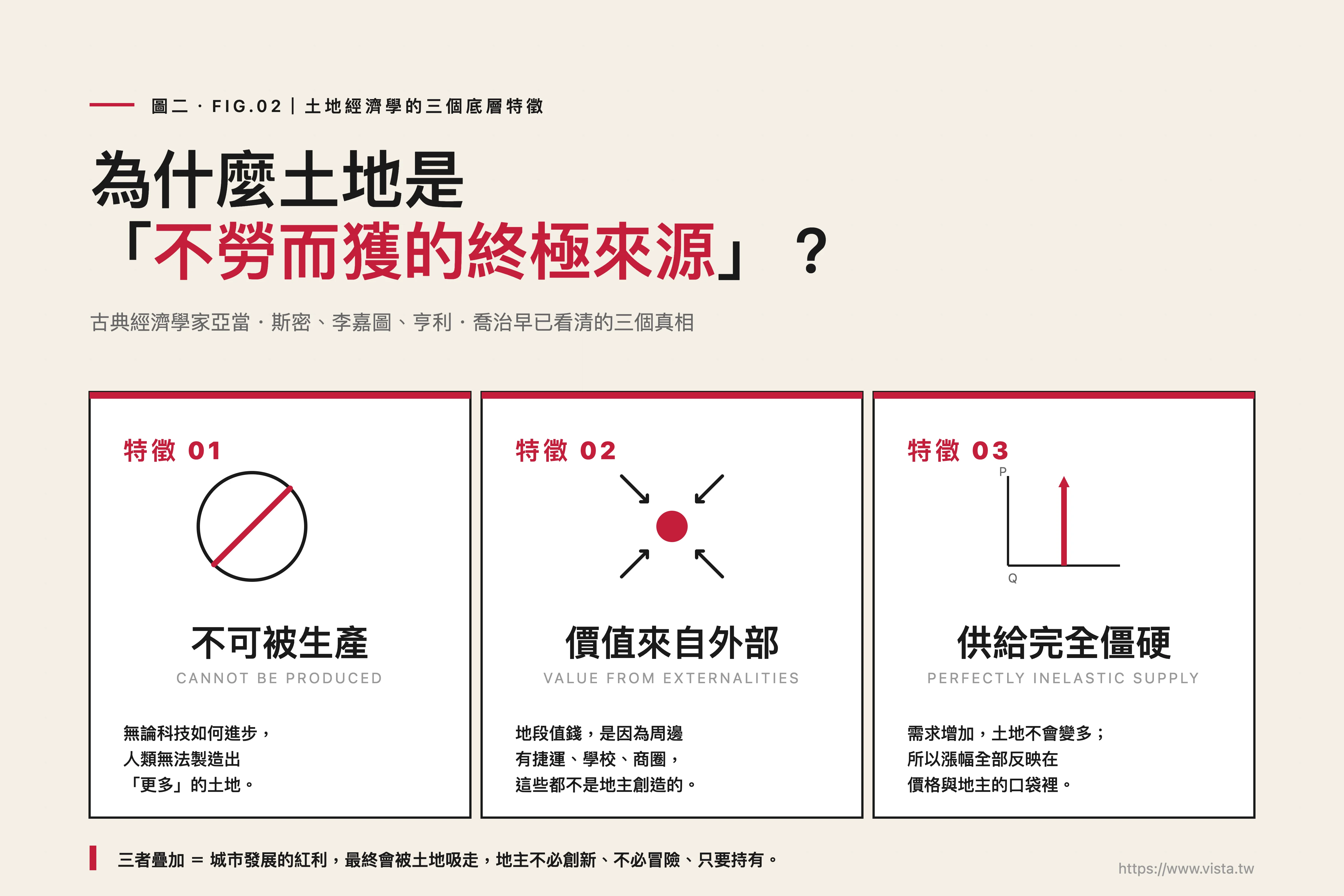
 *▲ The insight of classical economists: Land is not an ordinary commodity, but the core of a zero-sum game. *
Classical economists such as Adam Smith, Ricardo and Henry George actually saw it very clearly. Land has three unique properties, namely: first, it cannot be produced (you cannot create more land out of thin air); second, most of its value comes from the outside (a location is valuable because there are MRT, schools or business districts around it, which are not created by the landlord); third, its supply is completely rigid.
Well, what does this mean? This means that when a city develops, gathers talents, and upgrades industries, the dividends created by these advances will eventually be absorbed by the land. In other words, landlords don’t need to innovate or take risks, they just need to hold on. He just sat there quietly, waiting for others to raise the lot for him. This was the most perfect unearned gain in the economic sense.
Bird uses a very vivid metaphor in the book: modern capitalism plays Monopoly, and the game Monopoly was originally used to satirize the monopoly of landlords. The original game was called “The Landlord’s Game” and was designed by economist Elizabeth Magie in 1903 to allow players to experience first-hand the injustice of land monopoly. Ironically, this cautionary game was later transformed into a joyful national entertainment - just like today we all know that the rules of the game are unfair, but we still wake up every day and continue to roll the dice.
Fighting revolution with mortgages: Capitalism’s smartest political design
The fourth chapter of the book, “Fighting Revolution with Mortgage,” can be said to be the most fascinating chapter I read. Bird pointed out that the reason why Western governments fully promoted home ownership after World War II was actually a calculated political project: when everyone has to carry a mortgage for thirty years, he will not go to the revolution.
 *▲ Mortgage is the most sophisticated political project in modern times: when everyone has to carry a loan for thirty years, he will not go to the revolution. *
Workers with mortgages are moderate workers because they need a stable salary, housing prices continue to rise, and the financial system does not collapse. Once you become a shareholder in real estate, you can no longer see the world from a proletarian perspective. This is an extremely profound political observation - it explains why Taiwan’s middle class, in every real estate policy debate, often stands on the opposite side that young people cannot imagine.
The experience of East Asia also echoes this logic. Chapter 5 of the book talks about land reform during the Cold War: Taiwan’s 375 rent reduction and land to the tiller, Japan’s agricultural land reform, and South Korea’s land redistribution were essentially actuarial arrangements under the leadership of the United States to fight communism. Give land to more people and you create a more anti-communist middle class. After all, half of the background of Taiwan’s economic miracle today is actually written in this period of political history.
Comparison of Four Land Philosophies in East Asia
Chapters 7 to 10 in the book are the parts that I think are most worthy of repeated reading by Chinese readers. Byrd compares four land systems in East Asia. Each case is like a mirror, reflecting different policy choices and consequences.
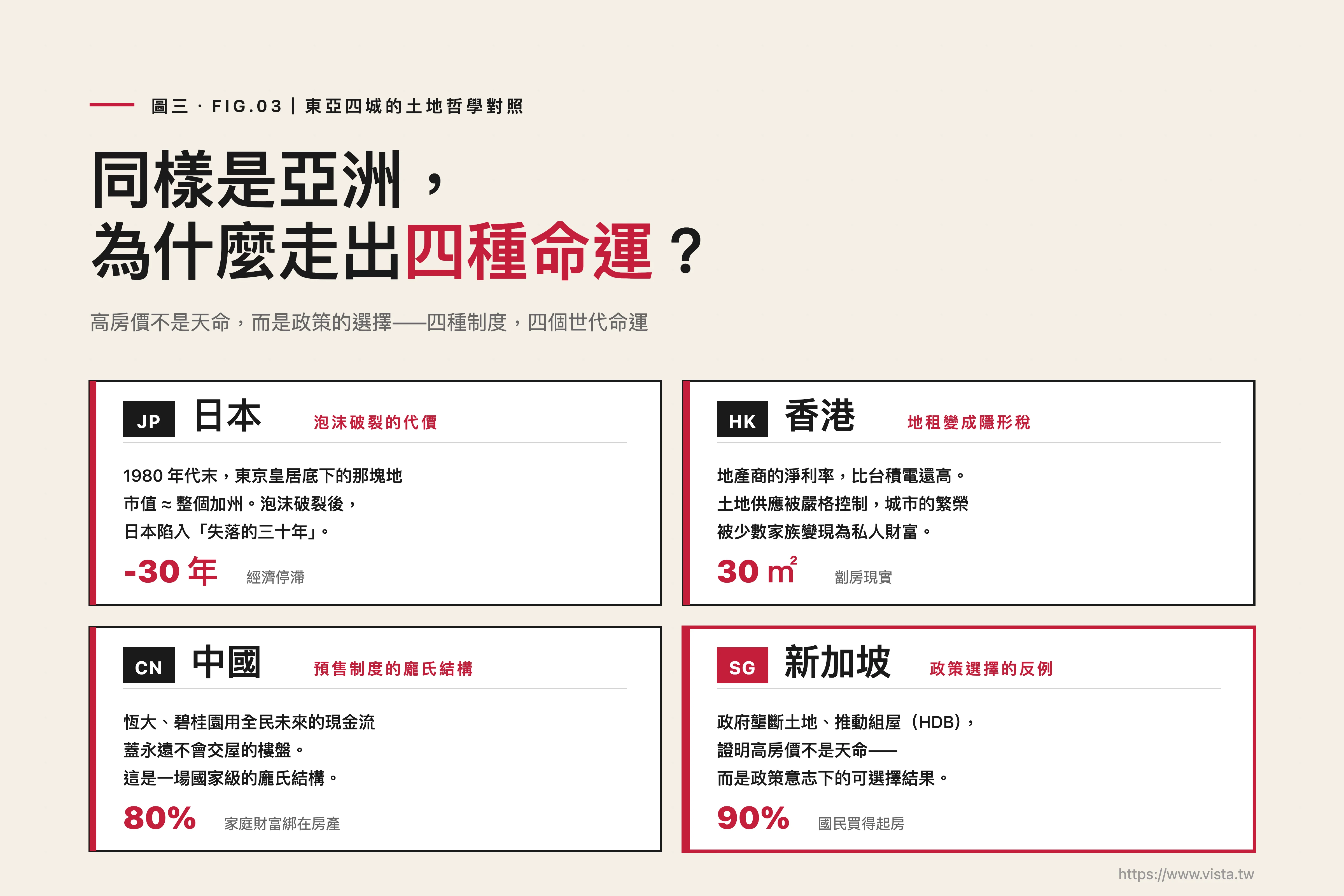 *▲ Japan, Hong Kong, China, Singapore: Four land philosophies in East Asia, reflecting the consequences of policy choices. *
Japan shows us what happens when land myths are shattered. In the late 1980s, the market value of the land beneath the Imperial Palace in Tokyo was said to be equivalent to that of the entire California. It was the largest real estate bubble in human history and the tipping point for the next thirty years of loss. Japan’s lesson is cruel and clear: land prices cannot rise indefinitely, but the cost of falling is the youth of an entire generation.
Hong Kong is at the other extreme. Its net profit margin for real estate developers is even higher than that of TSMC because land supply is strictly controlled and the prosperity of the entire city is turned into private wealth by a few families. Explanation of the Hong Kong model: When land becomes a hidden tax, ordinary people can only survive in a 30-square-meter subdivided house.
China shows the madness of the pre-sale system. When 80% of household wealth is tied up in real estate, giants such as Evergrande and Country Garden are actually using the people’s future cash flow to build properties that will never be delivered. This is a national Ponzi structure, and it is disintegrating at a speed we can see.
Singapore is a rare counterexample. Through the government’s land monopoly and HDB system, 90% of the people can afford housing. This proves one thing: high housing prices are not an inevitable destiny, but a policy choice. When I see that Singapore can do it but other Chinese societies cannot, there is only one explanation I can think of - that is a problem of political will, not economics.
So, what about Taiwan?
Closing the book, I couldn’t help but put this analysis back into the context of Taiwan.
Are we a smaller version of the Hong Kong model? Taipei’s housing price-to-income ratio is already among the best in the world; we have a huge number of vacant houses that are not owned by ourselves; we have a financial system that relies heavily on real estate; we also have a group of people who have become completely rich due to the soaring housing prices, and another group of people who have been completely marginalized in the rental market.
But we are not purely a Hong Kong model. Taiwan has a relatively complete middle class, a strong technology industry, and a small-scale landlord structure inherited from the land reform in the authoritarian era. This makes Taiwan’s land issue even more complicated in comparison—it is not just the monopoly of a few financial groups, but the housing consensus of the entire society: the vast majority of vested interests, including many middle-class families, retired people, and local politicians, rely on the continued rise in housing prices to consolidate their sense of security.
As a result, we are stuck in the classic deadlock described by Bird: when land prices rise, young people collapse; when land prices fall, the financial system and existing asset holders collapse. Every government is stuck between “dangers when things go up and disasters when things go down.” This is why all kinds of housing crackdown policies end up being mere formalities, because if they are actually implemented, they will hurt too many voters.
🪁 In a tilted game, build yourself a vehicle
If you are like me, after reading “Making Wealth from Land” you think “Then what can I do for myself?”, welcome to join the “[Vibe Coding Practical Workshop] (https://www.solo.tw/courses/vibe-coding)” designed by me - 3 hours to take you to use AI to create the first online work. When your job is no longer tied to the rent of a certain piece of land, you have the opportunity to free your attention and time from the gravity field of the mortgage.
👉 Learn the course content now: solo.tw/courses/vibe-coding
Three questions for creators, teachers and knowledge workers
As a person who writes books, teaches courses, and produces content, what I gained from this book was not only economic knowledge, but also three questions about my career.
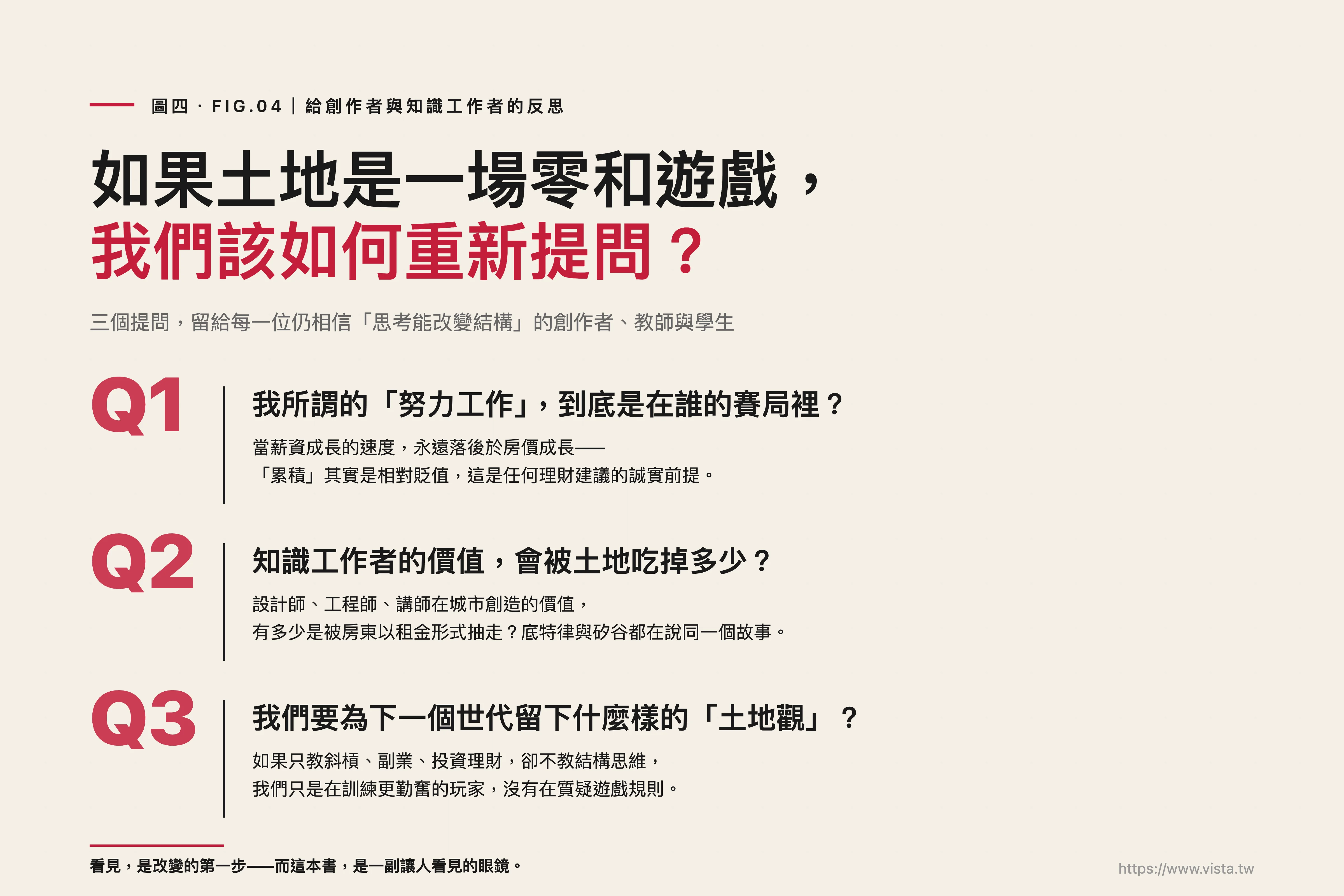 *▲ How much of the value of knowledge workers will be eaten up by the land? *
Whose game is this so-called “hard work” in?
If a person works a job in Taipei with a monthly salary of 70,000 yuan and saves 300,000 yuan a year, then it will take him twenty years to save the down payment for a 30 square meter old apartment - and that house may have tripled in value during these twenty years. What we think of as accumulation is actually relative depreciation. This is not because individuals do not work hard, but because the game itself is tilted. Understanding this matter is the prerequisite for any financial advice and the starting point for any honest career consultation.
How much of the value of knowledge workers will be eaten up by the land?
Our generation has long been told that knowledge is power, skills are capital, and personal brand is the new asset. All of this is true, but Bird reminds us that intellectual capital still ultimately operates in a physical space. For an excellent designer, engineer or lecturer, how much of the value they create in Taipei is taken away by landlords or landlords in the form of rent? When urban rents eat up too much productivity, innovation is pushed away from the core. The rise and fall of Detroit and Silicon Valley is the best portrayal. This is why I have become more and more convinced in recent years that knowledge workers should consciously move their “production assets” to the Internet - I also discussed this observation in my previous book review “[One-Man Company in the AI Era] (/blog/ai-era-one-person-company-book-review)”.
What view of the land do we want to leave for the next generation?
This is an issue that I want to talk about more and more in class in recent years, but it is the most difficult issue to talk about. To be honest, the younger generation does not lack the will to work hard; what they lack is an understanding of structure. If we only teach them to develop slashes, side hustles, or investment and financial management, but do not teach them to understand the underlying logic of land and capital, we will only be training more diligent players without questioning the rules of the game itself.
From “making wealth” to “checking and balancing”
Did you find out? The Chinese translation of this book, “Land to Make Wealth,” uses the word “make” extremely well. It is not “getting rich” but “making wealth” - land is not a tool for people to get rich, but the invisible hand that restricts the distribution of wealth and dominates the economic structure.
Throughout the book, Bird did not give a clear solution because there is no single solution to this problem. He prefers the Land Value Tax idea of Henry George’s school: tax the added value of the land and let the unearned part return to society. Singapore’s success is essentially the policy implementation of this set of thinking.
I am not sure whether Taiwan has the political conditions to embark on this path, but I am sure of one thing: as a knowledge worker, a teacher, and someone who still believes that reading can change thinking, I can at least let my students and readers see this $180 trillion invisible gravity field.
Seeing is the first step to change. And this book is a pair of glasses that allows people to see the current situation more clearly.
If you care about the future of the younger generation, have thought about why your salary will never catch up with housing prices, or simply want to understand how the land beneath our feet determines our destiny - this book is worth a cup of coffee and a quiet morning to read.
📚 Book purchase link: “[Wealth from Land: The Global $180 Trillion Invisible Battlefield, From Mortgage to the Underlying Logic of Political Stability] (https://www.books.com.tw/exep/assp.php/vista/products/0011050988?utm_source=vista&utm_medium=ap-books&utm_content=recommend&utm_campaign=ap-202605)” (from blog)
🔗Extended resources:
- My own content creation workstation: content.tw
- One-person company operating system: solo.tw
- Personal works and introduction: vistacheng.com
- Business card and quick link: vista.st
- More book reviews: vista.tw/tags/讀書心得
📖 深入探索相關主題