Can AI really understand the website I wrote by hand? Reflections on reading "AI Global Search Practice: SEO・AEO・GEO"
 *▲ I used Vibe Coding to build a house that I am very satisfied with, but can AI, the visitor in the new era who really has the right to recommend, understand this house? *
A while ago, I used Vibe Coding to rebuild the two websites vista.tw and solo.tw. I have to admit, that feeling is very charming: I no longer have to wait in line for engineers to be available. I just need to explain the idea in my mind clearly, and the layout, color matching and interaction will grow out line by line, almost instantly. For a moment, I thought this was the ideal state for a creator—to finally be able to fully control his or her digital appearance.
It wasn’t until I opened Mr. Harris’s new book “AI Global Search Practice” (opens in a new tab) that a thought suddenly came to my mind, sending a chill down my spine: I built a house that I am very satisfied with, but can AI - the visitor in the new era who really has the right to recommend - understand this house? What really touched me in this book was not any technique, but that it forced me to ask again: In the era of zero clicks, who decides on “being seen”.
Let’s admit an uncomfortable fact first: there is no solution to the decline in clicks.
There is a passage in the book where the author speaks very frankly. Many customers asked him what to do if the AI summary lost clicks? His answer is: There is actually no solution to this matter, we can only watch it happen with regret. Data shows that after the launch of AI summaries, the click volume of global Google searches has structurally dropped by 18% to 30%. Pay attention to the word “structural” — this is not a one-time algorithm tweak, but a shift in the entire territory of the search ecosystem. After the user reads the AI summary at the top, their needs are satisfied, they don’t click on the links, don’t watch the ads, and then leave.
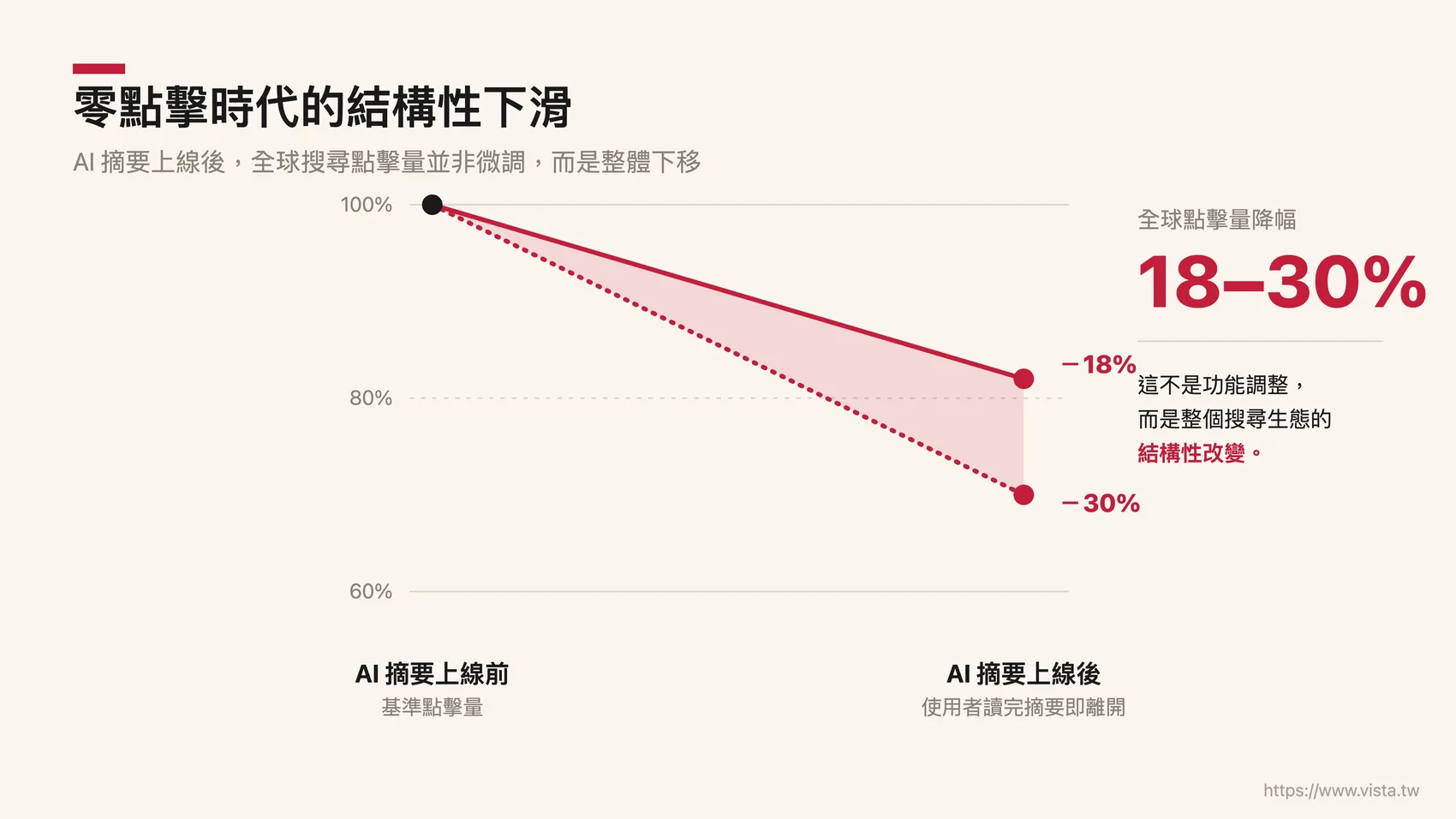 *▲ This is not a fine-tuning of the algorithm, but a shift in the entire search ecosystem: after users finish reading the AI summary, their needs are satisfied, and they do not click on links or watch ads. *
I especially appreciated that the author didn’t give cheap comfort. Over the past two decades, marketers have been raised by the belief that “clicks will lead to conversions”, so they regard clicks as their lifeblood. But he broke through a logic that we are not willing to face: the decline in click-through rate is not the problem itself, but the result. If you are still thinking about “how to bring back the click-through rate”, it is almost doomed to be in vain, because you are betting against the direction of the entire ecosystem. This force has actually started since this round of digital marketing reshuffle caused by AI browsers. What really needs to be replaced is the order of priorities.
From flow thinking to mindshare thinking: a quiet power shift
I will condense the core insight of this book into one sentence: search engines are becoming answer engines, and the power of judgment is quietly transferred from the hands of users to the hands of AI.
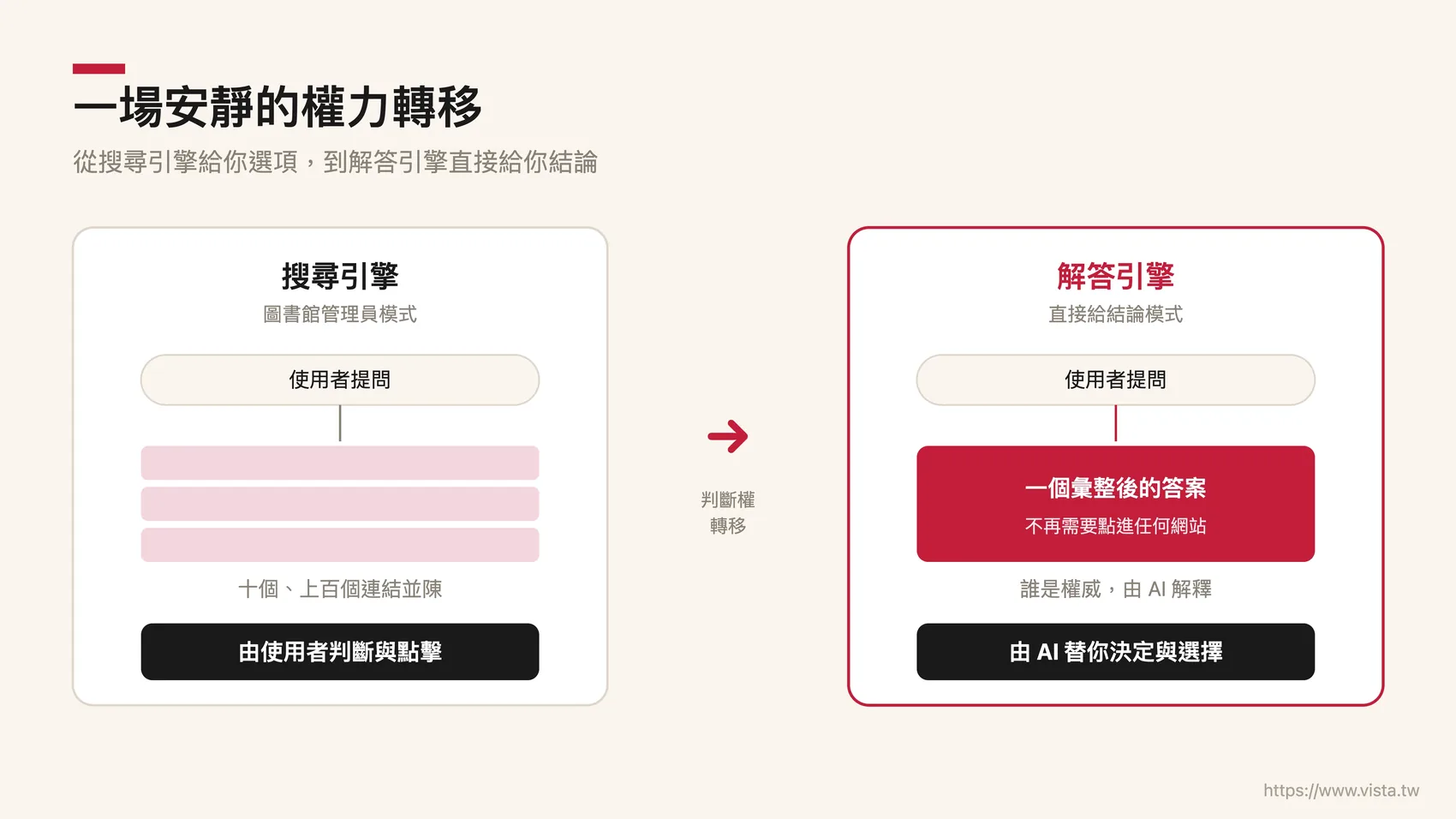 *▲Search engines are becoming answer engines. When AI directly gives conclusions instead of options, it also takes over the right to interpret “who is the authority?” *
In the past, Google was like an impartial librarian. You asked a question, and it handed you a list. It was up to you to compare and decide which one to click. The power lies on the user’s side, which is also the foundation for SEO to flourish - divided attention and equal opportunities, whoever produces good content will have a chance to be selected. But when AI directly gives conclusions instead of options, it also takes over the authority to explain who is authoritative. In the future, if your brand is not included in the answers compiled by AI, it will mean that you are completely absent from that search situation.
So the coordinates of measurement also have to be changed. In the past, we focused on clicks and keyword rankings, but now we look at the mention rate and citation rate of the brand; in the past, the goal was to import people into the website, but now the goal is to win trust and priority. This is what the author calls “Heartshare” - an asset that is scarcer than traffic and more difficult to be washed away by an algorithm update. To grow your heart share, you rely on long-term and consistent personal brand management.
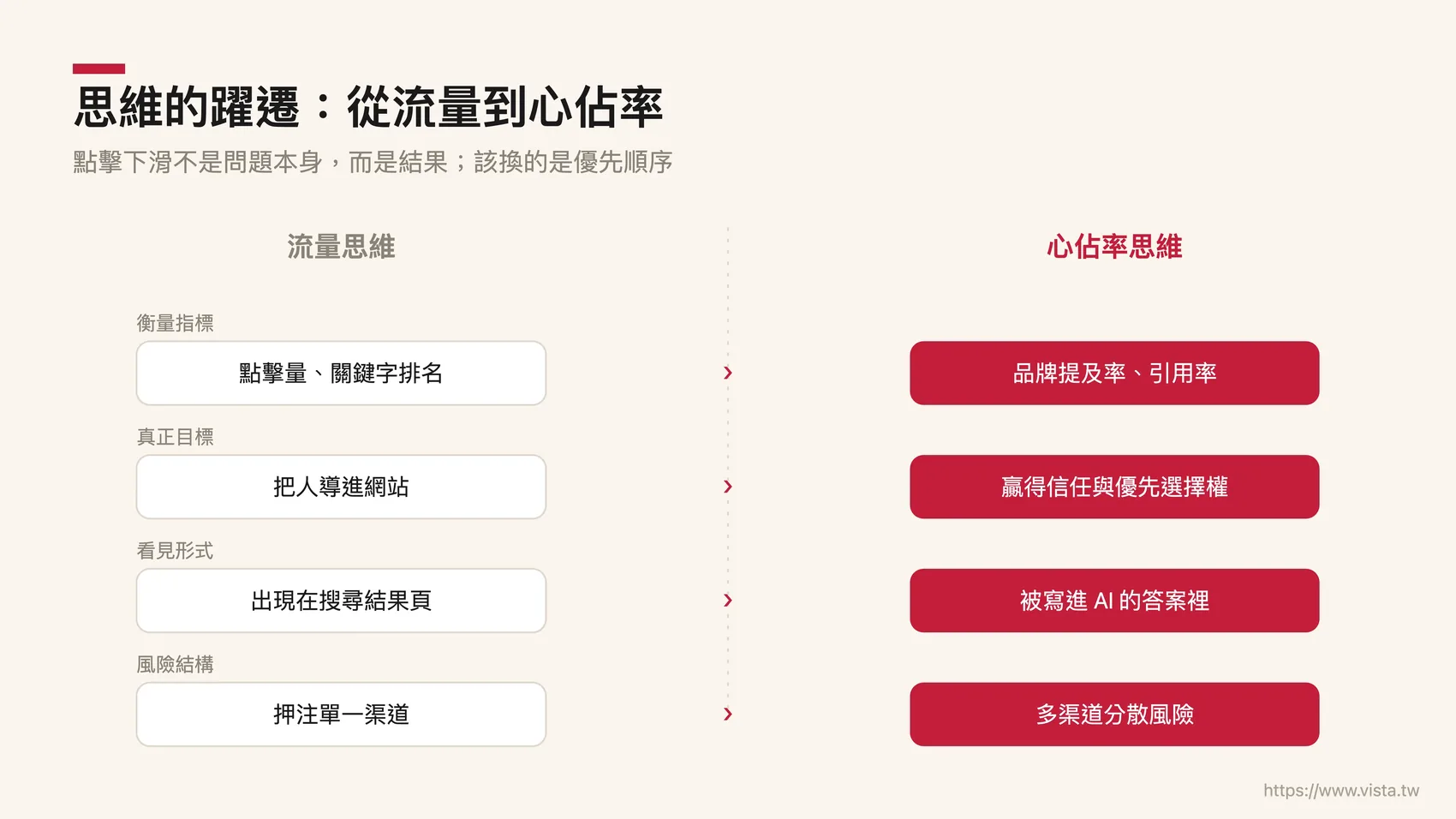 *▲ The coordinates of measurement have changed: from clicks and rankings to mentions, citations and priority. Heartshare is a scarcer asset than traffic. *
SEO is not dead, it just became the foundation
There is something easily misunderstood here that deserves to be clarified. Many people think that SEO is outdated when they hear GEO (Generative Engine Optimization), but the author’s position is exactly the opposite: SEO, AEO, and GEO are not substitution relationships, but superposition relationships.
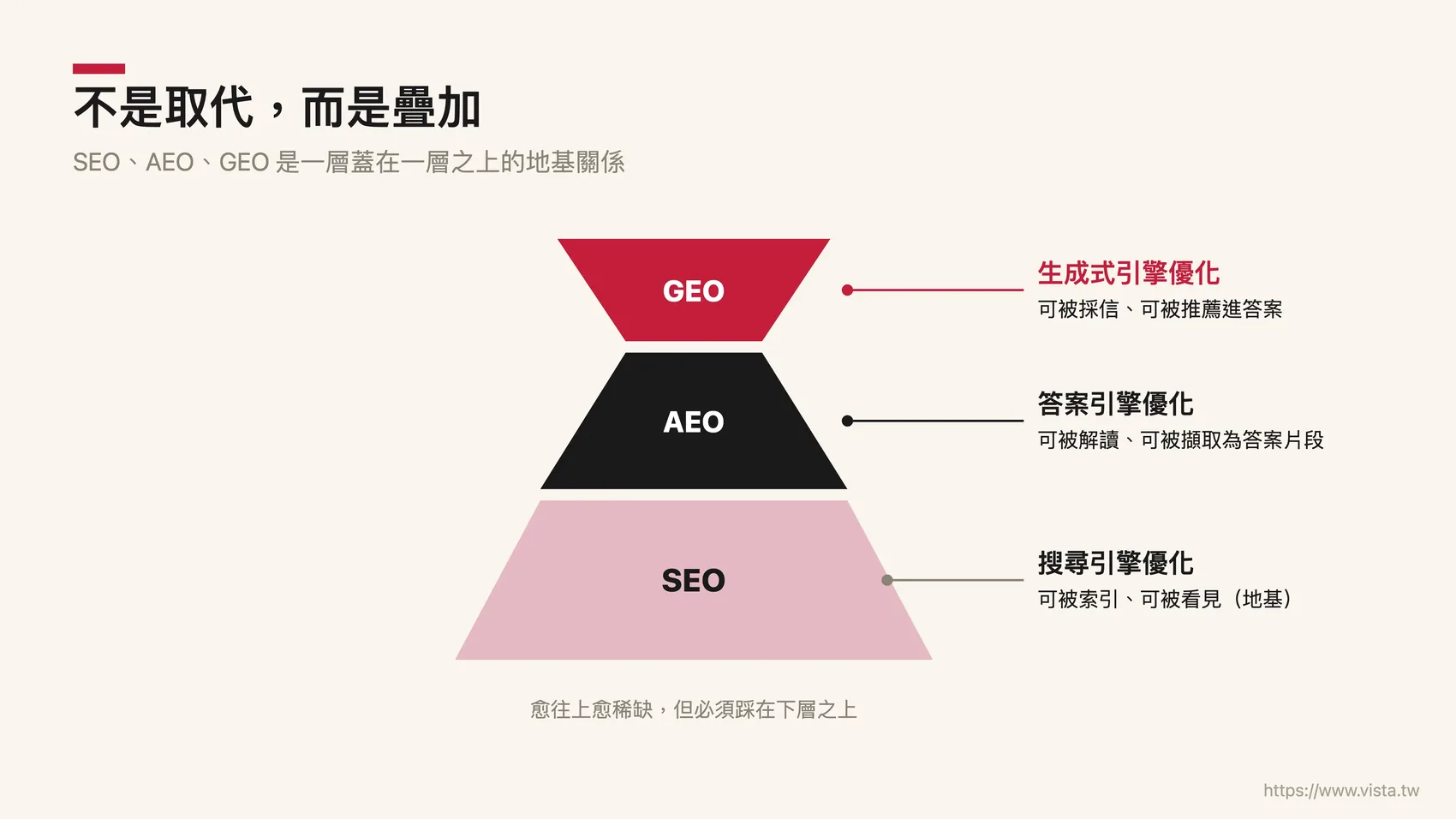 *▲ SEO, AEO, and GEO are not substitution relationships, but superposition relationships: each floor must stand on the foundation of the previous floor. *
The reason is hidden in the working mechanism of AI. AI uses RAG (Retrieval Augmented Generation) when generating answers. It scans indexed search results in real time, selects high-quality, relevant, and relatively credible sources, and then compiles them into answers. In other words, if your website cannot stably appear in the early stages of traditional searches, the chance of being adopted and cited by AI will be significantly reduced. Basic skills of SEO is still the threshold for entering AI answers. AEO allows your content to be interpreted into answer fragments, and GEO allows you to be accepted and recommended, but both of these floors must be based on the foundation of SEO.
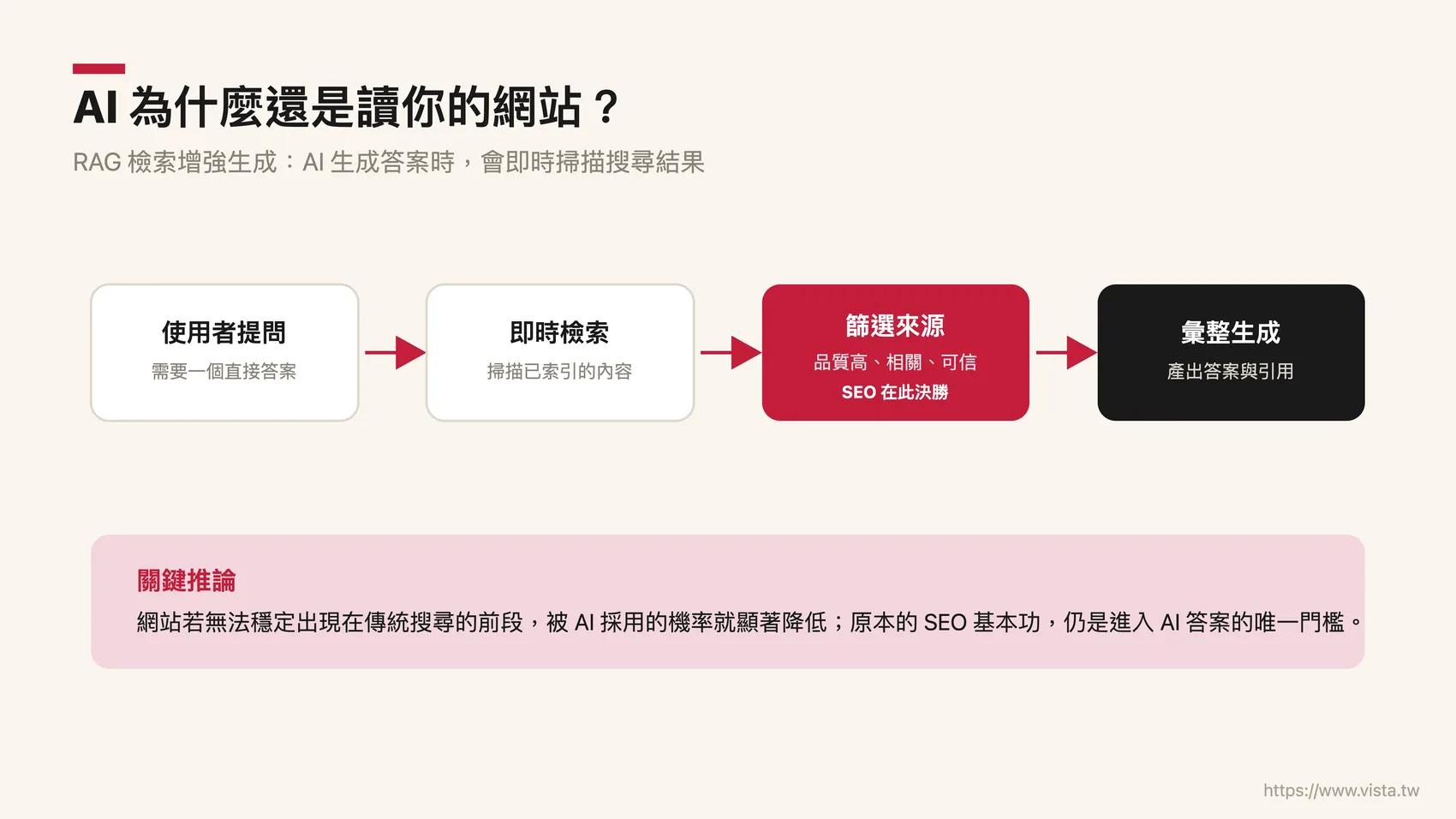 *▲ AI uses RAG to instantly scan indexed results. If you cannot consistently appear in the early stages of traditional searches, your chances of being cited will be significantly reduced. *
Another concept in the book that I really like is semantic blocks. AI does not read your article word for word, but extracts it in units of semantically independent paragraphs. It means: a certain paragraph of yours must be able to be complete and understandable even if it is separated from the context. This is a very practical reminder for writers - stop writing sentences that can only be understood by “as mentioned above, continuing from the previous paragraph”. Each important paragraph should be able to stand on its own. I have a more complete breakdown of this idea of breaking down content into units that can be referenced in This AEO Practical Review.
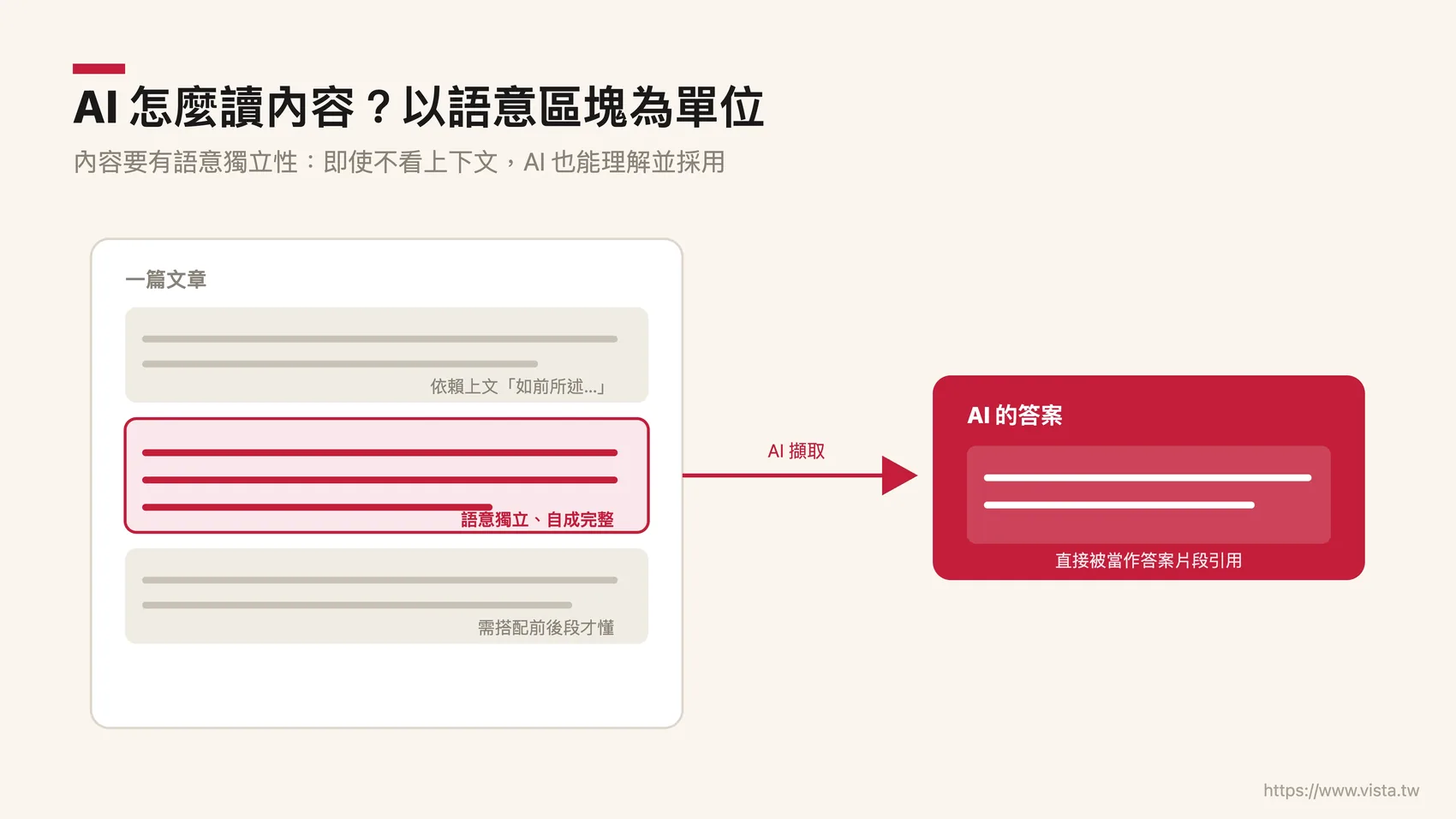 *▲ AI extracts each semantically independent paragraph as a unit. Every important paragraph should be able to stand on its own without context. *
Like this kind of thinking that breaks down the AI trend for you?
(opens in a new tab) I compiled the AI × content creation ideas that I read, thought about, and implemented every day into letters of inspiration. Welcome to subscribe for free to Vista AI Inspiration Supply Station (opens in a new tab), so that these concepts can appear in front of you when you need them.
The sweet trap of Vibe Coding: high beauty, but low readability
After reading this book, I really looked back at the website I built using Vibe Coding.
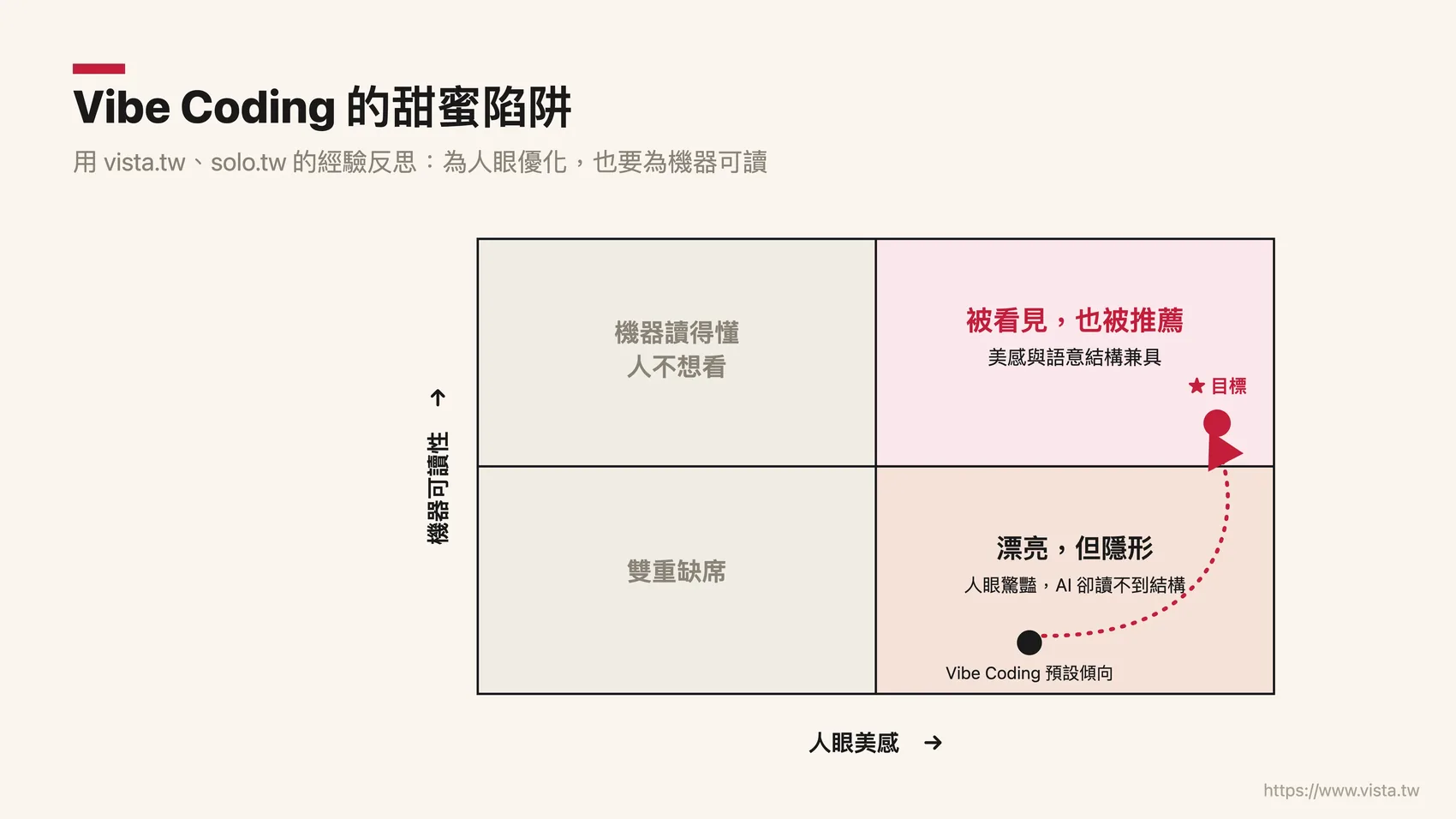 *▲ Vibe Coding optimizes the human sense of atmosphere, but GEO requires machine readability. These two things don’t automatically happen at the same time. *
Vibe Coding lowers the threshold for building a website to an extremely low level, which is its great thing - it allows writers, lecturers or creators to own their own digital assets without having to rely on an engineering team. But it also hides a sweet trap: when we describe to the model “I want a page with good texture, smooth movement, and a sense of visual design,” we are actually giving instructions to people. The model obediently complied. The problem is that no one - including myself - would take the initiative to say at that moment: “Please complete the Schema structured data and clarify the title hierarchy so that each piece of content is semantically independent and machine-readable.”
So there is a quadrant that I think is most worthy of vigilance: high beauty, low readability. The website is stunningly beautiful, but AI cannot read its structure – beautiful, but invisible. This is exactly the default tendency of Vibe Coding. It optimizes the human sense of atmosphere, while GEO requires machine readability. These two things will not automatically happen at the same time, unless you bring GEO’s awareness into it at the moment you press the prompt word.
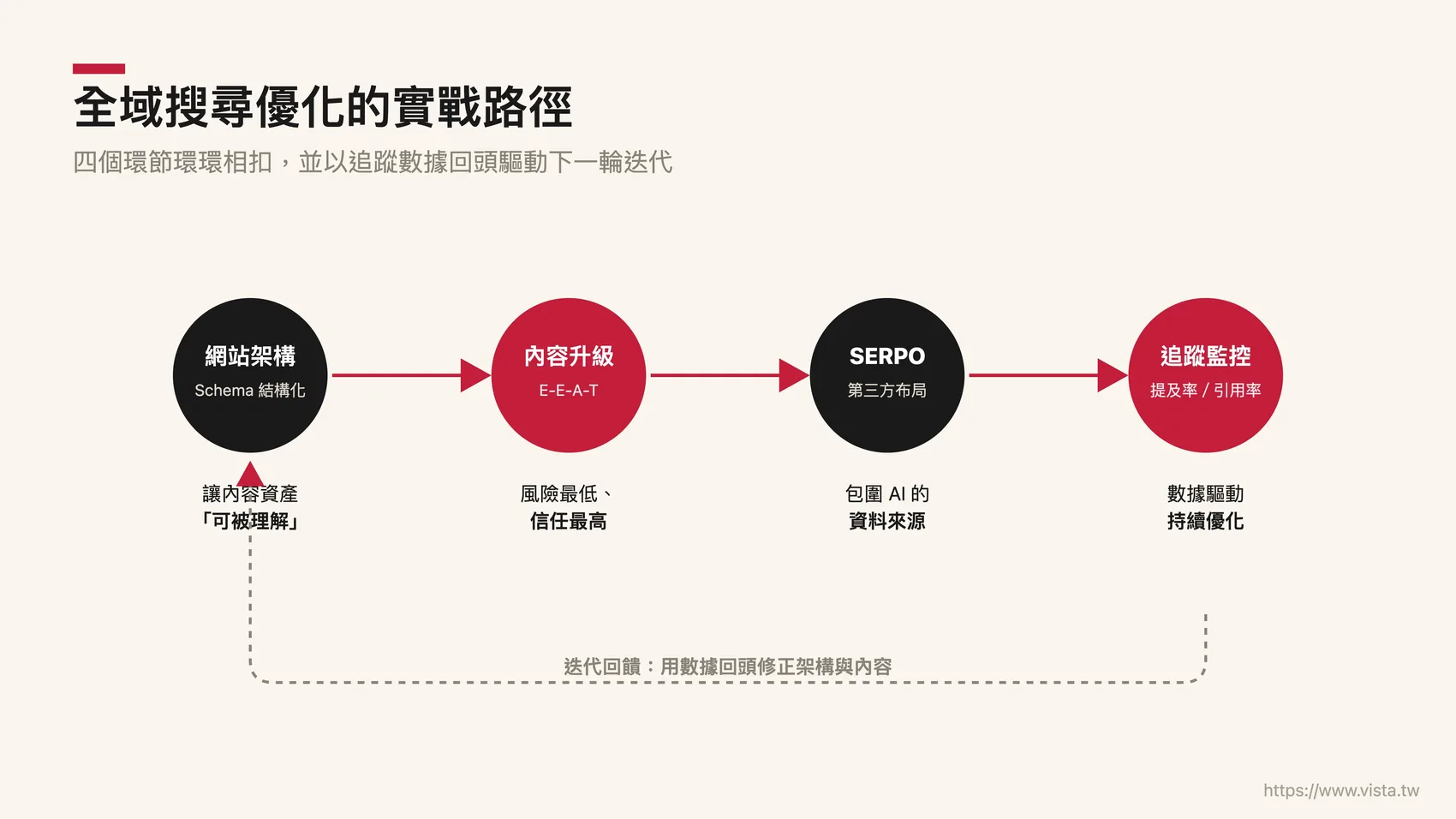 *▲ Bring GEO awareness into every demand description: complete structured data, arrange semantic blocks that can be retrieved independently, and then manage a consistent brand footprint outside the site. *
This experience made me more confident in Vibe Coding instead of making me more anxious. Because it hands the initiative back to the creator: since the website is “made” by me personally talking to AI, then I have the ability to add a machine-readable requirement every time I describe the needs; in each piece of content, deliberately arrange semantic blocks that can be independently captured; outside the site, follow the SERPO ideas mentioned in the book, let the brand be mentioned consistently and repeatedly in third-party media, communities, podcasts or short videos, and slowly grow an AI Recognized entities and credit profiles.
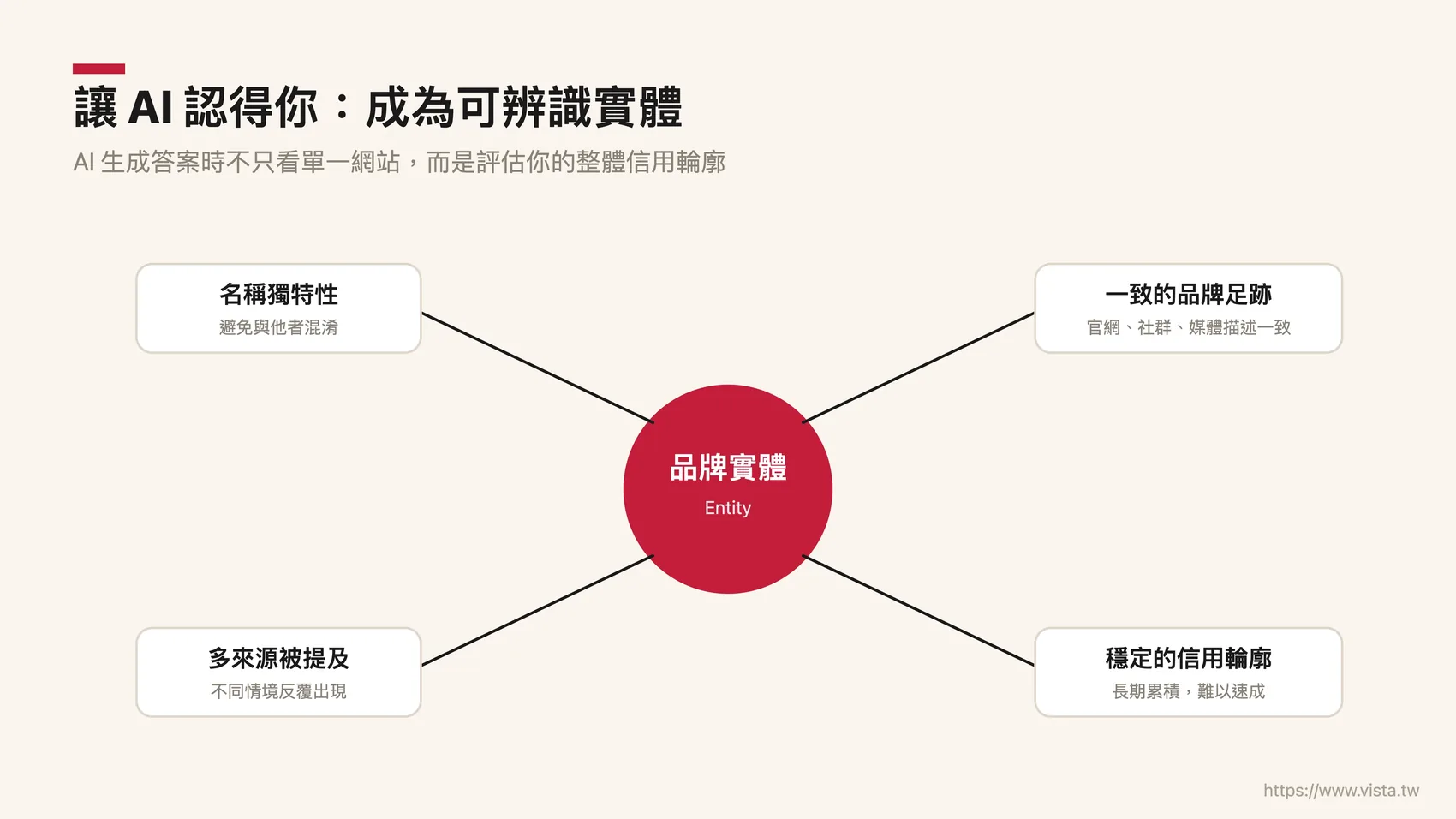 *▲ According to the SERPO idea, let the brand be mentioned repeatedly and consistently in third-party media, communities, and podcasts, and slowly grow an entity recognized by AI. *
In this era, multi-channel layout is no longer just a growth strategy, but a basic risk diversification - platforms will change one by one, and placing all exposure on a single channel is itself a risk.
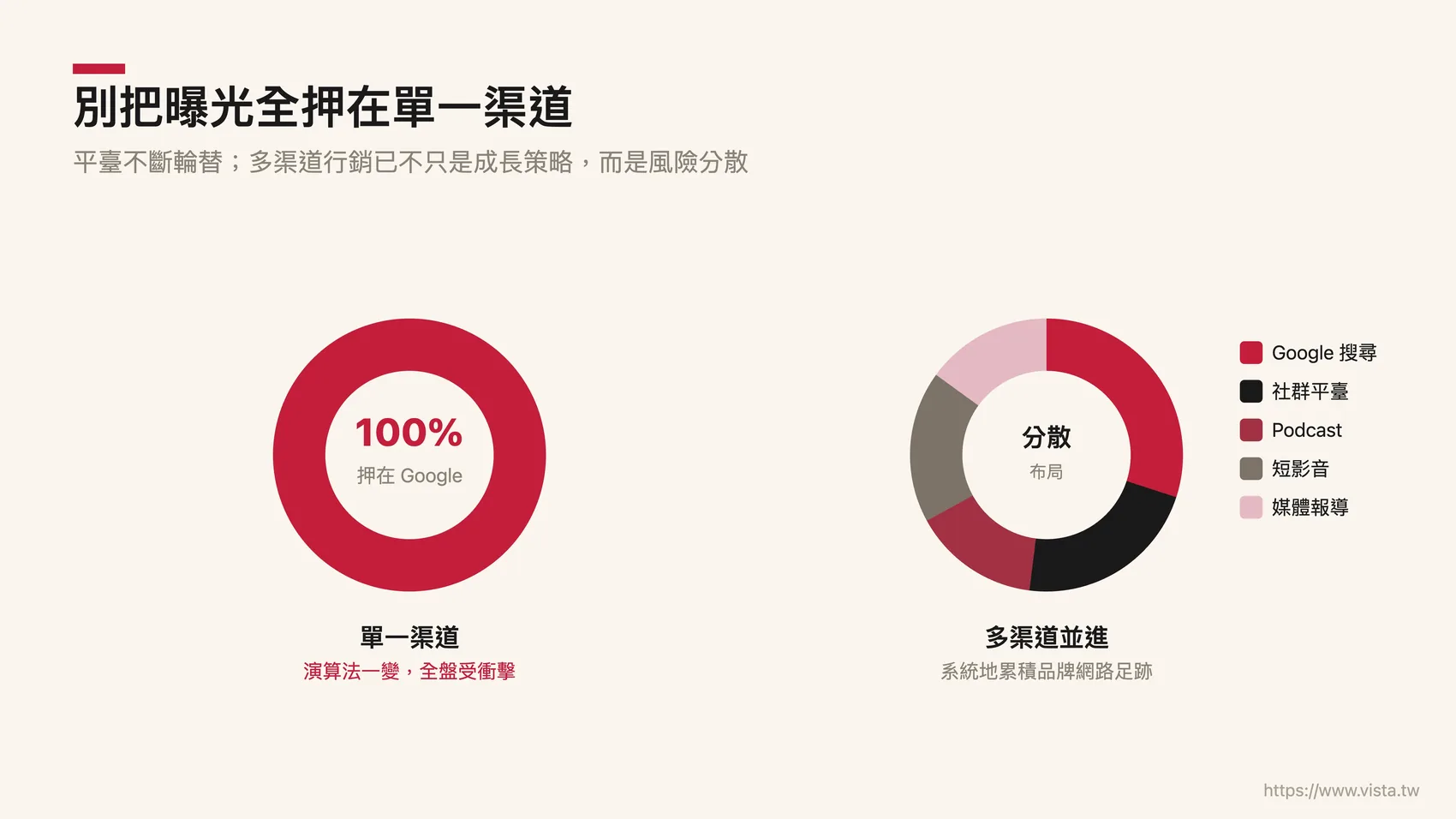 *▲ The platforms will change one by one. Betting all exposure on a single channel is itself a risk; a multi-channel layout is already the basic plan. *
Back to the creator: digital sovereignty is a proactive gesture
After reading the whole book, what came to my mind was not which tool should I learn? Rather, it is a proposition closer to what I have long argued. I often say that the relationship between man and machine is “human and machine seventy-three” - the machine is responsible for amplification, and the human is responsible for orientation. GEO made this division of labor more specific: AI determines how the answer is grown, but why your brand is included in that answer still depends on your long-term accumulation of content quality, semantic clarity, and credit footprint. Machines cannot do these things for you.
Therefore, the real question has never been whether AI will replace my website, but whether I am willing to take the initiative to fight for the increasingly scarce recommendation qualification after AI takes over the entrance? The visible form is being redefined, but the power of definition has not completely left the hands of the creator. This is why I repeatedly remind myself Don’t be a digital tenant, build yourself a digital headquarters. When I open Vibe Coding next time and prepare to add a new page to vista.tw, I will remember: I am not just building a beautiful house for readers, I am also leaving a door that it can understand for that silent but crucial visitor-AI.
If you also want to understand more systematically how SEO, AEO and GEO overlap, I highly recommend reading Mr. Harris’s “AI Global Search Practice: SEO・AEO・GEO” (opens in a new tab). It won’t give you cheap comfort, but it will give you a map that still stands up in the zero-click era.
Next step
Bring this topic to your team
Vista Cheng speaks and runs workshops on AI workflows, writing and content systems for companies, schools and public agencies.