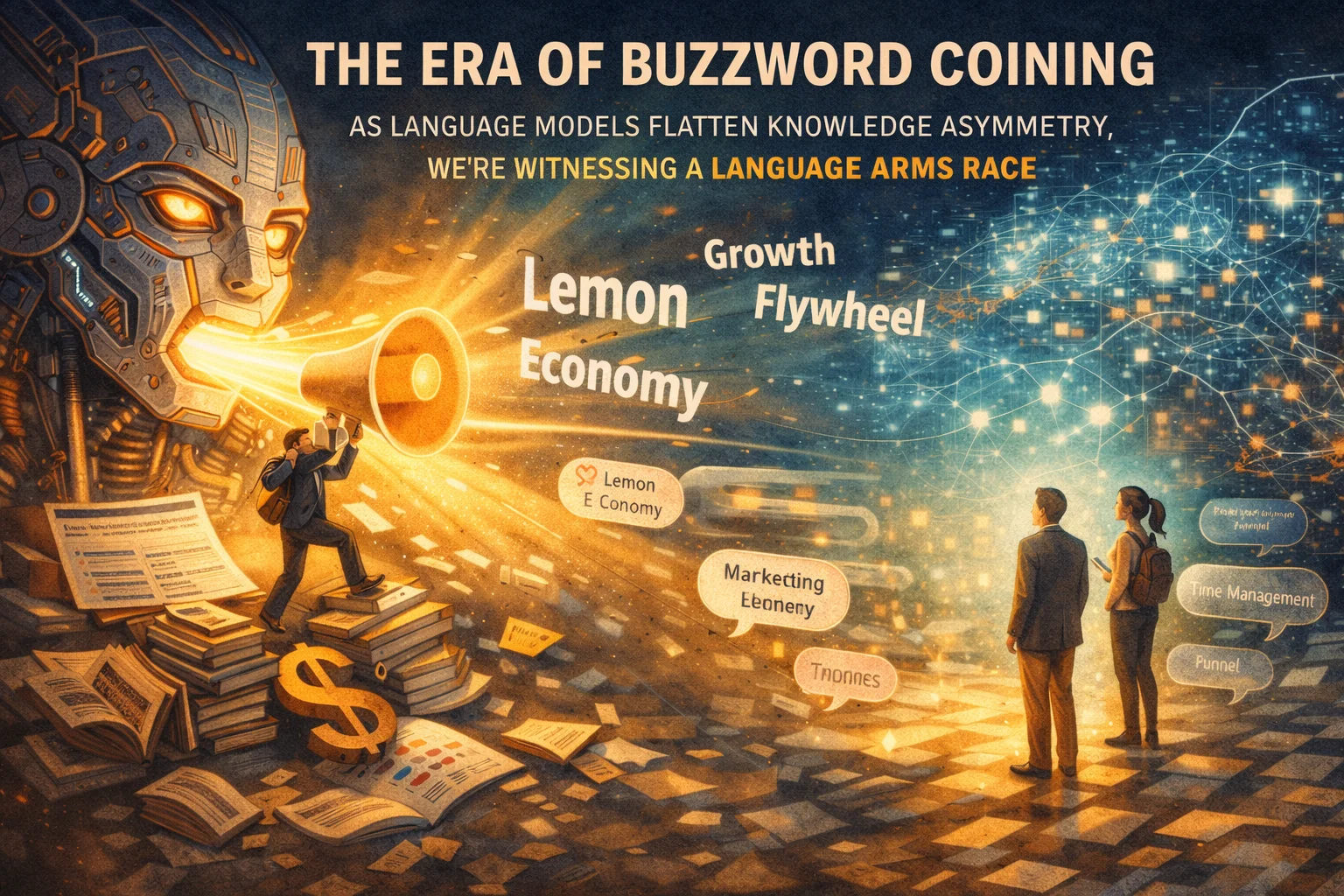
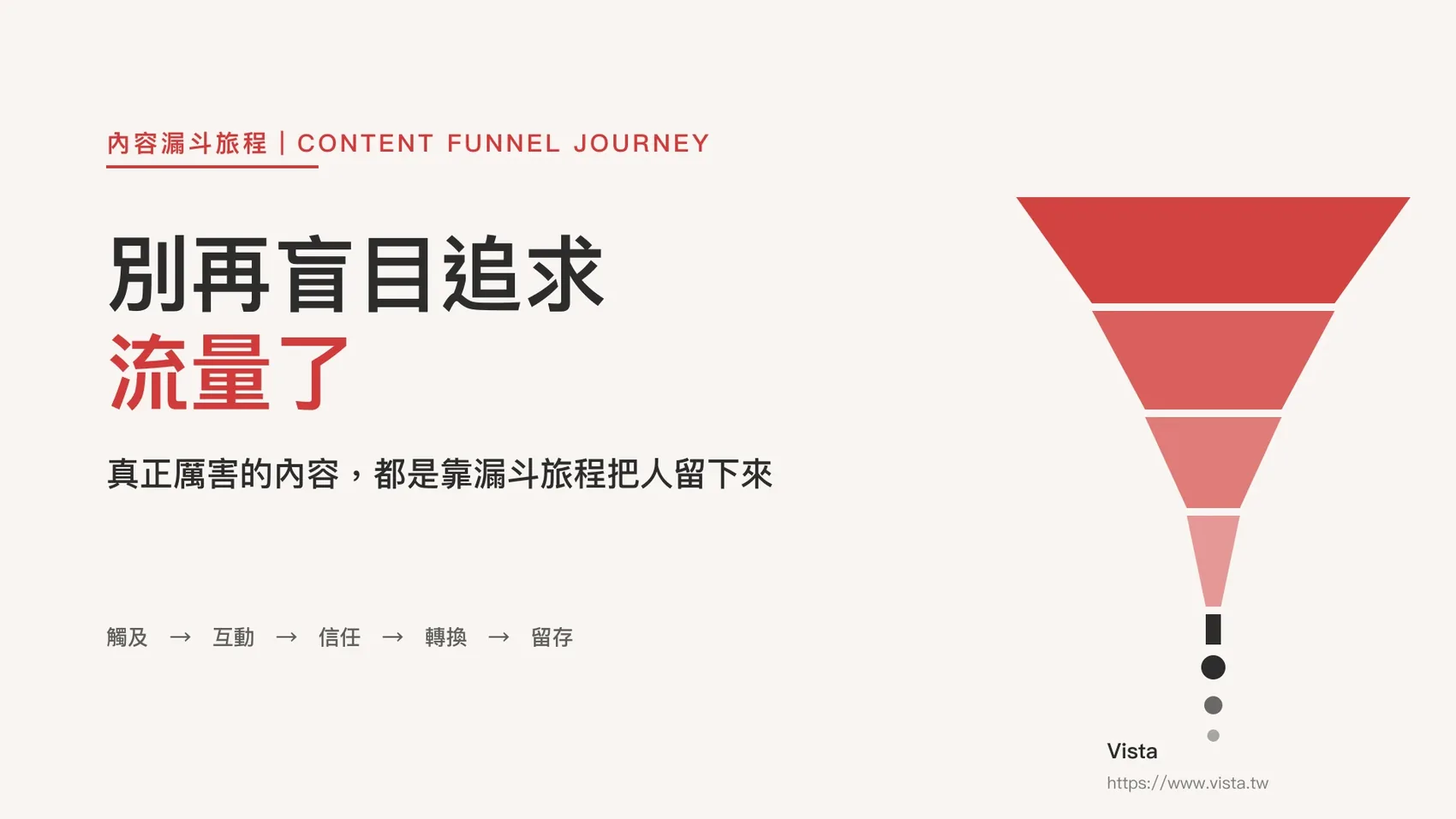
Stop blindly pursuing traffic: truly great content relies on the funnel journey to retain people.

Popular articles can bring temporary popularity; but only content designed through funnels can bring real and stable growth.
After every public class or in-house training, I always like to chat with the students and look forward to the opportunity to teach and learn from each other. Additionally, I would also like to know if this course would be helpful to them? Or, what else could be improved?
A while ago, after an in-house training session at a certain company, a trainee came over to chat with me. She is responsible for brand marketing in the company. She is young and looks very smart, but there is something strange about the look on her face.
She told me that she was producing content every day, from writing posts, posting to social media, organizing pictures and texts to chasing data. She was very busy, but as she was doing it, her heart became increasingly empty. I still remember every word she asked me.
She said: “Teacher Vista, I seem to have been producing content, but I feel like I haven’t really helped the company produce anything? Is this my problem, or is it just hard to produce content now?”
I didn’t answer immediately. Instead, I asked her first: “What do you mean by what you want to do?”
She was stunned for a moment, and then replied to me naturally: “Just post! Post regularly every week, and try to follow current events, topics, or product needs… However, if occasionally an article gets good traffic, I will be very happy! But most of the time… I finish posting and then wait for the next article.”
Well, her words actually revealed the crux of the problem. It’s not that they don’t work hard, or that there isn’t enough content, but they understand the content from beginning to end as something they send out one article at a time, but they don’t treat it as a journey that can advance the relationship. So, every day is like doing a routine: writing, posting, looking at numbers, getting lost, and then starting over again. At first glance, he looks very hard-working, but in fact he has not accumulated any assets that truly belong to him.
I later told her that content with real commercial value, brand value, and even long-term influence never ends when it is posted. It is more like a road, a road that can slowly bring strangers in, allowing them to see you, pay attention to you, understand you, trust you, and finally be willing to cooperate with you, purchase your services, and even follow you for a long time. I usually understand this path as the funnel journey of content.
When many people see the word funnel, they think it is some kind of commercial, marketing or cold concept. But to be honest, I found it very human. Because what it talks about is not the skills of transferring orders, but the changes in the relationship. How do you get seen in the vast sea of information, how do you make others have their first impression of you, how do you make interactions more than just passing by, how do you make a little good impression grow into trust, and finally how do you make this trust transform into concrete support and companionship. This whole thing is not essentially about traffic, but the connection between people.
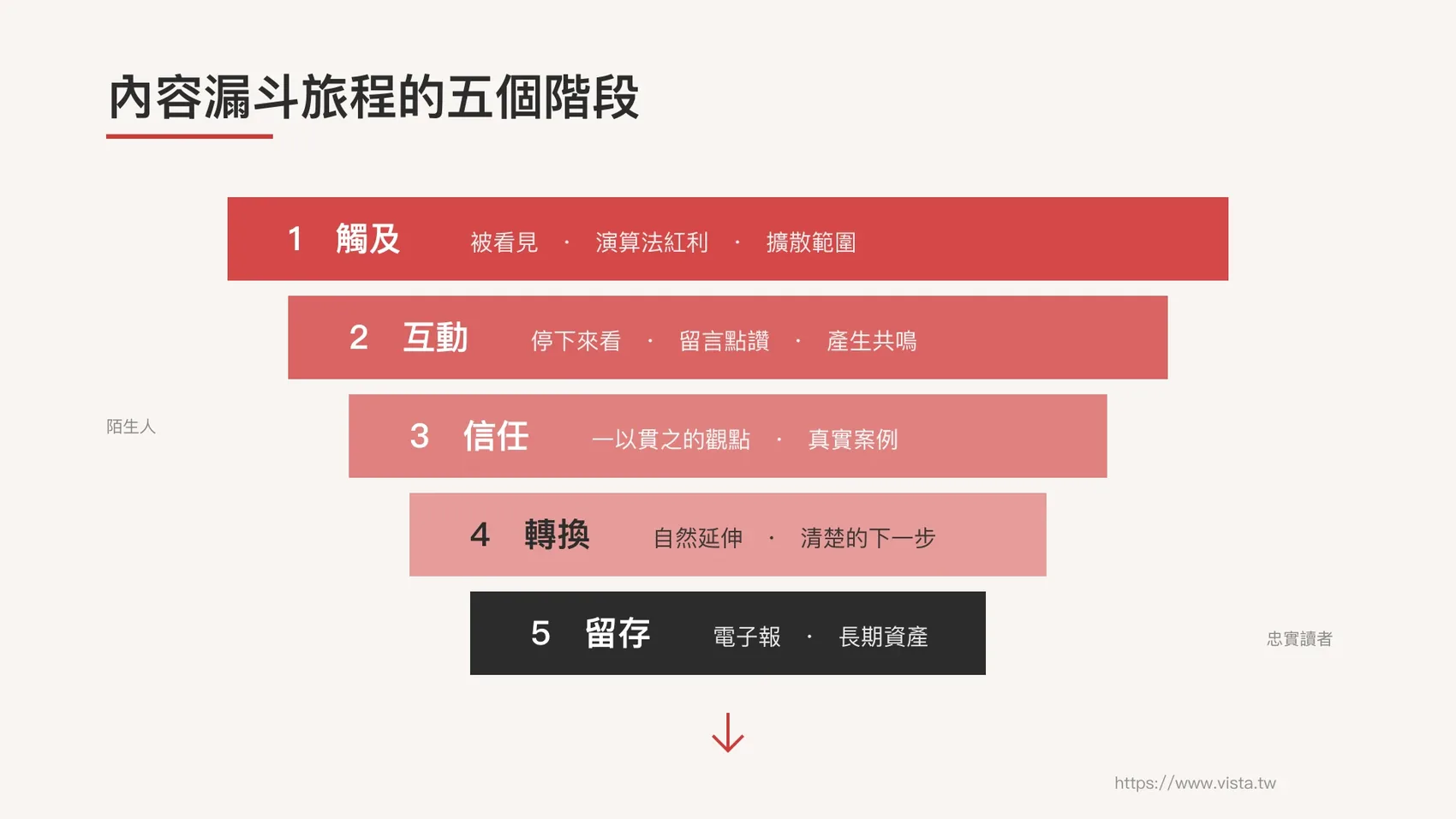 ▲ The five-stage journey from stranger to loyal reader, each level is not cut off from each other, but slowly connected.
In the past few years, I have been doing content, teaching, consulting, and personal branding. Along the way, I have seen many local Taiwanese creators, lecturers, or consultants stuck in a very similar dilemma. They are actually very informative and experienced, and even more worthy of being seen than many traffic-based creators. However, because they do not treat content as a system, they often fall into a pity state: they are obviously professional, but they cannot amplify it stably; they obviously have readers, but it is difficult to convert them into long-term audiences; people occasionally come to inquire about cooperation, but the overall business is ups and downs and not stable enough.
This is why I want to write an article more and more to explain the content funnel journey clearly. Because once you understand this concept, the way you view content will be completely different. You will no longer just pursue the performance of a single article, but will start to think: Where will my content take people? Am I making social posts or building relationships? Am I fighting for short-term publicity, or am I building a content system that can support long-term business?
##Touch: to be seen, but does not mean to be remembered
Well, let’s start at the very surface. Most people’s understanding of the content usually stops at this level. In other words, what he cares most about is how many people see it, how many people like it, how many people share it, or how many people see this article. This is of course important, because if no one sees you, many things will not happen at all. But the problem is that too many people regard touch as all content.
As a result, you will see many people constantly chasing popular topics, algorithm preferences, or the rhythm of the platform on the community. Today, short sentences are popular on Threads, so work hard to write golden sentences; tomorrow, Facebook likes emotions, so try to tell stories full of emotional value; the day after tomorrow, a certain topic becomes popular, and everyone rushes to follow it. On the surface it looks positive, but on the inside it’s actually anxious. Because once you tie the success or failure of your content to reach, you are bound to be led by the emotions of the platform. If today’s number is high, you feel you are valuable; if tomorrow it hits a low number, you begin to wonder if you are not good enough?
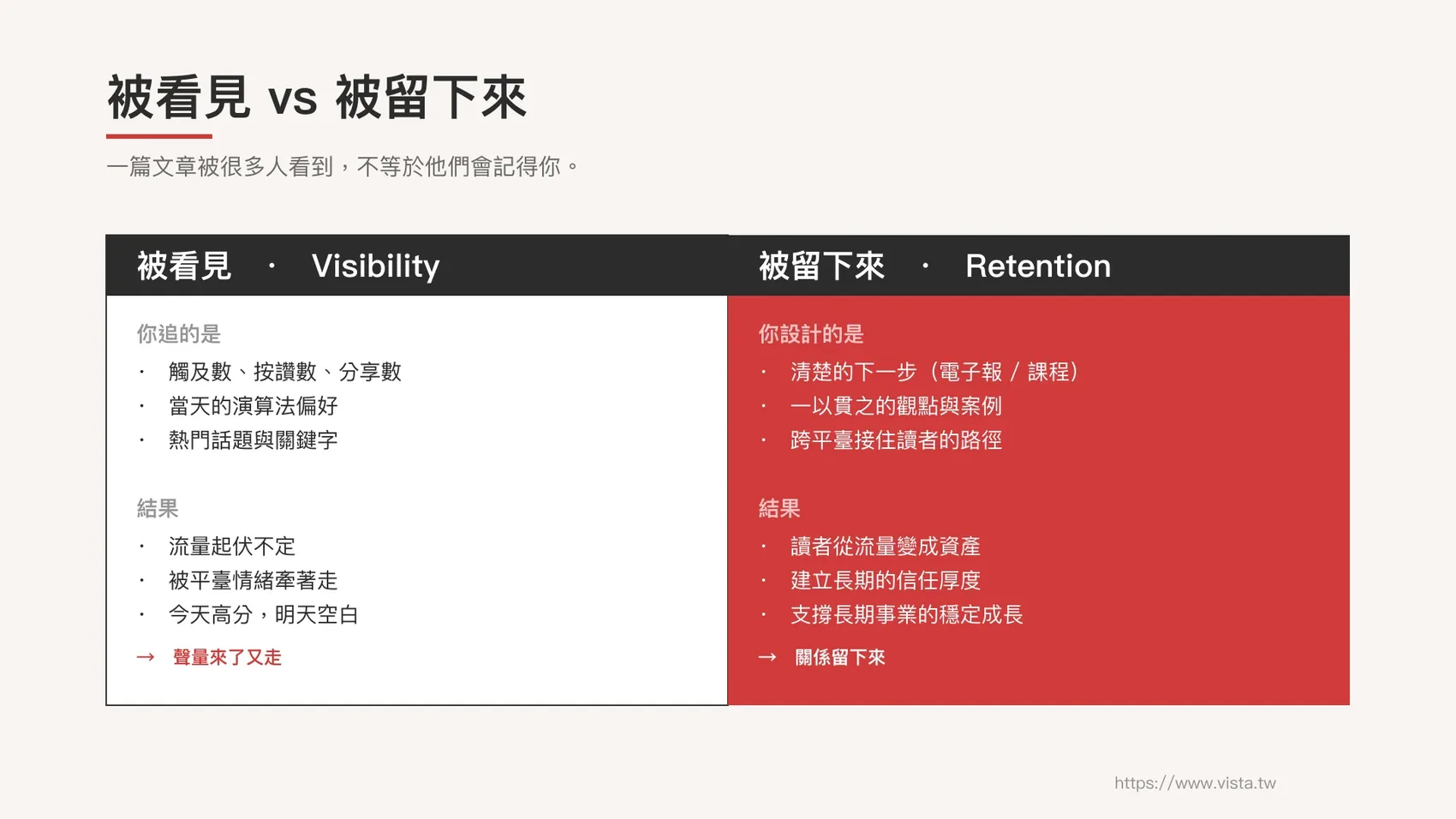 ▲ Chasing traffic allows you to follow the ups and downs of the algorithm; designing a funnel allows you to retain relationships
However, just because a piece of content is seen by many people does not mean that those people will really remember you. It doesn’t mean they are willing to get close to you, understand you or trust you. It’s like walking into an MRT station in Taipei and seeing colorful advertisements posted on the walls. Some of them are even beautifully designed and have eye-catching slogans, but most people just pass by after seeing them. It’s one thing to be seen, it’s another thing to be left behind.
Interaction: Not like, but willing to get close
Therefore, after touching, the second more critical stage is actually interaction. It’s just that the interaction mentioned here is not just as simple as clicking likes and leaving comments. What’s really important about interaction is that it means that someone who originally just glanced at your content is starting to pay some attention to you. He is willing to stop and think about it, to respond, to forward it to a friend, to message you privately, to click on the e-newsletter, and to read two more articles. These actions may seem small, but they are evidence that a relationship is beginning to happen.
I often feel that producing content is a lot like getting to know someone in an event. When you meet for the first time, the other person notices you first, which is touching; but if he starts to be willing to chat with you, ask you more questions, or remember one of your opinions, this is interaction. The reason why a lot of content cannot be made is not because no one sees it, but because there is no reason designed for people to get close to it.
I think this is especially true in Taiwan. Because when many professionals produce content, they accidentally enter the “I want to prove that I am professional” mode too quickly. Therefore, the article is very full, filled with information, and the terminology is very difficult, but the readers have no idea at first glance. Not because the content is bad, but because the distance is too far! For most people who meet you for the first time, they don’t first want to know how good you are, but first want to know: Do you understand my problem? Can you tell where I’m stuck now? Can you provide me with information that is truly helpful to me in a way that I can understand?
This is why truly good content interaction often relies not on showing off skills, but on a sense of substitution. Can you tell me the real situation that a Taiwanese office worker would encounter? Can you write down what an in-house training organizer is worried about? Can you describe the fatigue that a freelance worker feels every day between taking on projects and running a personal brand? When you write that this is how I feel, interactions will start to grow.
Trust: the thickness accumulated over time
However, interaction is not the end yet. Just because someone leaves a message with you, does not mean that they believe you; someone likes it, does not mean that they are willing to give you the opportunity to cooperate; someone thinks that what you said is good, does not mean that they really think that you are worth investing time and money. What really determines whether content can support a long-term career is often the third layer: trust.
Trust, in today’s era of AI and information explosion, is more scarce than before. Because on the surface everyone can write articles, make presentations, organize information, or do lazy things, but the more this happens, the more readers will subconsciously distinguish: Is this person just collaging information beautifully, or does he really have his own understanding? Is he just chasing hot topics, or does he have a consistent set of views? Is he talking about this because he has seen it or because he has done it?
Trust can never be obtained by saying “I am professional”. It is more like a kind of thickness accumulated over time.
In my opinion, you continue to appear in different places, continue to speak out judgmental things, continue to provide valuable cases, and continue to make people feel that what you speak is not empty words, but the experience you have experienced. Over time, your readers’ feelings about you will change. He no longer just thinks that this person’s content is good, but starts to think that this person is trustworthy.
This is why I always think cases are very important. Especially in the Taiwan market, whether you are a consultant, lecturer, content creator or brand operator, what everyone pays for in the end is often not an abstract concept, but a concrete sense of certainty. Instead of explaining a theory brilliantly, why not analyze a case that you have actually done? If you say that AI can improve efficiency, why not directly talk about how a Taiwanese company organized meeting minutes and accelerated internal briefings after it was introduced, or how changed content production from a single point operation to a process?
If you are very knowledgeable, you can definitely give some real examples. In recent years, many Taiwanese companies have been talking about AI, but what really makes managers willing to pay is not a vague statement like “AI is great.” It is whether you can tell: “A small and medium-sized enterprise with 50 to 200 people, without increasing manpower, can compress the content and internal communication process that originally took three days to complete into one day, and the quality is more stable.” Having said that, when you can translate abstract concepts into concrete situations, trust will begin to take hold.
Conversion: Not a hard sell, but thoughtfulness
And once trust is truly established, the next step is conversion. Many people have misunderstandings about conversion, thinking that it means selling hard, or asking people to pay the price as soon as they open the door. Not really. Good transitions feel more like a natural extension. When the reader has gained value from your content and gradually believes in your judgment, a thought will naturally appear in his mind: If I want to take a step forward, is there a more specific way to cooperate with you, learn from you, or ask you for help?
At this time, it would be a pity if you did not design a conversion path. Because many people actually don’t want to support you, but they don’t know how to support you. To be honest, this situation is very common. I have seen many teachers, consultants or creators. Although the content is very popular, people often say “the teacher taught it very well” or “this article is very useful”, but when I click on his page, I can’t find any clear next step? You have to know that if there is no e-newsletter, no service description, no course page, no form, no contact portal…for readers, that rare sense of recognition can only be exchanged for a few vague likes.
So I have always believed that conversion is not a hard sell, but consideration. You have to be considerate of the person who has been helped by you and has begun to trust you, and let him know: If you want to go deeper, I have the next step to choose from. That might be a handout, a lecture, a newsletter, a community, a course, or a consulting service. The forms can be diverse, but the road ahead must be clear.
Well, I often use a metaphor to describe this. Producing content is like opening a unique shop on the roadside. Touch is when a passerby sees the sign, interaction is when he stops and takes a few glances, trust is when he begins to feel that this store has taste, sincerity, and is not just a random shop, and conversion is when he finally opens the door, comes in, sits down, and orders a drink of what he really wants to drink. You can’t expect everyone who passes by to make a deal immediately, but you need to give those who are truly interested the opportunity to open the door and walk in.
Retention: Turn traffic into assets
However, there is a final layer to truly mature content management, and it is also the layer that I think is most easily overlooked, and that is retention. The key to this level is not whether the transaction was completed this time? But, will this person continue to follow you? Today, when social platforms dominate attention, this matter is increasingly important. Because if you only rely on a single platform to reach your audience, you are actually in danger. Because when the algorithm changes, people who originally could see you may not be able to see you tomorrow; as long as the platform’s wind direction changes, the traffic you have worked so hard to accumulate will be diluted in an instant. Therefore, a truly stable content operator will definitely think about one thing in the end: How do I turn readers from platform traffic into my own long-term assets? This is why I have always attached great importance to e-newsletters, website content databases and community lists, and even various ways to reach readers across platforms. The reason is simple, because you cannot place your precious interpersonal relationships entirely on the platform. You know, the platform can help you expand, but it cannot replace you in retaining people.
I also know that in the past few years, there have been many very capable content creators in Taiwan who were popular on a certain platform for a while, but then suddenly fell silent. It’s not because he didn’t work hard, but because he didn’t turn short-term popularity into long-term retention. On the other hand, some people may not necessarily write explosive articles every time, but because they continue to write e-newsletters (opens in a new tab), steadily update the website, and establish a clear theme line, they eventually form a group of loyal readers who will really follow them. This group of people may not leave messages every day, but they will look at you silently, remember you, seek cooperation with you at the appropriate time, buy your products, and even take the initiative to introduce you to others. Only this kind of audience is the one who can truly support a long-term career.
 ▲ You are not competing with the algorithm to win or lose, but you are paving a way for others to approach you in your own profession.
When you think of content as a journey, everything changes
In the final analysis, the funnel journey of content is not a complicated theory. It just reminds us: the value of content has never been about how many articles you have published? It’s about whether you take people to a deeper place step by step. From seeing, to interaction; from interaction, to trust; from trust, to conversion; from conversion, to retention. Each layer is not cut off from each other, but slowly connected. Really good content is like a naturally designed trail that will not force you to move forward, but will allow people who are willing to get closer to walk in step by step.
If you are running a personal brand, teaching business, consulting service, or any job that requires content to build influence, then I would like to remind you one thing: Don’t just ask how to make this article popular. What you should ask is whether your content can be seen by the right people at different stages? Because popular articles may bring temporary popularity; but only content designed through funnels can bring real and stable growth.
After the class that day, the student was silent for two minutes after listening to what I said, and then said with a smile: “I understand. Although I work hard to publish articles, it is more like handing in assignments according to the script, rather than building a trust journey with readers.” I was actually very moved when I heard this sentence. Because this is not only a problem she faces, but also a common situation for many content workers. It’s not that we don’t work hard, but we too often turn content into tasks instead of systems; we publish single articles but fail to form a system; we create exposure after exposure but fail to create long-term relationships.
And once you start looking at content as a journey, a lot of things change. You will no longer be so anxious about the performance of each article, because you know that different content has different tasks; you will no longer just blindly pursue reach, but will pay more attention to interaction, trust, and retention; and you will begin to understand that what really makes a person go long is not the sudden popularity of a certain piece of content, but whether he continues to deliver the right value to the right people, and allows this connection to have the opportunity to slowly become more profound.
And all of this is what I understand about content management. It is not a sprint, but a marathon with rhythm, design and temperature. You are not fighting against the algorithm to win or lose, you are paving a way for others to approach you in your profession.
If you also want to build a content funnel into a system
 ▲ One piece of material → Six formats, so that someone can catch it at every level of the funnel
After explaining the truth, the next step is the most difficult thing: actually making it happen.
Let’s be honest, it takes more than willpower alone to keep every level of your funnel running smoothly. You need a system - so that your input, research, production, refinement, and distribution can all perform their own duties; so that each piece of content knows what role it should play at a certain position in the funnel.
This is exactly what I have been polishing over the past few years and am preparing to fully demonstrate at the AI content production system workshop on May 23.
One piece of material is automatically produced in six formats - from input to multi-platform distribution in one go. In 3 hours, we will guide you to build your own five-layer content pipeline, turning you from the fatigue of chasing traffic to the practicality of building a system.
- Date: May 23, 2026 (Saturday) 9:00–12:00
- Location: Taipei City (will be notified after registration)
- Number of people: limited to 16 people (small class size)
- Fee: NT$7,000|Early bird NT$5,000 (deadline 14 days before class starts)
Click here to go to vista.tw/courses/ai-content to view the complete course outline and registration. If you want to learn about my other online/physical courses first, you are also welcome to visit solo.tw (opens in a new tab).
Further reading:
- Why is now the best time to learn Claude Code?
- What should I do if I get stuck in writing? An underrated breakthrough method
- Why I choose Ulysses as my main writing tool
External resources:
- AI Content Production System Workshop|solo.tw
- Solo Creator|Vista’s one-person company school (opens in a new tab)
- Vista Newsletter (Substack) (opens in a new tab)
Next step
Bring this topic to your team
Vista Cheng speaks and runs workshops on AI workflows, writing and content systems for companies, schools and public agencies.