I read "The Age of Computing Power": Use the Industrial Revolution as a mirror to see clearly which side you are on

A conclusion drawn out in advance
Opening Wang Boda’s new book “Computing Power Era: Artificial Intelligence is Starting the Second Great Divergence (opens in a new tab)”, the first sentence in the preface is very interesting: What I originally planned to write was actually another book.
That book wanted to answer an old question: What are the conditions for becoming an economic hegemon? The Netherlands replaced Spain, the United Kingdom replaced the Netherlands, and the United States replaced the United Kingdom. The process of each replacement was different, but the underlying logic behind it seemed to be the same. He writes along a timeline, from the Industrial Revolution to the post-Cold War dollar system. When writing Chapter 9, he had to answer the most critical question: What will determine the world order next time?
His answer is computing power.
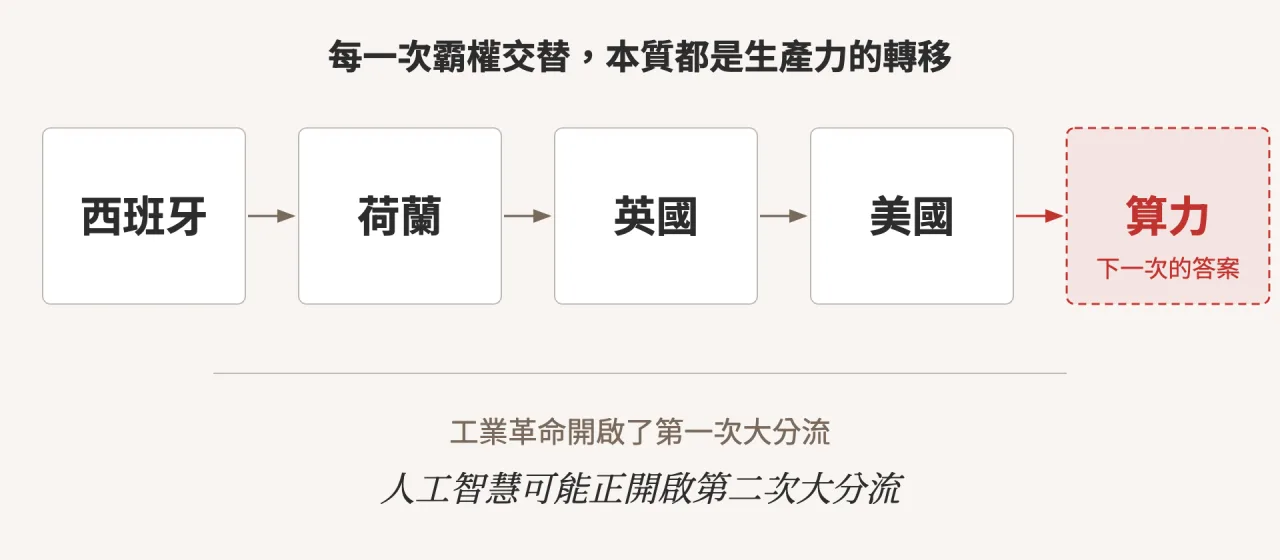
As a result, the chapter got longer and longer, until it didn’t feel like the conclusion of one book, but the beginning of another. After discussing with the publisher, he decided to put down his original plan, draw out the conclusion, and write this book.
I really enjoyed this process of writing a book. Anyone who has written a book knows that it takes a lot of determination to put down a manuscript that has reached Chapter 9. But precisely because of this, this book has a rare foundation: every judgment about AI is supported by hundreds of years of historical research.
Why should we compare it with the Industrial Revolution?
Wang Boda has more than 20 years of experience in the financial industry. He has served as a company listing financing, mergers and acquisitions and investment consultant. He now runs the financial self-media “Wang Boda’s Viewpoint”. His daily job is to judge where interest rates are going and where funds are flowing, but in this book, he extends the time scale to two hundred years.
His reason is clear: the Industrial Revolution is the only productivity revolution that mankind has completed in its entirety. From technological breakthroughs, concentration of wealth, latecomers catching up, outbreaks of social conflicts, to the establishment of a new order, every link has history to follow. Comparing it with an ongoing revolution does not guarantee that the inference is completely correct, but at least it gives the inference a focus.
Therefore, almost every judgment in this book will first talk about the industrial revolution. When talking about the scarcity of chips, let’s talk about cotton first; when talking about the impact of AI on employment, let’s talk about the Luddite Movement first; when talking about the output of computing power, let’s talk about India’s deindustrialization first.
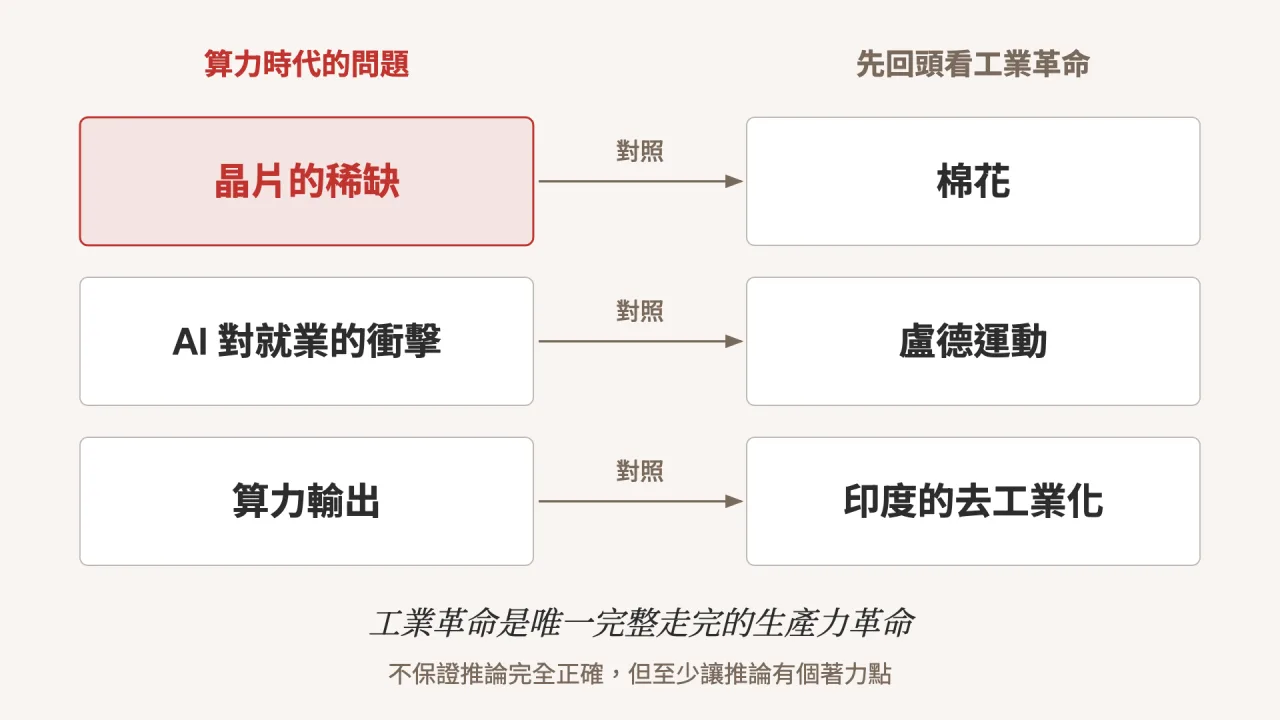
I compiled the comparisons in the book into a table:
| The first major divergence | The second major divergence | |
|---|---|---|
| Driving Technologies | Steam Engines | Artificial Intelligence |
| Object of Liberation | Human Muscle | Human Cognition |
| Main industries affected | Manufacturing | The service industry that has not been liberated in two hundred years |
| The time it takes for society to find a new order | Nearly one hundred and seventy years | Technology is iterating in months |
The last column makes me restless the most. The last time, humans experienced unemployment struggles, geographical competition, and two wars. It took nearly 170 years to figure out how to get along with machines. This time, the time left for us is much shorter.
The ceiling of the service industry may be broken this time
The title of the introductory chapter is a question: Can the artificial intelligence revolution unlock the productivity curse of the service industry?
I am often asked this question in corporate internal training, but I just put it in a different way. Bosses will ask: If the factory can be automated, why do we still have to rely on people to do our business, administration, and customer service for so many years?
The answer actually lies in the book. Steam engines liberate muscles, but the service industry relies on cognition: understanding what customers want, judging how to respond, and writing a report. For two hundred years, no machine can do these things, so the productivity of the service industry has been stuck at the ceiling of manpower.
AI encountered this for the first time. In the first part, Wang Boda started from three directions: the service industry breaks away from the human ceiling, embodied intelligence enters the physical world, and the business flywheel driven by AI Agent. For me, who uses AI Agent to handle work every day, Chapter 3 is particularly resonant.
Apart from the four tickets, what really determines the outcome is the market
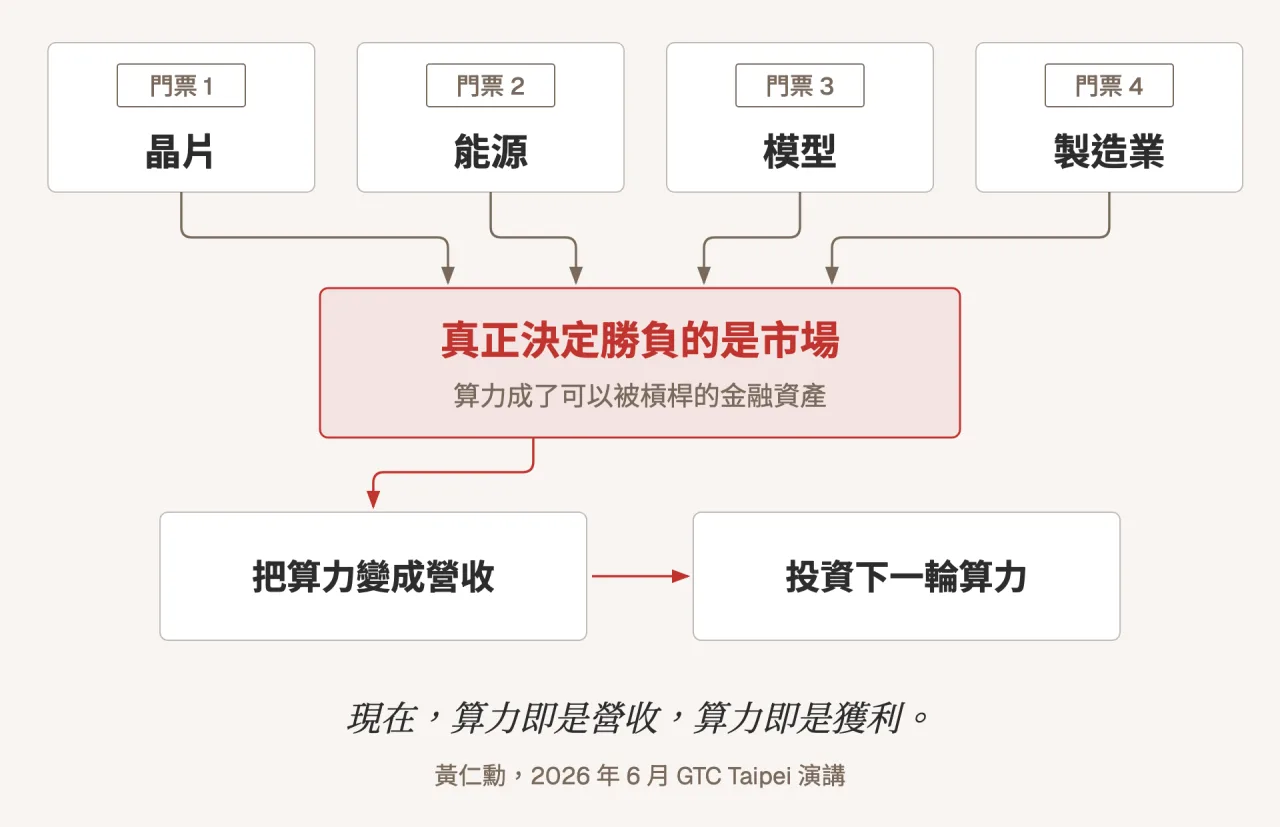
The second part talks about the computing power hegemony between the United States and China. Wang Boda proposed four tickets: chips, energy, models, and manufacturing.
The first three pictures are easy to understand, but the fourth one I was a little surprised at first. As you read on, you will understand that computing power will eventually be implemented into products, factories, and robots. Without manufacturing capabilities, computing power will just stop in the data center.
What’s even more interesting is his next judgment: when computing power becomes a financial asset that can be leveraged, beyond the four tickets, it is the market that really determines the outcome. This is the perspective that financial professionals have. Whoever can turn computing power into revenue can continue to invest in the next round of computing power. This also echoes the sentence quoted on the book cover, which Jen-Hsun Huang said in GTC Taipei in June 2026: “Now, computing power is revenue, and computing power is profit.”
If there is no beginner, how can one be experienced?
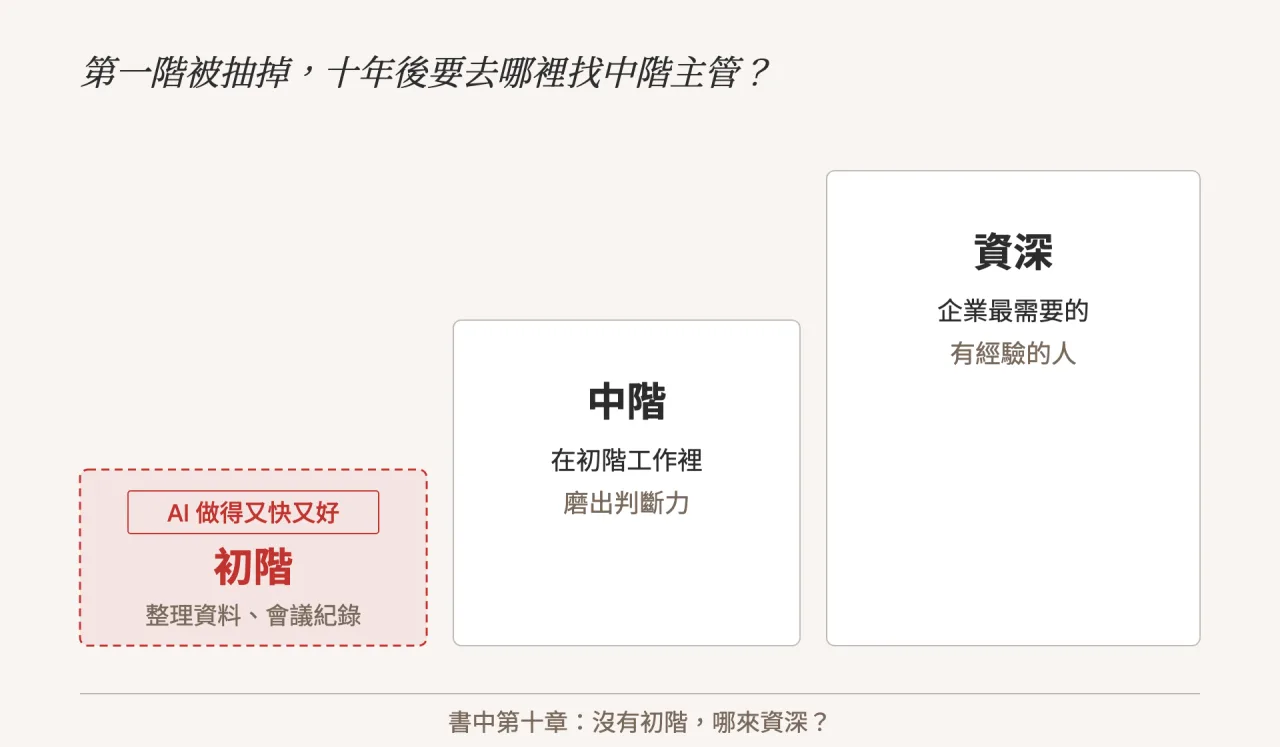
In the table of contents of the entire book, what made me stop the most was the title of Chapter 10: Without beginners, how can there be seniority? The collapse of the career ladder and the failure of the education system.
I feel this issue particularly deeply in graduate school and corporate classes. In the past, when a new employee entered the company, he would start by sorting out information, writing meeting minutes, and making the first draft of a presentation, and then developed his judgment step by step. AI can now do these jobs quickly and well, so companies are naturally not in a hurry to fill in the gaps for entry-level people.
But where do the senior people come from? They were all polished off in those seemingly trivial entry-level jobs. If the first step of the staircase is removed, where will companies find experienced mid-level managers in ten years?
The book places this issue in the fourth part, “Cracks,” and discusses it together with population aging, financial pressure, and the reconstruction of capitalism. I think this arrangement is very honest. The issue of career ladder is never just whether individuals should work hard, but how the whole society should redesign the learning path.
Chapter 13 gives personal direction: from executor to creator, the most valuable thing in the era of computing power is the period that cannot be touched by machines. I would like to share this sentence with students.
From the only one to one
The last chapter is written for Taiwan: from the only to the one, the beautiful island in the age of computing power.
In recent years, we are very accustomed to hearing that Taiwan is irreplaceable in the AI supply chain. What Wang Boda reminds us is the other side: when Taiwan’s niche changes from the only one to one, what else can be exchanged for the cards in hand?
It will be more interesting to read it together with the third part which talks about the situation of non-powerful countries. Should countries caught between the United States and China take sides or create their own problems? Who will become a digital wage earner? There are no standard answers to these questions, but as a Taiwanese, it’s hard not to take them to heart.
This book does not help you predict, it gives you a basis for judgment.
In the last paragraph of the preface, I mentioned a detail that impressed me very much.
The manuscript was handed in at the end of May 2026, but Wang Boda hardly stopped in the next few months because reality ran too fast. In mid-June, the U.S. Department of Commerce asked a U.S. company to stop providing the latest model to all foreign nationals; the next day, a Chinese company open sourced a model with more than 740 billion parameters; in late June, several European countries signed the U.S.-led Pax Silica in Washington. Many chapters in the book were revised more than once because of this.
He also confesses that the book deals with a process that is still moving from month to month, so it is not intended to predict the final outcome. What he wants to give readers is a set of basis for judgment: when you see in the news that a certain country has signed a technology agreement, a certain company has announced a capital expenditure that exceeds common sense, and a certain type of job has been reduced by 30% within a year, you can understand why this happened, what may happen next, and how you can respond.
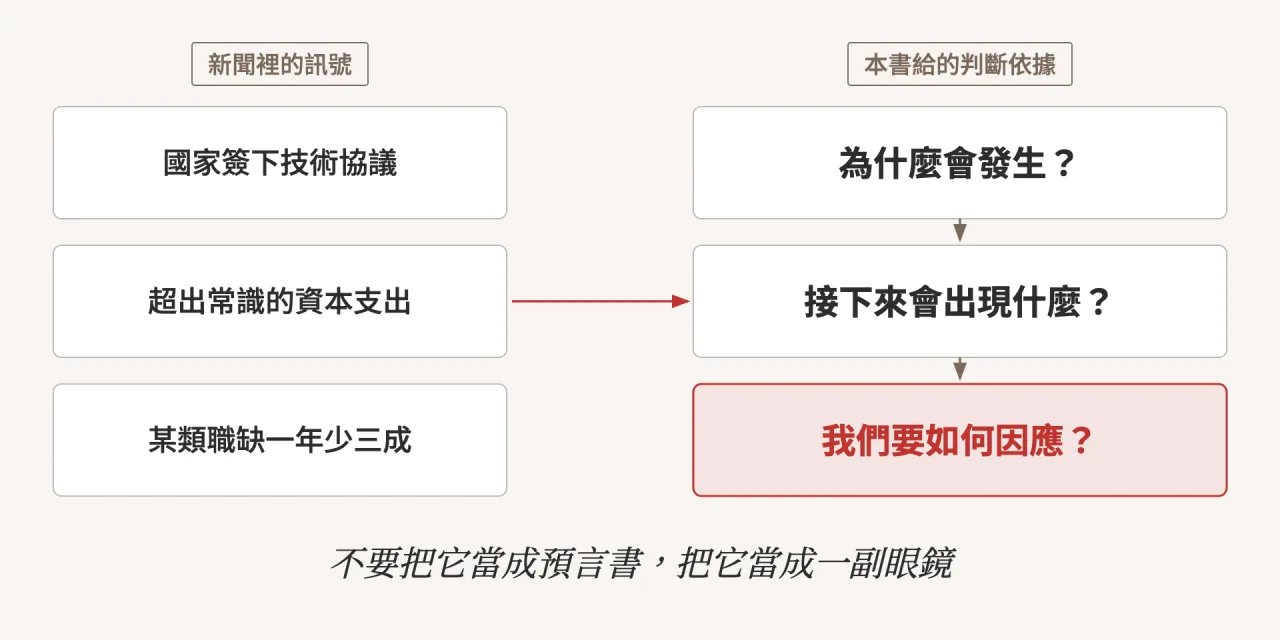
I think this is the best way to read this book. Don’t think of it as a prophetic book, think of it as a pair of glasses.
If time is limited, I would recommend reading the following three parts first:
- Prologue and Part 1: Understand why the productivity of the service industry will be unlocked this time
- Chapter 10: Everyone who leads a team, leads a student, or just enters the workplace should read it
- Chapter 14: Understand what other cards Taiwan has in hand
Who is this book for? I would recommend it to three types of people: investors and managers who want to understand the logic behind the U.S.-China technology rivalry, supervisors who are worried about how to train new employees, and workplace workers who are worried that their jobs will be replaced by AI and want to find the next step.
Which side will you be on?
The book cover asks a question: When the world is divided into two by computing power, will you be on the side that captures growth, or the side that bears the cost?
My impression after reading the entire book is that there is no automatic decision on which side to take. The reason why Britain was the first to break through during the last great divergence was because many conditions converged at the same time. It was the same this time, only much faster.
Understanding this set of underlying rules can at least make us not just surprised when the next news appears, but also know where to go.
Book information: “Computing Power Era: Artificial Intelligence is Starting the Second Great Divergence (opens in a new tab)”, written by Wang Boda, World Magazine, published on November 4, 2026.
Next step
Bring this topic to your team
Vista Cheng speaks and runs workshops on AI workflows, writing and content systems for companies, schools and public agencies.