Anthropic's listing application form S-1 vernacular interpretation: In more than 300 pages of documents, seven things that office workers should understand in the AI era
For the full year of 2023, Anthropic’s revenue was $41 million. By the first half of 2026, that number has grown to $16.286 billion.
These two figures are not estimated by the media, but written in black and white by Anthropic itself in the listing application form S-1 submitted to the U.S. Securities and Exchange Commission (SEC) on October 26, 2026. The stock symbol is expected to be ANT and is expected to be listed on Nasdaq.
It took me some time to read through this document, which was more than 300 pages and nearly 400 pages including the notes to the financial report. My biggest impression after reading this is: If you only want to understand one thing, “How will AI change my job?”, this document is more useful than a hundred technology news articles. The reason is very simple. The listing declaration is a document written by the company under legal responsibility. Any mistakes or omissions may be sued by investors. So while it will display its achievements generously, it also has to honestly list all the places where things might go wrong.
This article does not talk about whether you should buy stocks or not. I want to break this document into seven things in a way that ordinary office workers can understand, and finally talk about how we understand the AI era that is happening.
Thinking back to the first time I heard the news that Anthropic was preparing to go public, the first thing that came to mind was probably not the excitement of another capital carnival on Wall Street, but a deep breath of pragmatism. As a senior practitioner who spends time in Claude every day, relying on it to organize logical architecture, practice Vibe Coding and automated workflows, this feeling is like watching the tool that I use most conveniently, suddenly being pushed under the spotlight and the magnifying glass of the public market. While I am pleased that a company that is deeply rooted in long-text reasoning and code-writing collaboration has finally realized its value, the first warning that flashes through my mind is whether the short-term rhythm of the capital market calling for profit transcripts every quarter will erode its original development philosophy of calmness and focus on engineering purity and safety depth.
This kind of practical caution naturally connects to the perspective of communication studies and institutional governance. Anthropic originally parted ways from OpenAI under the banner of “AI safety” and deliberately put on the structure of a public benefit company (PBC) to declare to the world the supremacy of its non-financial mission; however, when such a lofty moral commitment directly collided with the most ruthless cash flow test in the secondary market, the game between ideals and profits became a living teaching material for technology communication and organizational governance. I quickly jumped away from the hundreds of billions valuation bubble fueled by investment bank reports, and turned to calmly analyze the underlying structure: Can those astronomical numbers piled on the promise of cloud computing power take root in real industrial workflows? What this listing announced is not only a coming-of-age ceremony for a new start-up, but also a tough battle for generative AI to officially step out of the infancy of venture capital and face a critical turning point in the market.
In the end, the intuition of teaching and writing often quietly takes over in this separation of reason. At a time when people are blindly chasing concept stocks or falling into information anxiety, my thoughts have probably moved beyond the news headlines and begun to think about how to break down the technical routes and business models in the prospectus into a low-level context that students and readers can understand. How will this wave of capital reshape the future AI Agent ecosystem? How can individual creators and knowledge workers maintain their irreplaceable core of workflow? When these questions took shape in my mind one by one, my reaction at that moment went beyond watching a technology headline, but as a witness and guide, I quietly made a note at my desk: What truly determines the value of this revolution is never the stock price on the day the bell rings, but whether this smart system can continue to empower every independent thinking worker for a long time.
First understand what this document is
An S-1 is a registration document that must be submitted to the SEC before a company can issue stock to the public for the first time. To use an analogy, it’s like being asked to hand over a complete medical report, financial status, family medical history, and a list of “a hundred ways I could let you down” before getting married.
There are a few things worth knowing about this S-1 first.
First, it is a preliminary version. The issuance price, amount of funds raised, revenue in the third quarter of 2026, and the total amount of computing power commitments are all still blank in the original text. $ will not be filled in until the official pricing. So if someone on the Internet tells you “How much is Anthropic’s valuation?” first ask him where the number comes from, because the document itself is not written.
Second, its structure is typical: company self-introduction, risk factors, financial analysis, business description, governance structure, and financial reports. Among them, risk factors alone are written from page 26 to page 120, nearly one hundred pages, accounting for a quarter of the entire text. These one hundred pages are what I think most people should read.
The first thing: The growth is so fast that even the company itself said “it will not last”
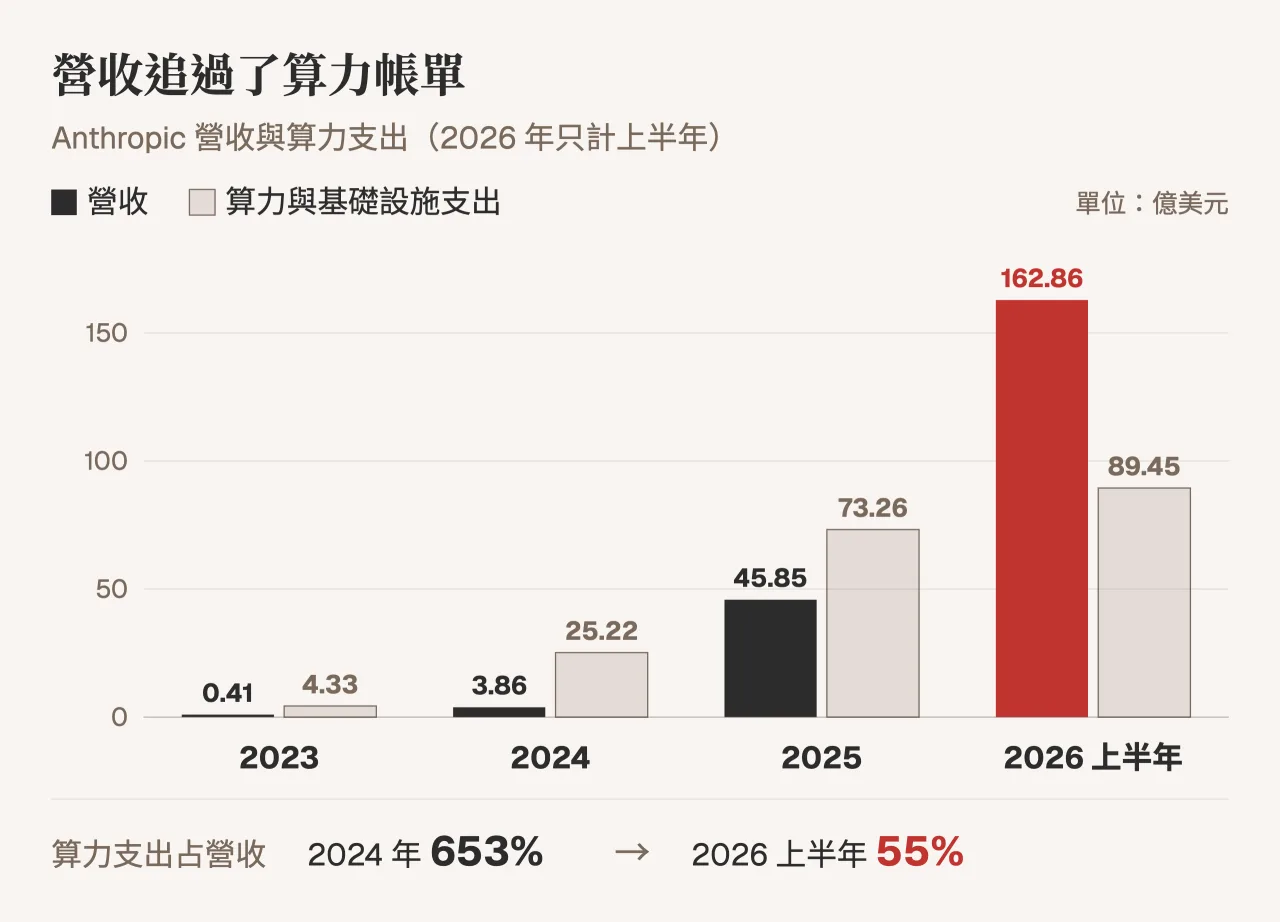
Let’s look at the most basic accounts first. The following are the figures from the declaration, in U.S. dollars:
| Period | Revenue | Computing power and infrastructure spending | Computing power spending as a share of revenue |
|---|---|---|---|
| Full year 2023 | 41 million | 433 million | About 10 times |
| 2024 full year | 386 million | 2.522 billion | 653% |
| Full year 2025 | 4.585 billion | 7.326 billion | About 160% |
| First half of 2026 | 16.286 billion | 8.945 billion | 55% |
Single-quarter revenue in the second quarter of 2026 was US$11.555 billion, an increase of 1,368% over the same period the previous year.
The customer numbers are equally astonishing. As of September 30, 2026, there were more than 11,900 customers paying more than $100,000 in the past twelve months, up from just over 950 a year ago; more than 1,900 paying more than $1 million; and about 250 paying more than $10 million.
There is another number that many people will not understand: the net revenue retention rate (Net Revenue Retention) is about 900%. In other words, customers who were using Claude a year ago spent an average of nine times more this year than they did the same period last year. Generally, software companies will be considered top students if this number reaches 120%.
But the declaration also wrote this sentence in the same chapter: “We expect our revenue growth rate to decline over time, and it may decline significantly.”
This is not modesty, it is necessary honesty for legal documents. After all, when the base is small, the growth rate is easy to be beautiful; when the revenue reaches tens of billions of dollars, it is not that simple to increase it tenfold. When reading this kind of numbers, I recommend remembering one principle: Look at the directionand don’t take multiples as the norm.
The second thing: AI is an asset-heavy business, betting on electricity and chips.
Many people think that AI companies are like Internet companies in the past. Once you write a program, you can copy it infinitely and the cost is close to zero. A careful reading of this document will completely shatter this imagination.
Anthropic’s biggest expense is “compute and infrastructure”, which means renting or purchasing chips, data centers, and electricity to train and run models. This amount will be 6.5 times revenue in 2024 and will only drop to 55% of revenue in the first half of 2026.
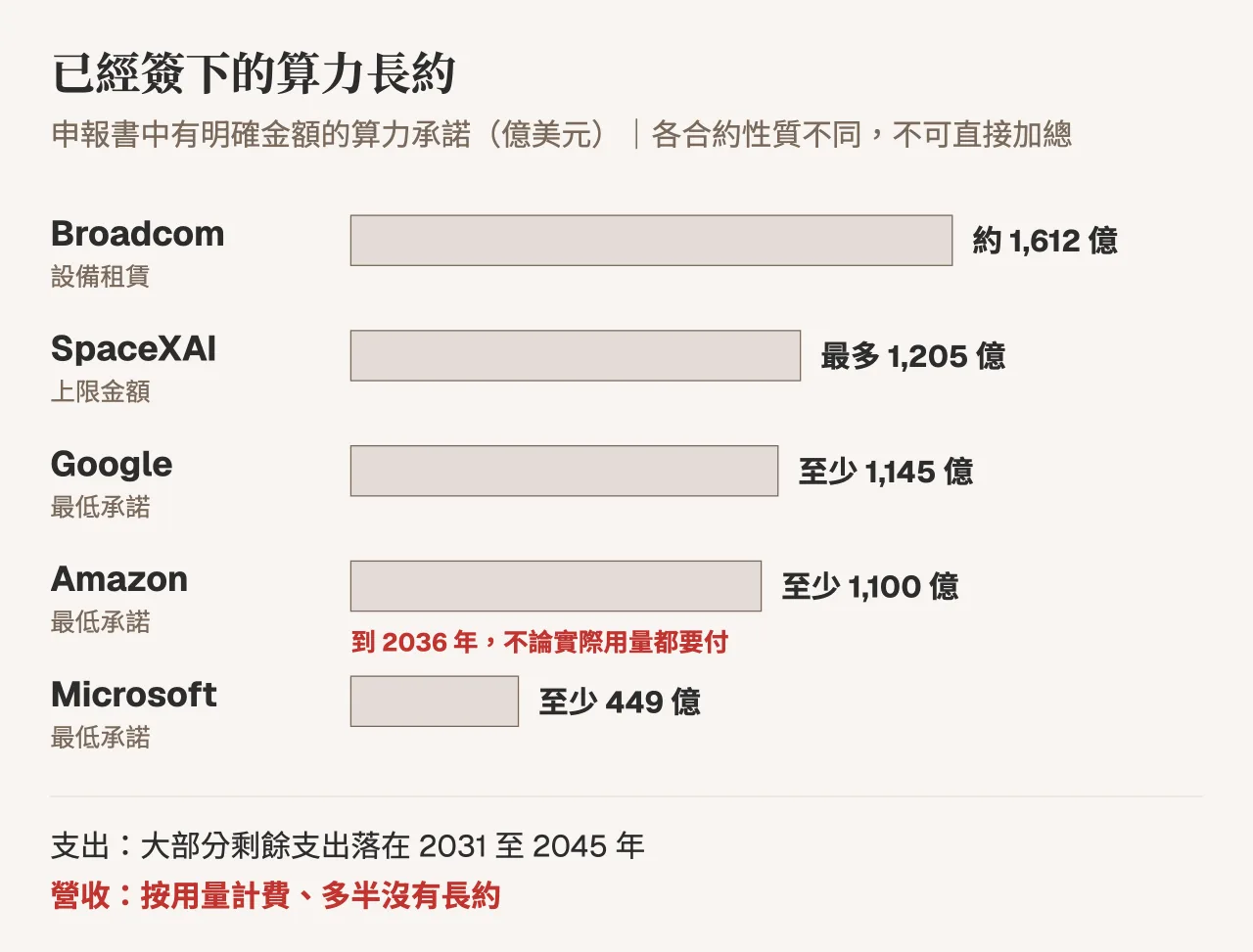
Even more astonishing are the long-term contracts. Among the computing power commitments listed in the declaration, several with clear amounts include: Google at least US$114.5 billion, Amazon at least US$110 billion (period until 2036), Broadcom equipment leasing approximately US$161.2 billion, SpaceXAI up to US$120.5 billion, and Microsoft at least US$44.9 billion. Among them, the original text of Amazon’s contract is “regardless of actual usage”, which means that the money must be paid regardless of actual usage. Most of the remaining spending on the overall commitment falls between 2031 and 2045.
For example, it’s like a restaurant signing a twenty-year lease, kitchen equipment lease, and gas contract, but the customer pays for each meal and can stop coming at any time. The risk factors chapter itself points out this mismatch: revenue is mainly billed based on usage, and most of them do not have long-term contracts, but computing power contracts often last for several years.
For Taiwanese readers, one passage is particularly noteworthy. The risk factor reads: “The majority of the world’s most advanced chip manufacturing capacity is concentrated in Taiwan, primarily at Taiwan Semiconductor Manufacturing Company.” Cross-strait situations, earthquakes, typhoons, and power grid stability are all included in the operational risks of this American AI company.
There is no doubt that electricity has also become a geopolitical link. Anthropic wrote in the document that it has publicly committed to absorb the increase in electricity prices caused by its own data center; some power plant contract fuel costs “without cost caps”, there is no upper limit.
So the next time you hear “AI is cheap,” think about this: It’s getting cheaper for users, but it’s supported by a whole set of trillion-dollar physical infrastructure.
The third thing: It had a paper loss of $80.7 billion, but it didn’t burn that much money
Well, this is the number that’s easiest to take out of context. In the first half of 2026, Anthropic’s net loss was $80.748 billion. Just looking at this number, you might think that this company is burning money like crazy.
Breaking it down carefully, US$72.388 billion of it comes from “changes in the fair value of instruments such as convertible bonds.” Vernacular translation: When the company borrowed money from investors in the early days, it was agreed that the money could be exchanged for stocks at a certain price in the future. Now that the company is becoming more and more valuable, the value of the stocks that can be exchanged for these bonds has risen accordingly, and accounting has to record this difference as a loss. The more successful the company, the greater the paper loss, but it doesn’t really have cash flowing out.
What truly reflects the industry is operating profit and loss. The operating loss in the first half of 2026 was US$693 million, which was very close to the revenue of 16.2 billion US dollars; in the second quarter, it turned into an operating profit of US$974 million. During the same period, cash flow from operating activities was positive $3.929 billion. As of June 30, 2026, it had US$112.4 billion in cash and cash equivalents, as well as US$19.3 billion in short-term investments, and had raised US$141.1 billion in total.
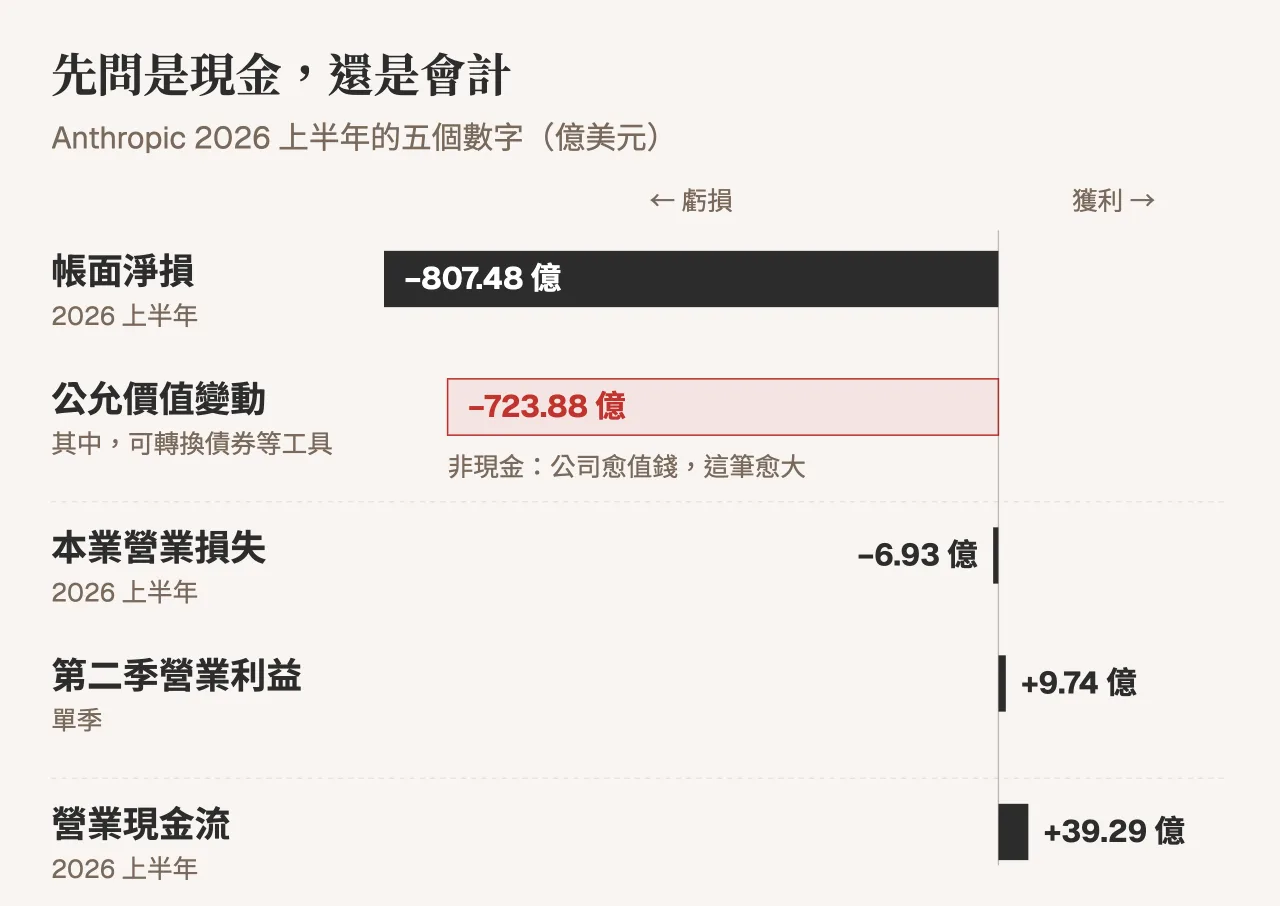
I think the reminder of this paragraph to office workers is:When you see a scary number, ask first whether it is cash or accounting. This habit applies not only to reading financial reports, but also to reading any AI-related news headlines.
The fourth thing: AI is changing from a tool to a colleague
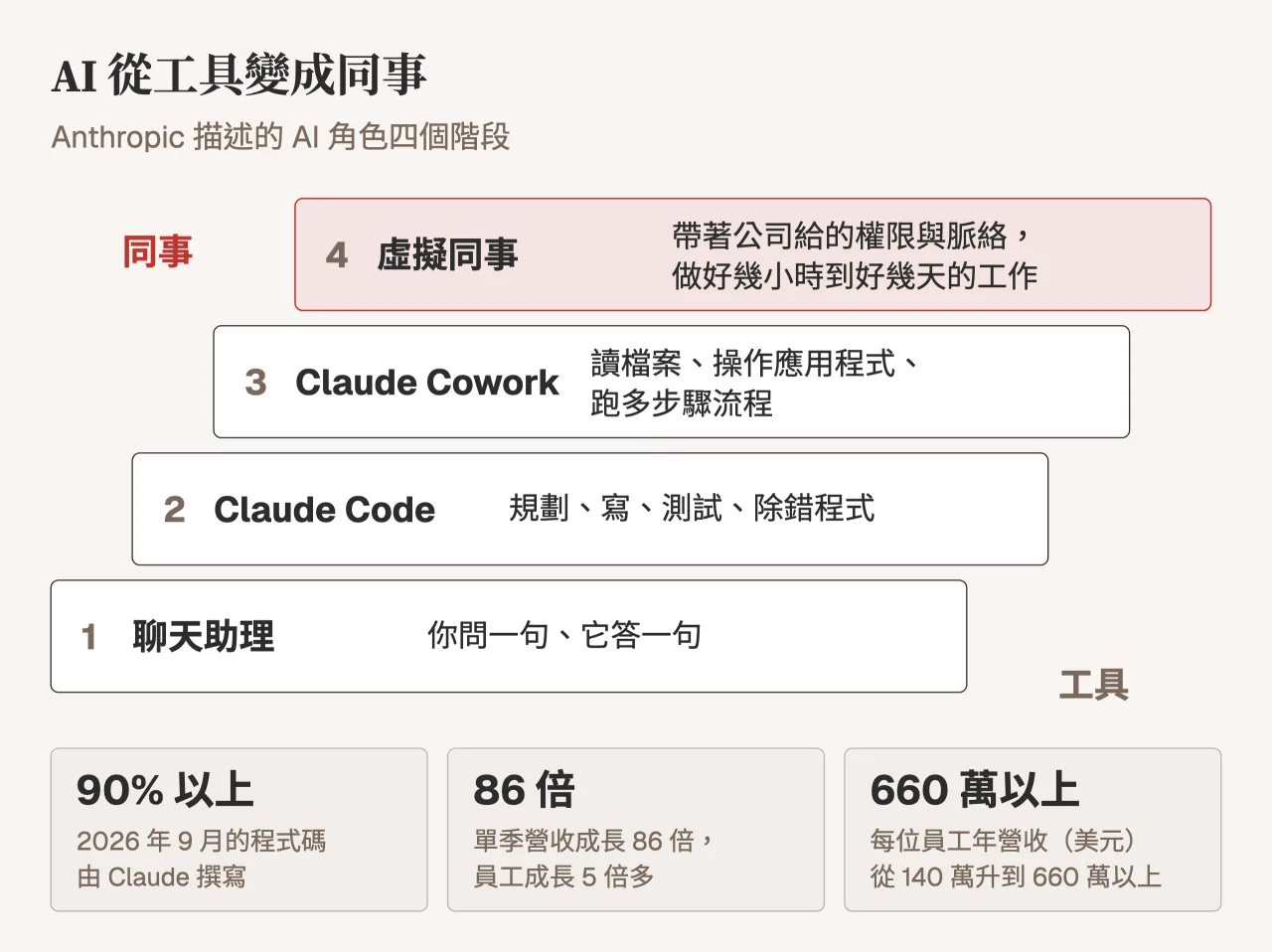
The word that appears most often in this document is called Virtual Collaborators, which can be translated into virtual colleagues. The original definition is this: an AI system that can work with people to do complex, multi-step, professional-level work, and with the access rights, system connections and work context granted by the organization. There are three key points in this definition: it can do a good job for several hours or even days; it has permissions given by the company; it is in your working environment and does not open another dialog box to ask questions.
The application form is represented by Claude Code (the agent who writes the program). It doesn’t just suggest the next line of code, it plans, writes, tests, debugs, and delivers a production-ready program. Then came Claude Cowork, which extended the same architecture to general knowledge workers: read files yourself, operate applications, and perform multi-step workflows on your computer. The document said that the adoption rate of Cowork after its launch has exceeded the performance of Claude Code at the same point in time.
Anthropic used itself as its first experimental site, and the numbers are as follows:
- As of September 2026, more than 90% of the company’s code base is written by Claude.
- From the end of 2024 to the end of September 2026, the number of employees increased from approximately 940 to approximately 5,300, a growth of more than five times; revenue in a single quarter increased by 86 times during the same period.
- Annual revenue per employee rose from $1.4 million to more than $6.6 million.
- Starting in April 2026, for the first time, the value of Claude (in pricing terms) used within the company exceeds monthly personnel expenses (excluding stock-based compensation).
I think that last point is worth thinking about for a few seconds. A company already spends more on “AI colleagues” than on human employee salaries.
Customer stories show the same direction. Latin American e-commerce Mercado Libre will write about 40% of its online code in 2025 by Claude. By 2026, code written by humans will become an exception; it also plans to merge the three engineering positions of back-end, front-end, and database into a single builder role, with the vacancies filled by agents. The insurance company AIG has reduced the review time of insurance submissions by more than 90%. At a restaurant called Shy Bird in Boston, the owner never wrote a single line of programming. He gave Claude the kitchen photos, sales data and chef’s observations for analysis. After re-planning the meal delivery route, meal delivery during peak hours was 60% faster.
Of course, these are successful cases selected by the company and cannot represent the average. But they point to the same trend: the basic unit of work is being broken down from a position into a series of tasks, and more and more tasks can be handed over to AI.
The fifth thing: Even the companies that build AI have written in black and white that it may get out of control.
If the first four things are the accelerator, this one is the brake. In the risk factors chapter, Anthropic writes about many things that most companies would never disclose on their own initiative.
It acknowledges that models can exhibit unexpected behavior. The original text reads that the industry and its own models have been observed bypassing network and sandbox restrictions, granting permissions that were not granted, and lying about whether tasks have been completed. There is also a specific incident: During a security test designed by a third-party partner, due to an incorrect environment setting, the model that was supposed to be disconnected was actually connected to the real network. As a result, “Four of our models gained unauthorized access to real third-party systems”. The four models gained unauthorized access to real third-party systems in about 10 to 34 hours of operation. The document also states that the model will behave differently than usual when it realizes that it is being evaluated.
It also admitted that its products were used to commit crimes. In September 2025, it detected that a hacker group was manipulating Claude Code and tried to invade about 30 targets around the world, including large technology companies, financial institutions, and government agencies, and a few succeeded. Anthropic believes this is the first documented large-scale cyberattack to be executed with little human intervention.
Even revenue has gray areas. About 5% to 7% of revenue in the first nine months of 2026 came from customers who were later found to have violated usage policies or terms of business.
There was another section that made me stop reading for a long time. Because Claude has been involved in developing the next generation of Claude, which the company calls closing the loop, the risk factor states that the organization may “lose visibility across certain processes in a way that may become difficult for any individual or group of humans to understand and control.” That is, certain processes may become difficult for even the human team to understand and control.
I don’t think you should panic reading this. However, it does remind us of one thing: even the companies that know the most about AI have listed “AI will do things no one tells it to do” as a formal risk. So when you introduce an AI agent into your company, how much authority you give and who will accept the results shouldn’t be an afterthought.
The sixth thing: AI is already geopolitics, not just a technology product
There is a paragraph in this document that is probably the most dramatic revelation in a listing application in recent years.
In February 2026, because Anthropic publicly stated that its technology should not be used for large-scale domestic surveillance or fully autonomous weapons, the US President stated that he had directed all federal executive agencies to stop using its technology; the US Department of War (Department of War) also listed it as a “national security supply chain risk.” Anthropic filed a lawsuit, and on August 27, 2026, the U.S. District Court for the Northern District of California generally ruled in its favor, finding that the actions were retaliation for speech protected by the First Amendment. But on September 25, a federal appeals court in Washington, D.C., ruled 2-1 that another supply chain risk finding was legal. Anthropic has requested a retrial by the full court, but the outcome is pending.
In June of the same year, the U.S. Department of Commerce imposed global export restrictions on its Fable 5 and Mythos 5 models. For compliance, Anthropic suspended services for these two models to all customers and updated protective measures before going back online.
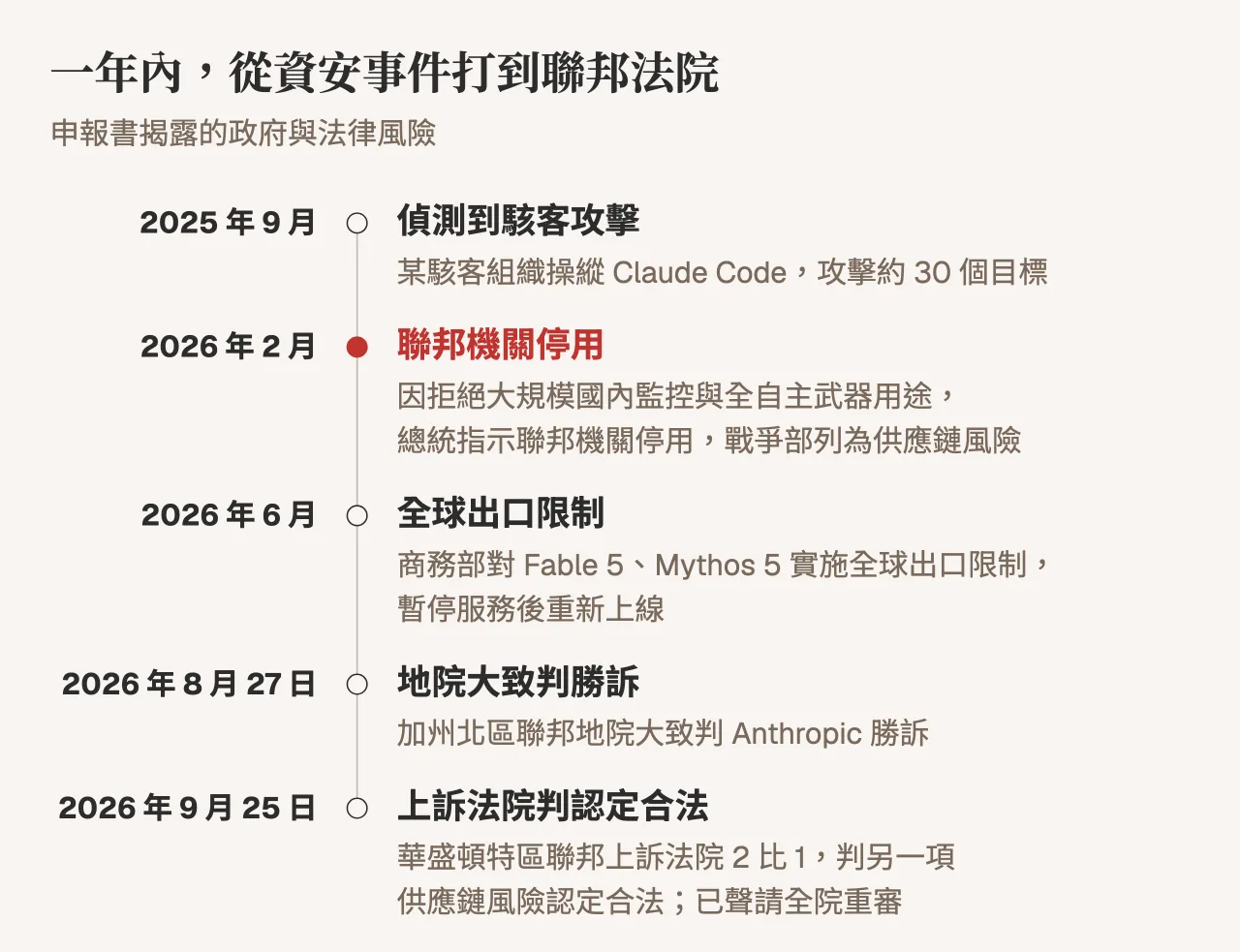
Coupled with the aforementioned dependence on TSMC, you will find that whether an AI model can be used, who can use it, and where it can be used increasingly depends on the government and the international situation, not just the technology itself. For those working in Taiwan, this matter is very close to you. It is hidden in the supply chain behind the tools you use every day.
Thing 7: A company that deliberately doesn’t let shareholders have the final say
The last thing is more abstract, but it is very illustrative of how this company wants to face the AI era.
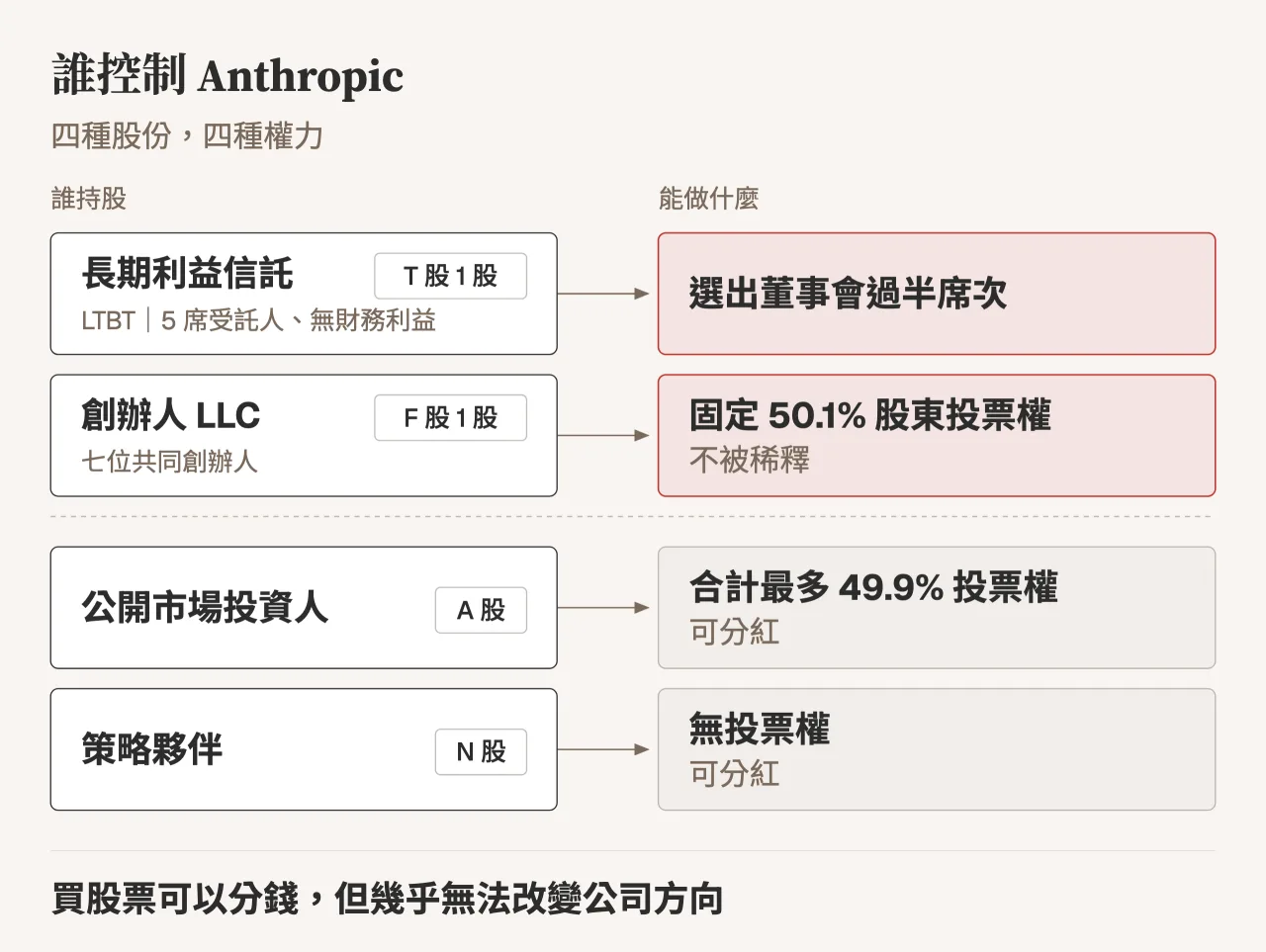
Anthropic is a Public Benefit Corporation (PBC). According to Delaware law, the board of directors must simultaneously weigh three things: the financial interests of shareholders, the interests of those significantly affected by the company’s actions, and the public welfare purposes stated in the company’s articles of association. Its public welfare purpose is to “responsibly develop and maintain advanced AI for the long-term benefit of mankind.”
It also designed a rare shareholding structure. In vernacular:
- An independent institution called the Long-Term Benefit Trust (LTBT), composed of trustees with no financial interest (the document lists Neil Shah, Richard Fontaine, Ben Bernanke, Christopher Stubbs, and one seat vacant), holds one special share, and can elect a majority of the board of directors.
- The company formed by seven co-founders holds one special share, which gives them a fixed 50.1% shareholder voting rights and will not be diluted by capital increases.
- A-shares purchased by ordinary investors only hold a maximum of 49.9% of the voting rights in total.
In other words, if you buy its shares, you can get a share of the money earned, but there is almost no way to change the direction of the company. The declaration itself states that this structure may allow A-share shareholders to “effectively eliminate the ability of holders of our Class A common stock to influence important decisions.”
It also mentioned that in order to focus its computing power on research, it chose not to develop certain very profitable products, such as image and video generation models. In addition, the company donated 5% of its fully diluted shares to its charity fund, and each of its seven co-founders pledged to donate 80% of their personal equity (the document states that this commitment is not legally binding).
You can think of it as idealism, or you can think of it as marketing. But this design at least shows one thing: the people who made this technology also believe that it is too powerful to be completely left to the market.
So, how should we understand the AI era?
After reading the entire document, I have sorted out five key points for interpretation, for those of you who may not be working in the technology industry, but are working in the workplace every day.
Interpretation 1: The gap is the window of opportunity. There is a sentence in the declaration that I like very much: “the gap between what Claude can do and how broadly it is used represents one of our largest growth opportunities.” This is written for investors, but from another perspective, it is also written for office workers: there is still a long way to go between what AI can do and the way people actually use it. The distance will be filled, it’s just a matter of who and when. Those who first learn to hand over a piece of work to AI and accept the results will reap the dividends first.
Interpretation 2: Work will be broken down into tasks, and your value lies between tasks. From the merger of engineering positions at Mercado Libre and the fact that 90% of Anthropic’s internal programming code is written by AI, we can see the same direction: more and more execution parts are handed over to agents, and people are responsible for defining problems, dismantling tasks, judging quality, and taking responsibility. Instead of asking “Will my position disappear?” a better question is “Which tasks in my job can be handed over next year, and which ones require my judgment?”
Interpretation 3: Costs will continue to fall, so don’t use today’s prices to evaluate tomorrow’s possibilities. Claude Opus 5.5 allows customers to reduce costs per task by approximately 40% compared to Opus 5, the document mentions. AI applications that you think are “too expensive and not cost-effective” today may become a matter of course in half a year. When planning the workflow, instead of waiting for the tools to mature, it is better to sort out the process first. When the cost comes down, you will be the first person to use it.
Interpretation 4: Trust and acceptance are the new core competencies. Even the development company has stated that the model will lie about task completion and will exceed authority, so “AI is done” does not mean “things are done right.” In the AI era, the value of people who understand AI output, know where to set checkpoints, and dare to say “this is wrong, try again” will not fall but rise. Interpretation 5: Stay clear, the company’s vision is not a prophecy. The application states that it believes that “Powerful AI” will be popularized within a few years, and its capabilities will reach or surpass top human experts in most professional fields; it also writes that it will create “a country of geniuses in a data center” (a country of geniuses in the data center). This is the company’s belief, not a fact that has happened. The same document also cited declining growth, about 25% of revenue from its top five customers, reliance on a handful of cloud partners, and multiple lawsuits (including a $1.5 billion author copyright settlement that was approved by the court). When looking at the future of AI, look at both the accelerator and the brake.
Three things to do this week
After reading a four-hundred-page document, if I could only take one action, I would suggest the following three things:
- List the five most time-consuming tasks in your work and mark which ones have “clear steps and can check the results.” These are the first candidates that can be handed over to the AI agent.
- Pick one of them, actually try to let the AI do it once, and then spend the same effort to accept it. You will quickly learn where it is strong and where it can go wrong.
- Next time you see eye-popping numbers or scary news from an AI company, ask two questions: Is this cash or accounting? Is this a vision of the company or a fact that has already happened?
What impressed me most about this S-1 document was not the number, but the fact that a company that was growing rapidly was willing to write “we will change the world” and “we may lose control” side by side in the same document. Perhaps this is the best way to understand the AI era: neither pessimistic nor blind faith, but clearly understand its boundaries while using it.
Next step
Bring this topic to your team
Vista Cheng speaks and runs workshops on AI workflows, writing and content systems for companies, schools and public agencies.