Don’t just learn AI tools: How researchers can create a reproducible academic co-pilot
In the past few years, when I was teaching, writing, and doing research, I often heard graduate students ask a question: “Teacher, there are so many AI tools now, which one is the most suitable for research?”
That’s a good question, but I don’t usually tell him right off the bat which tool should you use?
Because the real key is never the tool itself, but whether you have established a research process that can be operated repeatedly.
Many people will fall into tool anxiety when they first come into contact with AI academic tools. Today I heard that ChatGPT is very powerful. Tomorrow I saw that Claude can analyze long articles. The day after tomorrow I discovered that NotebookLM can organize documents and generate audio summaries. Then someone recommended Perplexity, Elicit, Consensus, Research Rabbit, Connected Papers… The more tools there are, the more confusing the mind becomes.
As a result, the original intention of letting AI help speed up research turned out to be another distraction.
I believe more and more that the research ability in the AI era is not about knowing many tools, but about being able to incorporate the tools into your own research process. In other words, it is not that tools replace researchers, but that researchers must learn to build their own research co-pilot systems.
In this system, NotebookLM is a tool worthy of careful mastery by researchers. It is not a panacea, nor can it replace your academic judgment, but it is very suitable to play a role: helping you organize a large amount of documents, notes, verbatim manuscripts and research materials into a knowledge base that can be understood, questioned, and transformed into writing materials.
1. The most time-consuming part of the research process is not writing, but organizing knowledge.
Many people think that the most difficult part of a thesis is writing.
But anyone who has actually done the research knows that writing is only the part that comes to the surface at the end. What really takes time is the invisible work in front of you: finding literature, reading literature, organizing literature, comparing theories, dismantling methods, establishing research questions, clarifying concepts, and responding to review comments.
A paper looks like a written work, but behind it is actually a knowledge project.
You need to know who has talked about this issue, who has proposed which concepts, which research methods have been used, which theories can be in dialogue, and which gaps have not yet been filled. What’s even more troublesome is that this information is often scattered among PDFs, notes, class handouts, verbatim transcripts of interviews, research plans, teacher comments and my own fragmented ideas.
The traditional method is: open a bunch of PDFs, copy and paste them into Word or Notion, manually extract the key points, and then slowly organize them.
Of course this can be done, and we have been trained this way in the past. But in the age of AI, researchers can be a little smarter.
Of course, we don’t have to spend all our time moving information. What is more worth spending time on is judging, interpreting, comparing and putting forward your own opinions.
This is where I think NotebookLM is valuable to researchers. It does not help you be lazy in writing papers, but it helps you save time on low-value information collection, allowing you to focus on high-value academic thinking. This logic is consistent with what I discussed in “[Let AI Become Your Thinking Partner] (/blog/let-ai-become-a-thinking-partner)” - AI is not meant to think for you, but to push the starting point of thinking forward.
2. Four highly time-consuming nodes in the research process
If you break down academic research, there are usually four most time-consuming nodes.
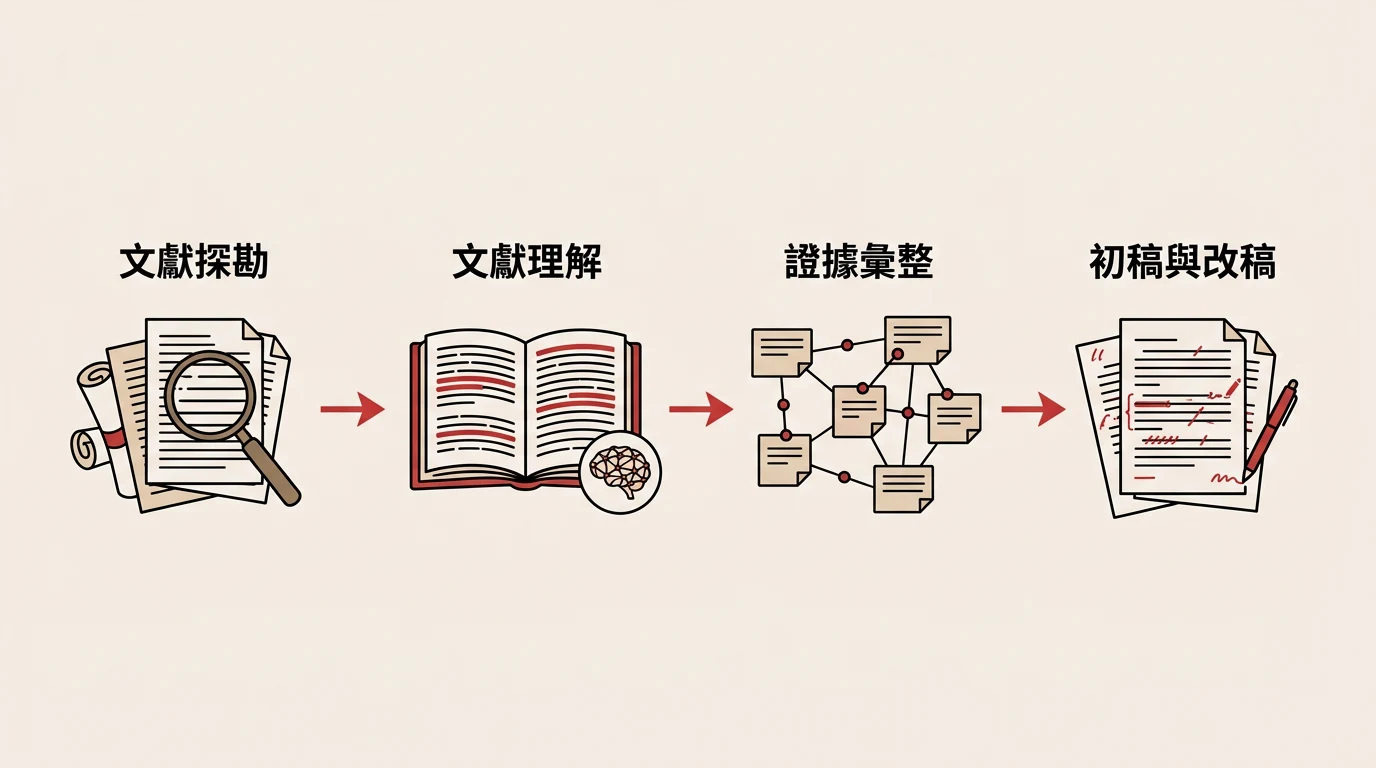
The first is literature exploration.
You must start from the keywords, find the core paper, and then follow the citation network to find important scholars, important theories and research lines. Many people think that Google Scholar gives a list, which is equivalent to completing a literature search. Not really. Google Scholar only helps you find the entry, but will not judge for you which article is the core document, which article is only relevant but not critical, or which article can support your research question.
The second is literature understanding.
What I fear most about reading PDFs is not the English, but that I don’t know what this article has to do with my research after reading it. Many graduate students will underline the abstract, research methods, and research findings, but after drawing them, they still don’t know how to put them into their own literature discussion. This is also the most common academic hurdle: you’ve read a lot but haven’t yet established a relationship.
The third is evidence collection.
Doing research is not about collecting information, but about answering questions. You can’t just say that many documents mention such and such a concept, but you need to be able to answer: Which documents support this point of view? What literature suggests otherwise? Which studies have methodological limitations? What results can be discussed together? What tensions exist between the pieces of evidence?
The fourth is the first draft and revision.
The most painful thing about writing a paper for many people is not that there is absolutely nothing, but that there are too many things and they don’t know how to organize them. You have literature abstracts, your own notes, teacher suggestions, and research materials, but turning them into logical chapters still requires a lot of organizing. Especially in the revision stage, the most troublesome thing is responding to review comments. It is not about changing a few words, but about re-adjusting the focus of discussion, chapter structure and conceptual cohesion.
These four nodes happen to be where NotebookLM can intervene.
3. The four most commonly used uses of NotebookLM by researchers
I will organize the usage of NotebookLM in the research process into four types.
The first is the “Literature Review Accelerator”.
Suppose you are writing a paper and need to quickly master 30 to 50 papers in a day. The traditional approach may be to read each article one by one, make a summary one by one, and then slowly compile a comparison table. But if you put the relevant literature into NotebookLM first, you can ask it to help organize the research questions, theoretical basis, research methods, main findings, and research limitations of each article.
The purpose of this is not to let AI judge everything for you, but to produce a preliminary inventory first. You can think of it as a rough draft of a document map. After you have this draft, you will have more direction when you go back and read the core documents carefully.
The most suitable scenario for it is literature exploration in the early stages of research. When you don’t know the important concepts in a field, NotebookLM can help you quickly organize the outline, allowing you to see the forest first and then decide which trees to delve into.
The second type is “Audio Overview commuting learning”.
This is a feature I really like. What researchers lack most is often not data, but time to digest the data. Many papers are kept in folders, always waiting to be “read again when I have time”. But the problem is, how often do researchers really have free time?
Audio Overview can convert important information on a certain topic into a voice summary similar to a two-person conversation. You can listen to it while commuting, taking a walk, or cleaning your room, turning the originally fragmented time into deep learning time.
This is helpful to researchers because academic understanding does not necessarily only happen at a desk. Sometimes, when you listen to a concept being re-explained with your ears, you will find a new angle of understanding.
However, I would like to remind everyone: Audio Overview is suitable for establishing a general direction and is not suitable for replacing careful reading. It is like a warm-up before entering the literature, and it is also like a voice note for reviewing the research topic. If you really want to quote, analyze, or write into a paper, you still have to go back to the original text for confirmation.
The third type is “Method paragraph expertization”.
This is the feature that many graduate students need most.
The research methods chapter is often the easiest place to write in a paper. Many people will write: “This study uses qualitative research methods and collects data through in-depth interviews.” But this statement is too thin. A truly good methods chapter should clearly state: Why is this method suitable for your research question? How to obtain your information? How are samples selected? How does the analysis process work? How to deal with reliability and validity? How to deal with research limitations?
If you put different textbooks, methodological documents, and sample papers into NotebookLM, you can ask it: “Please compare the definitions, operating procedures, advantages, limitations, and applicable scenarios of the in-depth interview method in these documents, and organize it into a structure that can be used in the method chapter of the paper.”
At this time, NotebookLM can help you advance from “I know I want to use a certain method” to “I know how to write the method with academic support.”
I think this is where it’s very practical. Because many graduate students don’t have the information, but they don’t know how to write credible methods. AI can act as a method chapter partner here, helping you organize scattered concepts into a discussion framework.
The fourth type is the “notebook of all things”.
This concept was inspired by Steven Johnson. Steven Johnson has long studied creativity, knowledge work, and writing. He once mentioned a very important way of working: putting core reference materials in different fields in the same knowledge environment, so that he can ask questions about the materials at any time.
For researchers, this is very important.
Our knowledge comes not only from papers, but also from class notes, verbatim transcripts of speeches, interview records, book excerpts, inspiration fragments and daily observations. In the past, this information was often scattered in different places, and eventually it became “I seem to have seen it, but I can’t find it.”
One of the values of NotebookLM is that it can turn these materials into a conversational knowledge environment. You can create different notebooks for different topics, such as “Research on AI Unemployment Fear”, “Literature Discussion and Writing”, “Generative AI and Platform Governance”, “Qualitative Research Methods”, “Course Design Material Library”, etc. Each notebook is like a theme lab.
When you need to write an article, prepare a lesson, formulate a research question, or respond to review comments, you don’t have to start from scratch. Instead, you can ask questions directly from your own database.
This is what I often say: researchers in the AI era should not just use tools, but build their own knowledge operating systems. I also have a relatively complete development of this concept in “Anytype × Claude: Build Your Own Second Brain”.
4. NotebookLM will not make you a good researcher, but it will amplify your research habits
However, let me be very clear: NotebookLM does not automatically make someone a good researcher.
It amplifies your habits.
If you just throw in a bunch of information and ask, “Please help me write a paper,” it’s likely to produce mediocre abstracts, loose paragraphs, and text that seems reasonable but lacks a sense of the real problem.
But if you already have a research question, a reading direction, a preliminary judgment, and are willing to ask questions repeatedly, then NotebookLM will be very useful.
For example, don’t just ask: “Please help me organize these documents.”
You can ask instead: “Based on these literatures, please sort out three explanation paths for the fear of AI unemployment, and compare their differences in theoretical assumptions, research methods, and research limitations.”
Don’t just ask: “What is this article about?”
You can ask instead: “Are the research questions, theoretical basis, method design, and main findings of this article consistent? Are there any gaps in it that can be extended by my research?”
Don’t just ask: “Write a literature review for me.”
You can ask instead: “Based on this information, please help me plan a chapter structure for literature review. Each section is required to explain its explanatory function and how it connects to my research questions.”
This is the key difference.
AI tools are not magic, they are leverage. Where you place the lever determines what you lever.
5. The true capabilities of AI academic research: from Prompt to system
Many people still talk about the academic application of AI at the level of Prompt.
Of course, Prompt is important. You need to be able to give instructions, explain tasks clearly, provide background, specify formats, and ask AI to make comparisons, limitations, and reflections.
But for researchers, just placing prompts is not enough.
The truly advanced approach is to establish a system.
The so-called system includes at least four things.
First, the data system.
You need to know which data should be put into NotebookLM, which data should be put into Zotero, which notes should be put into Obsidian or Notion, and which original data should be saved separately. Don’t mix everything together, otherwise the more information you have, the harder it will be to use.
Second, the questioning system. You will need to design different questions for different stages of research. The literature exploration stage asks “What are the core concepts in this field?”; the literature understanding stage asks “How does this research construct an argument?”; the method design stage asks “Is this method suitable for my research question?”; and the writing stage asks “How do these materials form a persuasive chapter?”
Third, the output system.
The content sorted out by AI for you should not just be viewed. You’ll want to turn it into a table, summary, cards, chapter outline, writing material, or research memo. Only things that can be saved, recycled, and reorganized can truly enter your knowledge system.
Fourth, the judgment system.
This is the most important thing. AI can help you sort it out, but it can’t take responsibility for you. You need to be able to judge whether its abstract is accurate, whether the concepts are confusing, whether the citation needs to be returned to the original text for confirmation, whether the discussion is too jumpy, and whether the suggestion meets the purpose of your research.
Without judgment, AI will just make you produce the wrong content faster. Only with judgment can AI become your research co-pilot.
6. A set of implementation procedures for researchers
If you are a graduate student, teacher, research assistant, or preparing a thesis and submission, I would suggest that you start this way.
Choose a clear topic first and don’t throw all the information into it at the beginning. For example, if you want to study “Application of AI tools in academic writing”, first create a NotebookLM notebook and only put information related to this topic.
Then enter the three types of data.
The first category is core literature, such as the 10 to 20 most important papers. The second category is methodological materials, such as research methods textbooks, sample papers, or research design articles recommended by your teacher. The third category is your own materials, such as class notes, research ideas, lists of questions, or drafts you have written.
Then, don’t rush to ask AI to write articles. You can ask it first: “Please help me organize the core concepts in these materials and point out the relationships between concepts.”
Then ask again: “Based on this information, please sort out the current awareness of the three main issues in this research field.”
Then ask further: “If I want to write a journal article, what three research angles can these data form? What are the advantages and limitations of each?”
Finally, I started writing: “Based on the above arrangement, please help me design a document discussion chapter structure. Each section is required to have a clear discussion task and explain which sources of information can be cited.”
In doing so, you are not letting AI replace your research, but rather letting AI become a research partner who can accompany you to organize, compare, interrogate and generate preliminary structures.
7. Three misunderstandings that researchers should avoid
The first misunderstanding is to regard NotebookLM as an essay writing tool.
This is the most dangerous usage. Because the value of academic research lies not in generating words, but in asking questions, building arguments and responding to knowledge gaps. AI can assist with organizing, but it cannot complete your academic responsibilities for you.
The second misunderstanding is to believe all abstracts of AI.
Even if NotebookLM answers based on the information you uploaded, it does not mean that its understanding is completely correct every time. In particular, theoretical concepts, methodological details, research limitations, and citation context must be returned to the original text for confirmation. AI answers can only be used as drafts and clues, and cannot be directly used as the final basis.
The third misunderstanding is that the more information you have, the better.
Many people think that the more PDFs they put in, the more powerful they will be. This is not the case. If the data is too complex, the output will become blurry. The really effective way is to create notebooks based on tasks. It is best for each notebook to have a clear theme, clear purpose and manageable data range.
A good NotebookLM notebook should not be like a utility room, but like a research room with a clear theme.
8. Researchers in the AI era must redesign their own learning methods
I often feel that the biggest change that AI brings to academic research is not that we read less books, but that it gives us the opportunity to redesign the way we read and think.
In the past, we often read literature in the same way: find one article, read one article, summarize one article, and organize one article.
Now we can study it in a more three-dimensional way.
We can first use AI to build an overall map, and then go back and peruse the core literature. You can first listen to the Audio Overview to establish a feel, and then proceed to the original text analysis. You can compare methodology textbooks and sample papers together to find out how to write your own methods chapter. You can put interview transcripts, research notes, and theoretical documents in the same notebook and ask: “What are the possible conversations between these materials?”
This is not a trick, but a new approach to knowledge work.
The real question is not: “Will AI make research too easy?”
The real question is: “When the cost of information collection drops, are we willing to put more effort into higher-level thinking?“
9. Research on the core spirit of the co-pilot system
I will summarize the research application of NotebookLM in one sentence: it does not complete the research for you, but helps you build a knowledge environment that can be questioned repeatedly.
Good research is not generated once, but grows out of repeated readings, comparisons and revisions. The value of NotebookLM is not to give you the perfect answer at once, but to allow you to enter the thinking scene faster.
You can think of it as a research assistant, helping you organize information.
You can also think of it as a reading club partner to discuss literature with you.
You can also use it as a method chapter coach to remind you where you need to add theoretical basis.
You can also think of it as a long-term accumulated research notebook, so that your knowledge no longer starts from scratch every time.
But in the end, you are the one who really decides the quality of your research.
Because AI can help you see the connections between data, but it cannot decide for you what issues are worth studying. AI can help you organize the literature, but it cannot assume academic judgment for you. AI can help you generate a first draft, but it cannot help you form your own opinions.
10. Conclusion: Don’t just learn tools, learn to create your own research workflow
If you are doing research, I would recommend that you stop thinking of AI tools as assistants that you use occasionally to ask questions.
You should start thinking: How to incorporate AI into your research process?
When doing literature exploration, it can help you find context.
When understanding literature, it can help you break down the structure.
It can help you compare ideas when compiling evidence.
It can help you organize your first draft and revision.
It can even turn materials into listenable learning content during commuting and odd time.
When these links are connected, AI is not just a tool, but a research co-pilot system.
In this era, academic research will not become effortless because of AI. On the contrary, it will test the researcher’s problem awareness, judgment ability and system design ability.
Tools will change, platforms will change, and functions will change, but one thing will not change: truly good research always comes from clear questions, solid data, rigorous methods, and the patience of researchers who are willing to continue thinking.
NotebookLM is just the beginning.
More importantly, we must learn to use AI to reorganize the way we work with knowledge, so that research is no longer just a lonely effort, but a reliable system to accompany us moving forward.
Briefing: AI Toolbox for Academic Research
I have compiled the concepts corresponding to this article into an interactive briefing, which is convenient for you to use directly when preparing lessons, reading clubs, or training within the team. The card below will not be loaded into the embedded page by default. The entire set of presentations will be pulled in after clicking it to avoid affecting the reading speed.
Slide Deck · Interactive Academic Research AI Toolbox: A Co-pilot System for Researchers ▶ Click here to load the interactive presentation, or open the full-screen version in New tab.
You are welcome to share the content of the presentation freely. Please indicate the source when citing. It is recommended to use a desktop browser for interactive operations.
I have included all the links that researchers are most likely to get stuck on. If you find this article helpful, you are welcome to visit my personal website or follow my business card page for more information. My own long-term content platform content.tw mainly accumulates writing and content creation methods, and one-person company solo.tw offers various online classes and workshops for creators and independent workers. The academic co-pilot system discussed in this article is exactly the way of working that I hope everyone can take with them in the long term.