Five things that AI cannot do: LinkedIn CEO personally taught the 5C framework and became irreplaceable in the AI era
Being afraid is completely understandable, but being afraid is completely unhelpful. ──Aneesh Raman, chief economic opportunity officer at LinkedIn
Originally published in “Technology Island (opens in a new tab)”
A while ago, after an internal corporate training in the financial industry, a senior assistant manager stopped me. He hesitated, then asked, “Consultant, if AI can do everything, what else can we do?”
I was silent for a few seconds. It’s not that I can’t think of an answer, it’s because I’ve heard this question no less than twenty times in the past six months - including in the EMA class at National Chengchi University, after a lecture at Sun Yat-sen University, and in workshops in various industries. The person asking was different each time, but the look in their eyes was the same, revealing real anxiety.
The assistant manager told me that less than three months after his team introduced AI tools, two entry-level positions had already been redefined—to put it bluntly, AI had taken over most of the daily work of those two people.
Of course, this kind of anxiety is not an isolated case. According to the World Economic Forum’s (WEF) 2025 Future of Jobs Report (opens in a new tab), approximately 92 million jobs globally will be eliminated by AI and automation by 2030. McKinsey’s 2025 survey (opens in a new tab) further shows that 88% of companies have introduced AI into at least one business function.
But the same WEF report also pointed out another figure: AI will create about 170 million new jobs, a net increase of 78 million.
In other words, the question was never, will AI take your job? The question is: are you ready to take advantage of those 170 million new opportunities? This is exactly what I emphasized repeatedly in “A Cruel Watershed in the AI Era” - also faced with AI, some people’s income is cut in half, while some people double their growth. The difference is not in tools, but in abilities.
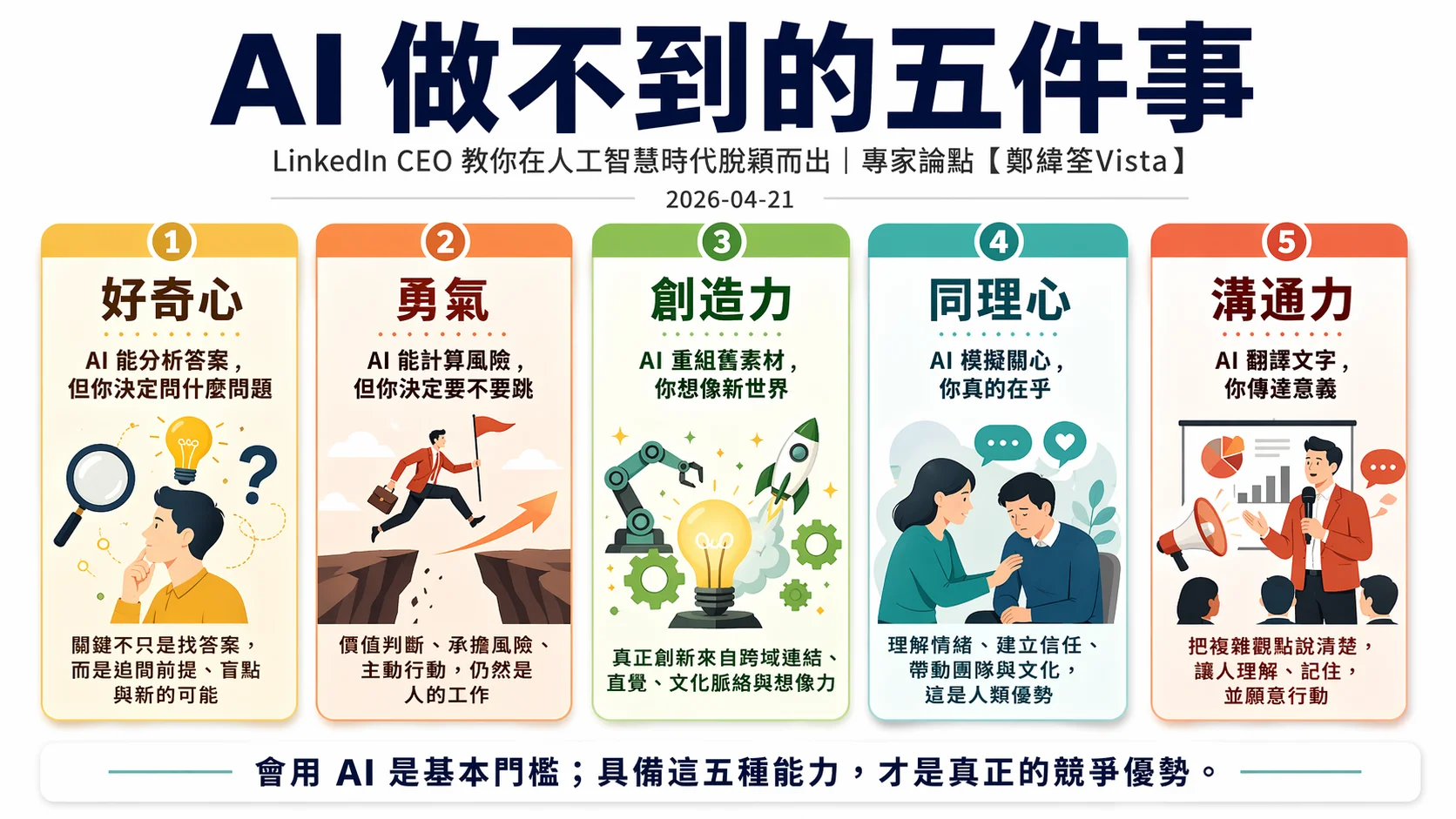
LinkedIn CEO Ryan Roslansky and Chief Economic Opportunity Officer Aneesh Raman published a new book “Open to Work: How to Get Ahead in the Age of AI (opens in a new tab)” at the end of March 2026, giving a very clear answer. After interviewing neuroscientists, organizational psychologists, behavioral economists, and talent leaders, they identified five human capabilities that AI cannot replace—what they call the 5C Framework:
- Curiosity
- Courage
- Creativity
- Compassion
- Communication
Aneesh Raman said something in the book that I think is worth chewing on: “It’s completely understandable to be afraid, but it’s completely unhelpful to be afraid.”
Today I want to break down these five Cs one by one and tell you readers: these are not five empty slogans, but five specific abilities that you can start practicing today.
The first C: Curiosity─AI can analyze the answers, but you decide what questions to ask
Everyone knows that AI is good at finding patterns in existing data. You give it a million sales records, and it can tell you in a few seconds which product sold best in which season?
But it doesn’t ask, “Why do we only sell these products?”
That’s the nature of curiosity—it’s not about finding answers, it’s about asking the right questions. I also talked about the same thing in “When AI makes answers cheap, what is really valuable is whether your questions are accurate enough” - when the cost of answers approaches zero, the value of asking questions becomes rare.
Greg Dyke is the 13th President of the BBC. Before he took office, he did something that surprised everyone: he spent five months visiting BBC offices across the UK and chatting directly with grassroots employees. It’s not an inspection or an assessment, but really asking questions. “What do you think is the biggest problem with the BBC?” “If you were the boss, what would you change first?” As a result, in his first year in office, the ratings of both BBC1 and BBC2 increased.
To be honest, even now, no business consultant or data analysis tool would recommend that a new CEO spend five months chatting with employees. But, human curiosity will.
Deloitte found in a 2025 survey (opens in a new tab) that high-performing team members were 2.5 times more likely than low-performing teams to explore unfamiliar ideas and continually learn new skills. The WEF 2025 report also states that 50% of employers have listed curiosity and lifelong learning as core workplace competencies.
How can you practice? Develop the habit of asking second-level questions. When you get an AI-generated analysis report, don’t just look at the conclusion. Ask yourself first:
- What are the assumptions underlying this report? What if the premise is wrong?
- What aspects does it fail to analyze?
- If I were a customer, what questions would I ask differently?
Curiosity is not a talent, it is a habit. It’s a muscle you can train deliberately.
The second C: Courage─AI can calculate risks, but you decide whether to jump
AI can tell you that an investment has a 63% chance of success and a 37% chance of failure, but it won’t decide for you whether to invest or not.
Because whether it is worth it or not is a human judgment, never a mathematical question.
In 2006, Huang Renxun made a decision that almost everyone thought was stupid at the time: launch CUDA (opens in a new tab), a platform that allows GPUs to do general computing. This decision increased NVIDIA’s costs by 50%, and its market value fell from US$12 billion to US$2 to US$3 billion. Investors are skeptical and the media is bearish.
But he sees a world where AI doesn’t yet exist, and where GPU computing could become the future of infrastructure. Eighteen years later, ChatGPT is running on approximately 30,000 NVIDIA GPUs. NVIDIA has a market capitalization of over $3 trillion.
Another example is Satya Nadella. When he took over as Microsoft CEO in 2014, he faced a company with a rigid culture, a failed mobile phone strategy, and low market confidence. He made a bold decision: to give up his mobile phone and go all-in on the cloud and AI, and later invested in OpenAI. He once said: “We needed courage in the face of opportunity.” Today, Microsoft’s market value has grown from about 300 billion to more than 3 trillion US dollars.
McKinsey’s analysis points out that more than 70% of the skills employers value apply to both automatable and non-automatable tasks. The difference isn’t in the skills themselves, but in when humans decide it’s time to risk taking a new path. I shared in the article “Make good use of AI Agent digital clones” that the real value of middle- and senior-level managers is shifting from “execution power” to “command power” and “decision-making courage.”
How can you practice? Start with a safe adventure.
- In your next meeting, bring up that point you’ve always wanted to say but were afraid to.
- Take the initiative to pursue a project that you are not 100% ready for
- When the AI gives you three safe options, ask yourself: Is there a fourth, bolder possibility?
Courage is not the absence of fear, it is the ability to act despite being afraid. Like Raman said – it’s understandable to be afraid, but it’s not helpful to be afraid.
The third C: Creativity──AI reorganizes old materials and you imagine a new world
Well, this is probably the most misunderstood of the five Cs. When many people see that AI can draw pictures, write poems and compose music, they feel that even creativity has been replaced.
Not really.
A study published in the journal “Nature (opens in a new tab) in 2023 showed that in divergent thinking tests, the average performance of AI is indeed better than that of ordinary people - but the most creative humans still surpass the most advanced AI.
Why? Because the creation of AI is essentially a recombination, it is nothing more than extracting patterns from training data and then arranging them in new ways. But human creativity involves intuition, cultural context, emotional resonance, and the ability to imagine things that never existed.
Research in the 2025 Frontiers (opens in a new tab) journal also discovered an interesting phenomenon: in human-computer collaboration design projects, senior designers always maintain dominance over the creative process. What AI is best at is late-stage execution and refinement, not early-stage concept development.
I often use an analogy in class: AI is a super powerful kitchen assistant that can prepare ingredients, season, and stir-fry according to recipes. But if you want to invent a dish that has never been made before, it requires the chef’s intuition, experience and courage.
Deloitte’s survey echoes this: 50% of high-performing teams learn from failures rather than holding them accountable, compared to only 21% of low-performing teams. Creativity requires room for error, and this space is a cultural construct of human beings, not something that algorithms can provide.
How can you practice? Deliberately make cross-disciplinary connections.
- Read a book outside your major every month
- When you are faced with a marketing problem, ask yourself: What would a doctor think if he came to see this problem?
- Treat AI as your creative research assistant, letting it help you collect materials, but you decide how to connect them
The core of creativity is not the quantity of output, but the quality of connections.
🎯 Do you want to turn 5C into a visible work? Start with a content system
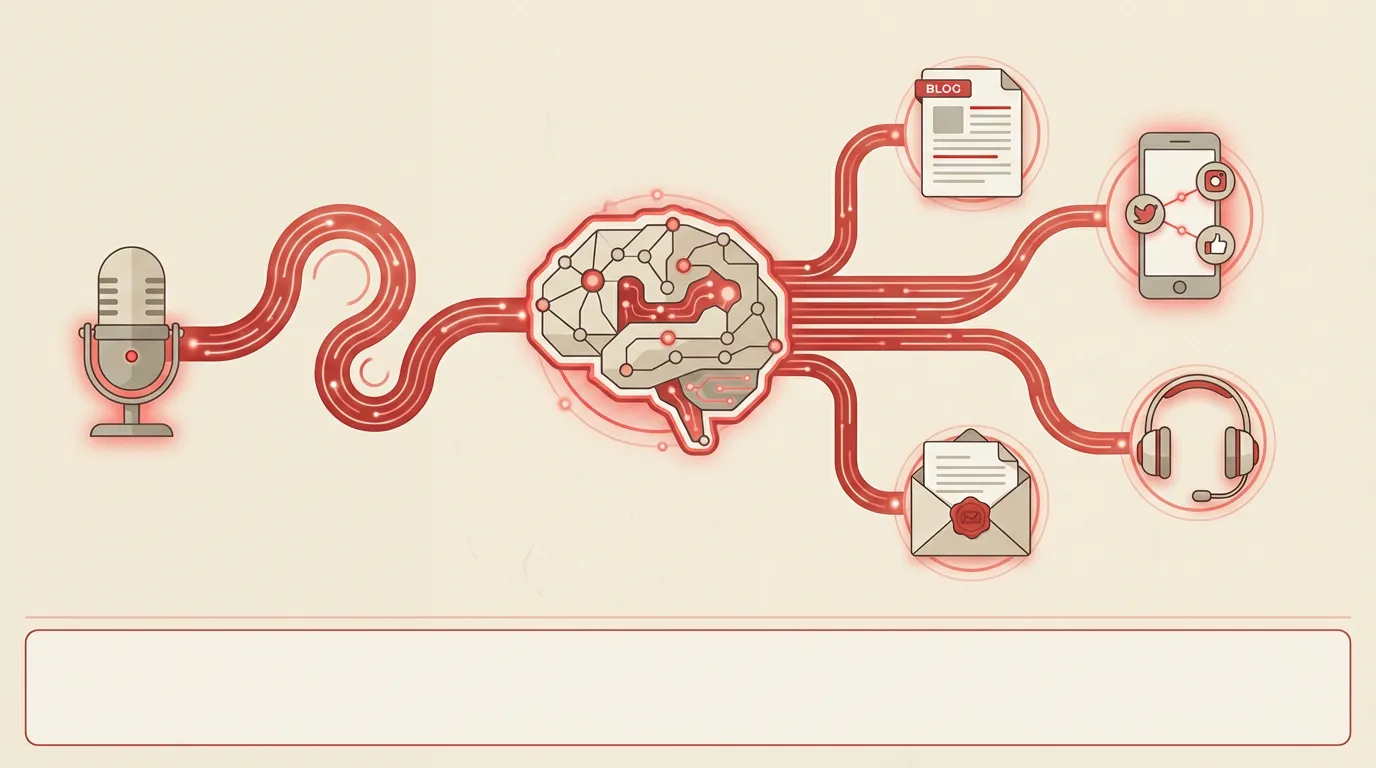
5C is the underlying capability, but for the capability to be seen by the market, there must be a system that can produce it stably. The “AI Content Production System Workshop” I designed is to string the C’s of curiosity, creation, and communication into a repeatable content production line - one material, running in six formats, covering the complete funnel from e-newsletters, communities, podcasts to courses.
👉 Learn about the course content now: vista.tw/courses/ai-content
The fourth C: Empathy──AI simulates caring, you really care
This is probably the most underrated of the five Cs.
Many people think that “empathy” sounds like chicken soup for the soul and has nothing to do with workplace competitiveness. But the data tells us the exact opposite story.
According to research from CCL (Center for Creative Leadership) (opens in a new tab):
- Employees with empathetic managers are 76% more engaged
- Employees are 4.5 times more likely to stay when they feel understood
- Teams in an empathetic environment are 2.5 times more creative
- 95% of employees say they would rather stay with an organization that demonstrates empathy
This is not soft power, this is hard data.
The best case may still be Satya Nadella. The first thing he did after taking over as Microsoft CEO was not to adjust product strategy, but to change the culture. He asked all senior executives to read a book - Nonviolent Communication - and then promoted a “growth mindset” within the company to replace the internal competition and mutual attack culture of the Steve Ballmer era.
Many business analysts believe that the core factor in Microsoft’s return to the top from the lost decade is not its cloud strategy, but its cultural transformation. The starting point for cultural transformation is a CEO’s empathy.
An AI can write a comforting letter in a polite tone, but it won’t actually worry about your health while you’re working until three in the morning. It can analyze employee satisfaction data, but it won’t feel the exhaustion behind your words in a one-on-one interview.
This ability to really care is the basis for building trust. And trust is at the core of all business relationships.
How can you practice? Before every important conversation, take thirty seconds to ask yourself: “What does the other person need most right now?”
- It’s not what you want to say, but what the other person needs to hear.
- Don’t rush to give advice, but first understand why he is anxious
- Instead of using AI to analyze his performance data, sit down and ask him: “How are you doing lately?”
Empathy is not about pleasing, it is about understanding. And understanding is the prerequisite for all effective actions.
The fifth C: Communication─AI translates text and you convey meaning
I put communication last, not because it is the least important, but because it is the amplifier.
Your curiosity, courage, creativity, empathy…if you can’t explain it clearly, they only exist in your mind. To put it bluntly, an idea that is not conveyed does not exist.
There is a data that I find very convincing: when you use statistics to communicate, the audience only remembers 5-10% of the content; when you use stories to communicate, the memory rate jumps to 65-70%.
AI can help you translate a Chinese report into English, and it can help you organize a clearly structured briefing outline. But it doesn’t help you tell a story in the boardroom so everyone understands why this project is worth investing in? It also can’t help you find the keywords that make your subordinates’ eyes light up during one-on-one interviews.
I mentioned in “Four-step methodology for AI copywriting” - AI gives 70% of the level, and the remaining 30% is your insight, your unique tone, and your refusal to compromise. That 30% gap is the stage for communication.
LinkedIn’s 2026 Skills Trends Report (opens in a new tab) also confirms this: cross-department coordination, leadership communication, stakeholder management, and public speaking are all rapidly growing skills. What’s more, 45% of job openings now prioritize skills over academic qualifications. In other words, communication is the skill that is most easily seen and the one that makes the difference fastest.
How can you practice? Practice speaking clearly in one sentence.
- Before each email, write the core message in one sentence, and then ask yourself: Is this sentence enough if you delete everything else?
- Prepare an elevator briefing before a meeting – If you only had thirty seconds, what would you say?
- Treat AI as your first draft generator, but the final polishing and storytelling is always yours
The essence of communication ability is not the ability to write, but the ability to turn ideas into actions. If you want to extend this set of communication skills to content management, Content Studio (opens in a new tab)’s tools and cases can give you a lot of reference - from e-newsletters to social posts, the “last mile” of content is actually this 30%.
In addition to 5C, AI empowers rather than replaces
A 2023 joint study by Harvard and BCG has demonstrated this gap: Using GPT-4 consultants’ work quality has improved by 40% and is 25% faster. But people who blindly relied on AI saw their performance drop by 23% on complex tasks that required judgment.
This is why being able to use AI is the basic threshold, but having the 5Cs is a competitive advantage. If you want to see more specific AI application paths in the workplace, you can refer to the “AI Action Guide to Learning and Application” I wrote.
Having said that, the senior associate manager who stopped me after training in the financial industry actually asked the wrong question.
He asked, “AI can do everything, what else can we do?” But the real question should be: “AI can do everything, what should we do more?” The answer is these five things. Ask questions curiously, make decisions bravely, think creatively, understand others empathetically, and communicate ideas clearly.
Anthropic CEO Dario Amodei (opens in a new tab) said something I like very much: “The most powerful use of AI is not to replace humans, but to give humans superpowers.”
But superpowers require a prerequisite, that is, you must first know what your superpower is?
These five Cs are your starting point. No need to wait for perfection to begin. When you go to work tomorrow, ask one more “why”.
Yes, that’s where it all started.
Further reading:
- A cruel watershed in the AI era: 5% doubled, 95% cut in half
- AI action guide to learning and application: A practical manual for professionals
- When AI makes answers cheap, what’s really valuable is whether your questions are accurate enough
- Make good use of AI Agent digital clones to upgrade from mid- to senior-level executives to Agent Commander-in-Chief
- Four-step methodology for AI copywriting
External resources:
- This article was originally published in “Technice Island” (opens in a new tab)
- WEF Future of Jobs Report 2025 (opens in a new tab)
- “Open to Work: How to Get Ahead in the Age of AI” (opens in a new tab)
- AI Content Production System Workshop (solo.tw)
- Vista Consulting and Corporate Training Services (vistacheng.com) (opens in a new tab)
Next step
Bring this topic to your team
Vista Cheng speaks and runs workshops on AI workflows, writing and content systems for companies, schools and public agencies.