Your next customer is not a human: When AI agents start shopping for consumers, brands must relearn to be seen by machines
This article was originally published in the expert argument column of “Technology Island (opens in a new tab)”.
In the past twenty years, one thing that marketers have been most concerned about is how to grab people’s attention. We study when consumers scroll on their phones, what kind of titles will be clicked, and what kind of thumbnails can make people stop for three seconds? The entire digital advertising industry is essentially a war for eyeballs.
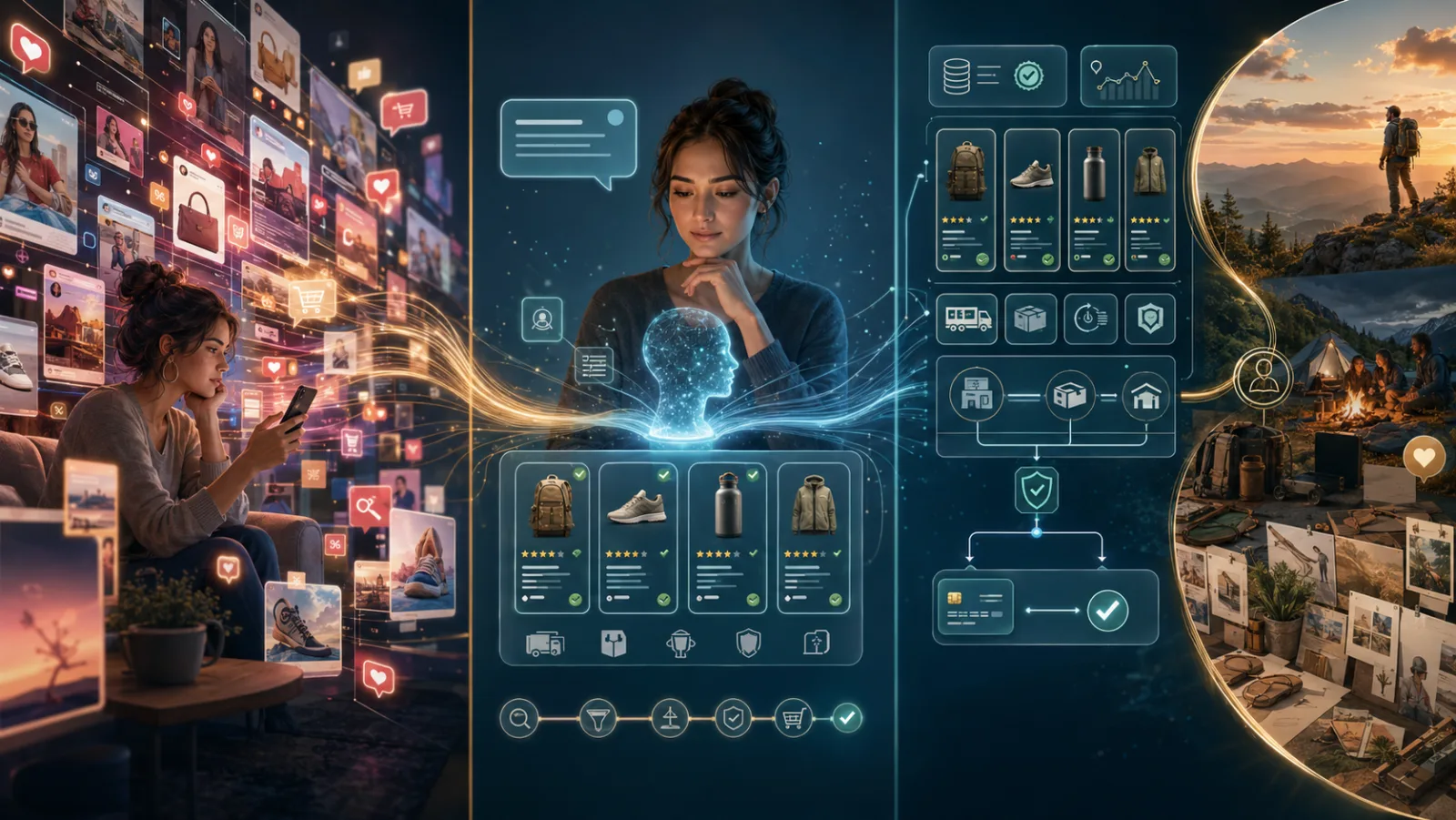
But there is a change taking place that may be rewriting the rules of this war: more and more purchasing decisions will no longer be completed by humans in person, but will be handed over to an AI agent who does the work for you.
The scale of this trend is greater than most people imagine. Gartner predicted at the IT Symposium/Xpo conference at the end of 2025 that by 2028, AI agents will mediate more than $15 trillion in B2B procurement spending, and 90% of enterprise purchases will be handled by agents by then. McKinsey estimates that by 2030, retail transactions completed through agent collaboration could generate $3 trillion to $5 trillion in annual revenue. This is no longer a niche technological experiment, but a structural shift.
A more specific scenario is this: when companies such as OpenAI, Google, and Amazon gradually add the ability to directly place orders and check out into their assistants, when consumers want to buy a pair of hiking pants, they may no longer open five shopping websites to compare prices one by one, but say to the assistant: Help me find a pair of hiking pants that are less than 2,000 yuan, waterproof, have good reviews, and can be delivered before Friday, and then place the order directly. Next, the entire process of selection, price comparison and checkout is completed by agents behind the scenes.
This means that the first-line audience of brand marketing is quietly changing from humans to machines.
From eye-catching to machine-readable
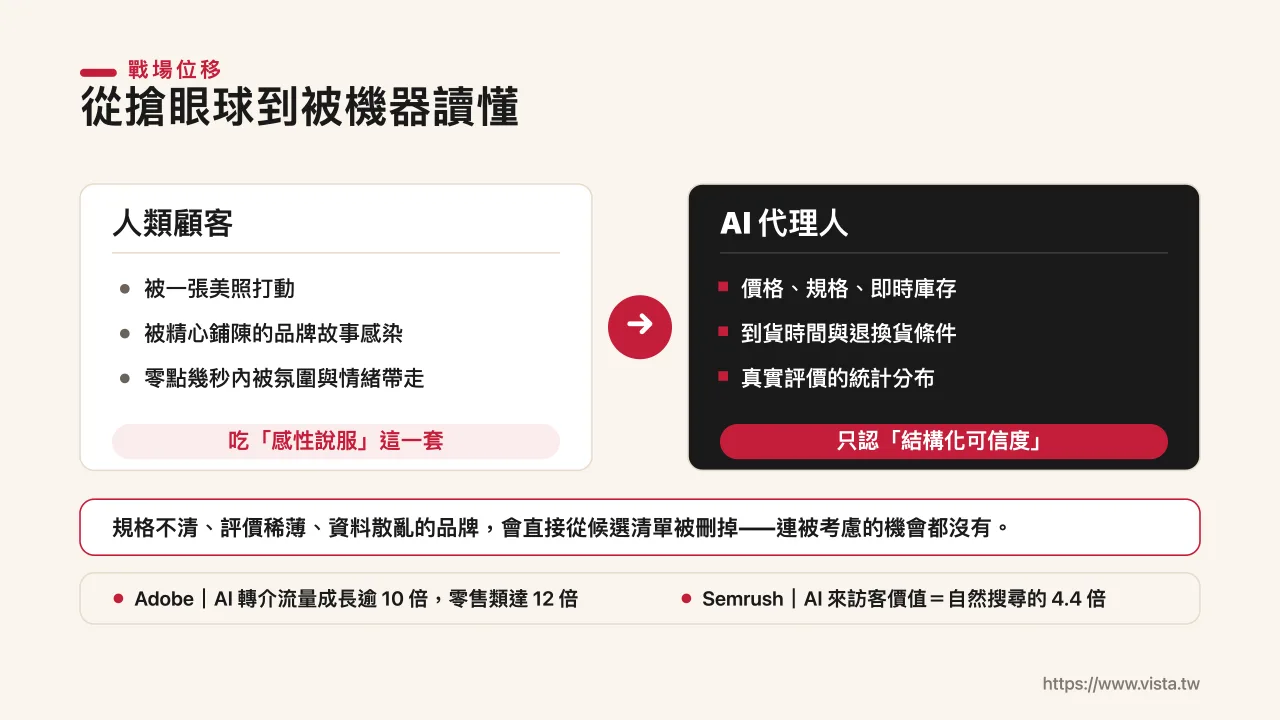
In the past, the brand’s exposure logic was designed to be seen by others. Beautiful main visuals, captivating copywriting, and carefully laid out brand stories are all designed to impress an emotional, impulsive, and easily infected person within a few tenths of a second.
However, agents don’t do this. It won’t be moved by a beautiful photo, nor will it bring tears to its eyes because of your brand story. What it wants is structured, readable and comparable information: price, specifications, inventory, arrival time, return and exchange conditions and the statistical distribution of real reviews.
In other words, when customers become agents, the marketing battlefield moves from perceptual persuasion to structured credibility. A brand with no clear specifications, thin reviews, and scattered information may be able to get away with a good-looking image in front of human customers; but in front of agents, it will be directly deleted from the shortlist without even a chance to be considered.
This is not an abstract deduction. According to data released by Adobe Digital Insights (ADI), from the second half of 2024 to the beginning of 2025, the referral traffic brought by AI in the United States will grow more than ten times, and the retail category will even grow twelve times, and will double approximately every two to three months. A study tracked by Semrush and digital marketing agencies found that visitors who were recommended inbound through AI tools (such as ChatGPT, Perplexity, Google AI Overviews) had an average conversion rate that was 4.4 times higher than that of traditional organic search visitors.
In other words, traffic is being redistributed, and the guests brought in by AI are more valuable. For brands, the other side of this sentence is: not being seen or quoted by AI is equivalent to disappearing from a rapidly growing entrance.
The giants have already laid out the infrastructure
If you think all this is still far away, look at the actions of these companies over the past year and you will know that the foundation is already grouting.
In September 2025, OpenAI launched Instant Checkout and jointly developed a set of open source agency business protocols with Stripe, allowing ChatGPT’s more than 700 million weekly users to place orders directly with merchants in the dialog box. More than a million merchants on Shopify, as well as brands like Glossier, SKIMS, Spanx and more, are joining. Then, at Google I/O in May 2026, Google launched the “Universal Cart”, which allows users to add products to the same shopping cart across Search, Gemini, YouTube and even Gmail. The product map connected behind it covers more than 60 billion products. The first brands to support agent checkout include Nike, Sephora, Target, and Walmart. In the same month, Amazon integrated its original shopping assistant and launched Alexa for Shopping, which can query, compare prices and place orders on behalf of users, and even schedule automatic purchases when the price is available.
Having an assistant alone is not enough, there are also people who take care of the payment process. Mastercard announced Agent Pay in April 2025, launching tokens bound to specific agents, merchants and authorization policies, allowing verified AI agents to make payments on behalf of consumers; Visa also launched corresponding smart commerce solutions. In other words, from finding products, adding shopping carts to swiping cards to check out, these payment giants are actively building an entire fast road that is run by machines, and it is being paved section by section by these giants.
Take Amazon’s shopping assistant Rufus as an example. More than 300 million customers will use it in 2025. The shopping process including Rufus has a conversion rate that is more than three times that of the general process. Amazon estimates that it has driven about $12 billion in incremental sales. When a robot shopping guide can really triple the conversion rate, no platform will put the brakes on it. Zooming out, according to Salesforce’s holiday shopping data, during the 2025 holiday period, AI agents have quietly participated in placing about 20% of the world’s online orders, amounting to hundreds of billions of dollars. In other words, machines helping people buy things have been happening around you and me since last Christmas.
is referenced by AI and is becoming a new order
For marketers, the most familiar word in recent years is SEO: How to get Google to rank you on the first page? But when more and more people look for answers through AI assistants instead of search engines, the question changes from how to be ranked by search engines to how to be cited and recommended by AI?
These are not two things, but two phases of the same trend. First, the content must be read, trusted, and quoted by AI, which is GEO, generative engine optimization that has been discussed in the past two years; then, when AI not only answers, but also directly helps you buy, being quoted will further turn into being purchased. Similarweb’s observation is that the conversion rate of e-commerce traffic referred through ChatGPT is about twice that of natural search. If a brand is absent from AI’s recommendation list for a long time, it will not only lose traffic, but also the order itself.
For small and medium-sized enterprises and one-person companies, this is actually an underestimated opportunity. In the past, competing for rankings on Google often involved an arms race between budget and content. It was difficult for small brands to win over large companies. But what agents care about is whether the information is clear, the specifications are complete, and the reviews are true. These are precisely where flexible small brands can do things quickly and solidly. Agency business has the opportunity to bring competition back to who can do the basics better, rather than who has a bigger marketing budget.
Don’t rush to cheer, be careful of three basins of cold water
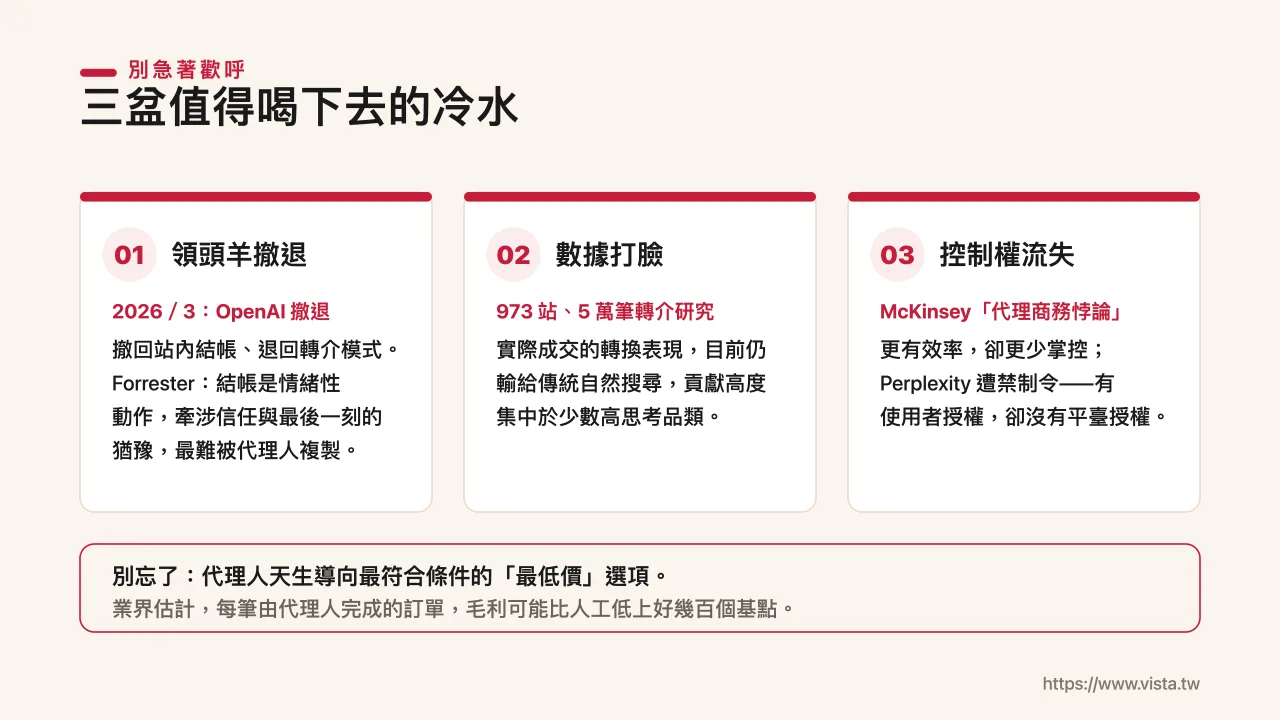
At this point, you may be ready to fully embrace agency business. But a discerning observer should look twice in the opposite direction at this time. Because on this road, several basins of cold water have been poured on me recently.
The first basin of cold water came from the leader himself. In March 2026, OpenAI, the leader in agency commerce, quietly withdrew the function of direct checkout within ChatGPT and changed it back to directing users to the merchant’s website or app, which is equivalent to returning to a simple referral traffic model. The analysis by Forrester, a research organization, hits the nail on the head: checkout is the most difficult stage for agents to copy, because placing an order is actually an emotional action involving trust, compliance and last-minute hesitation, and it is easy to lose the customer’s patience before completion. Its survey also shows that even among Generation Z, who are most willing to try new things, using AI assistants to complete purchases is still the least common usage scenario.
The second basin of cold water comes from academia. A study conducted by the University of Hamburg and the Frankfurt School of Finance and Management in Germany on 973 e-commerce websites around the world and more than 50,000 ChatGPT referral transactions found that from the perspective of actual transactions, the conversion performance brought by ChatGPT is currently still inferior to traditional natural search. In other words, AI shopping guides are very vocal, but their actual contribution to orders is still very small at this stage and highly concentrated in a few categories that require careful consideration. It is a dangerous misjudgment to regard agency business as a tsunami that will eat everything tomorrow.
The third basin of cold water is about control. When the transaction is handed over to agents, the brand gains efficiency but loses direct relationships with customers. McKinsey calls this dilemma the paradox of agency commerce: more efficiency, but less control. BCG also reminds that brands that rely too much on third-party agent platforms will gradually lose visibility, relevance, and the most precious opportunity to talk directly with consumers. Looking further down the road, agents are naturally inclined to direct traffic to the lowest-priced option that meets the conditions, which will compress profits. The industry estimates that the gross profit of each order completed by an agent may be hundreds of basis points lower than that completed manually. Giving up the entire customer relationship and pricing power is never a good deal.
Not to mention trust and safety. In March 2026, a federal judge in San Francisco issued an injunction prohibiting Perplexity’s browser agent from logging in and shopping on Amazon on behalf of consumers. The key dispute is: there is user authorization but no platform authorization. When machines begin to act for people, who has the authority to act for whom and where the boundaries are will be issues that will continue to be debated in the next few years.
So, what should brands do now?
After drinking this cold water together, the conclusion is actually very clear. Agent commerce will not replace all human shopping overnight, just as e-commerce did not make all physical stores disappear. It is more like growing a new fast road on the existing consumption map, driven by machines. Smart brands won’t go all-in, but they won’t pretend not to see it, either. Specifically, there are three things worth starting to do now.
First, make the basic skills so that the machine is willing to read. Check whether your product information is structured, whether the specifications are complete, whether the reviews are true and rich, and whether the inventory and arrival information are real-time and accurate. These things that used to be regarded as logistical chores will directly determine whether you are put on the shortlist in the age of agents. This is a threshold, not a bonus question.
Second, upgrade from business visibility to business citation. Don’t just think about how to be seen by people, start studying how to be read and recommended by machines. Let your content, your opinions, and your products become objects that AI will actively reference when answering relevant questions. For smaller brands with limited resources, this could be the fairest reset of competition in a decade.
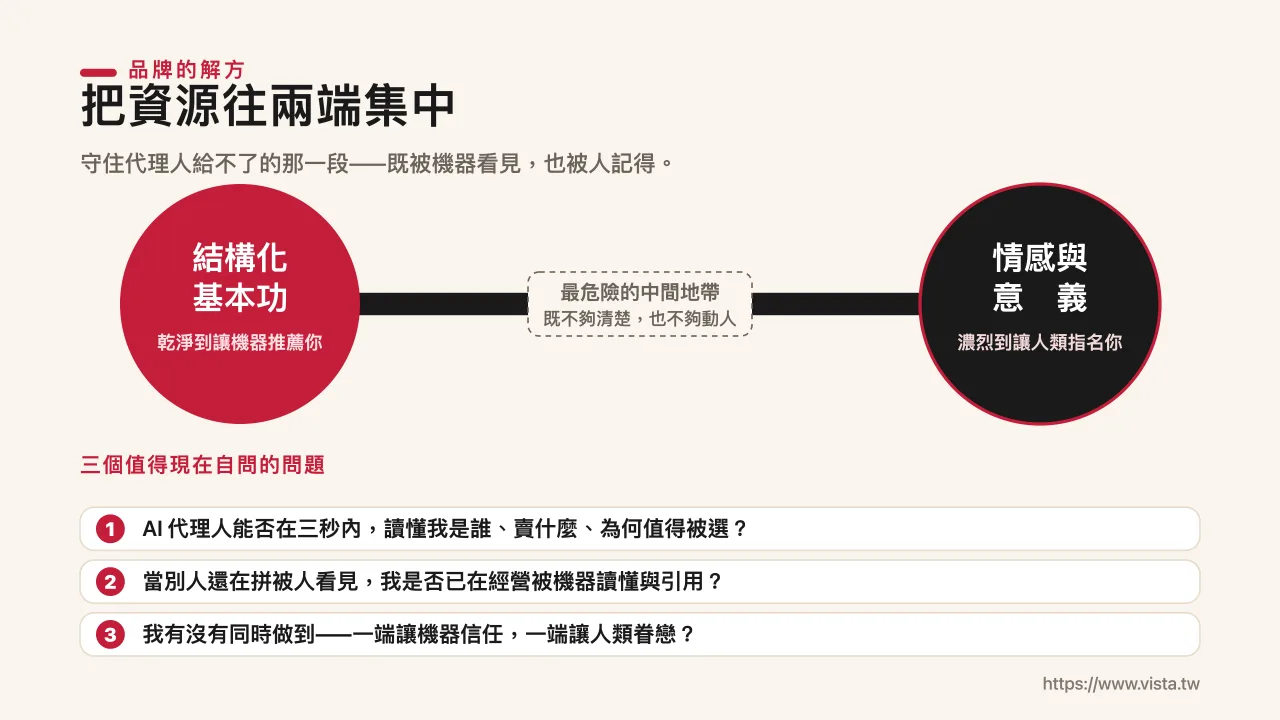
Third, and most importantly, concentrate resources at both ends and guard the area that agents cannot provide. Agents are great at dealing with clear needs: I want a pair of hiking pants that meet these criteria. But it’s not good at dealing with vague cravings: I wanted a brand that would make a weekend trip to the mountains feel more ritualistic. The former is a specification question, and the latter is an emotion and identity question. When the transaction layer is taken over by agents, the real moat of the brand will be concentrated at two ends: one end is the structured basic skills that are clean enough that machines are willing to recommend you, and the other end is the emotions and meanings that are strong enough that humans are willing to name you. Brands caught in the middle, neither clear nor moving enough, will be the most dangerous group in this transformation. This also echoes what I talked about before: when machines take over standardized transactions, people need to be picked up by a warm community and real experience.
Three questions worth asking yourself now
So instead of worrying about whether your customers will turn into machines, you should honestly ask yourself three questions now.
First, if my next customer is an AI agent, can it understand in three seconds who I am, what I sell, and why I deserve to be chosen?
Second, when others are still struggling how to be seen by others, how can I be read and quoted by machines if I have started my business?
Third, when the transaction will be taken over by an agent sooner or later, have I concentrated resources on both ends: one end to make the machine trust it, and the other end to make the human being attached?
When we think clearly about the brand of these three issues, we will not be afraid that customers will become machines. Because it has been prepared long ago, it is seen by the machine and remembered by people at the same time.
Next step
Bring this topic to your team
Vista Cheng speaks and runs workshops on AI workflows, writing and content systems for companies, schools and public agencies.