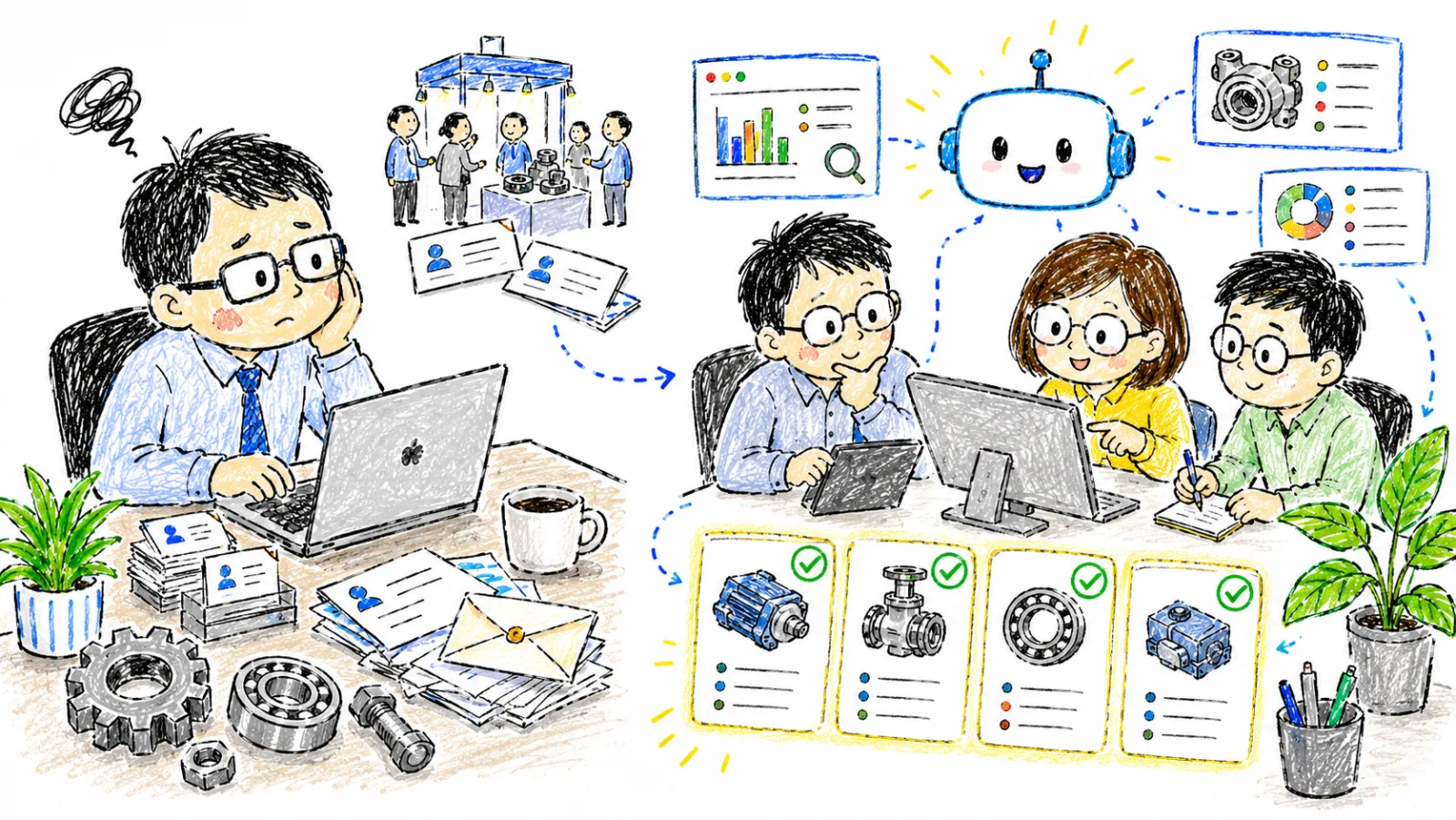
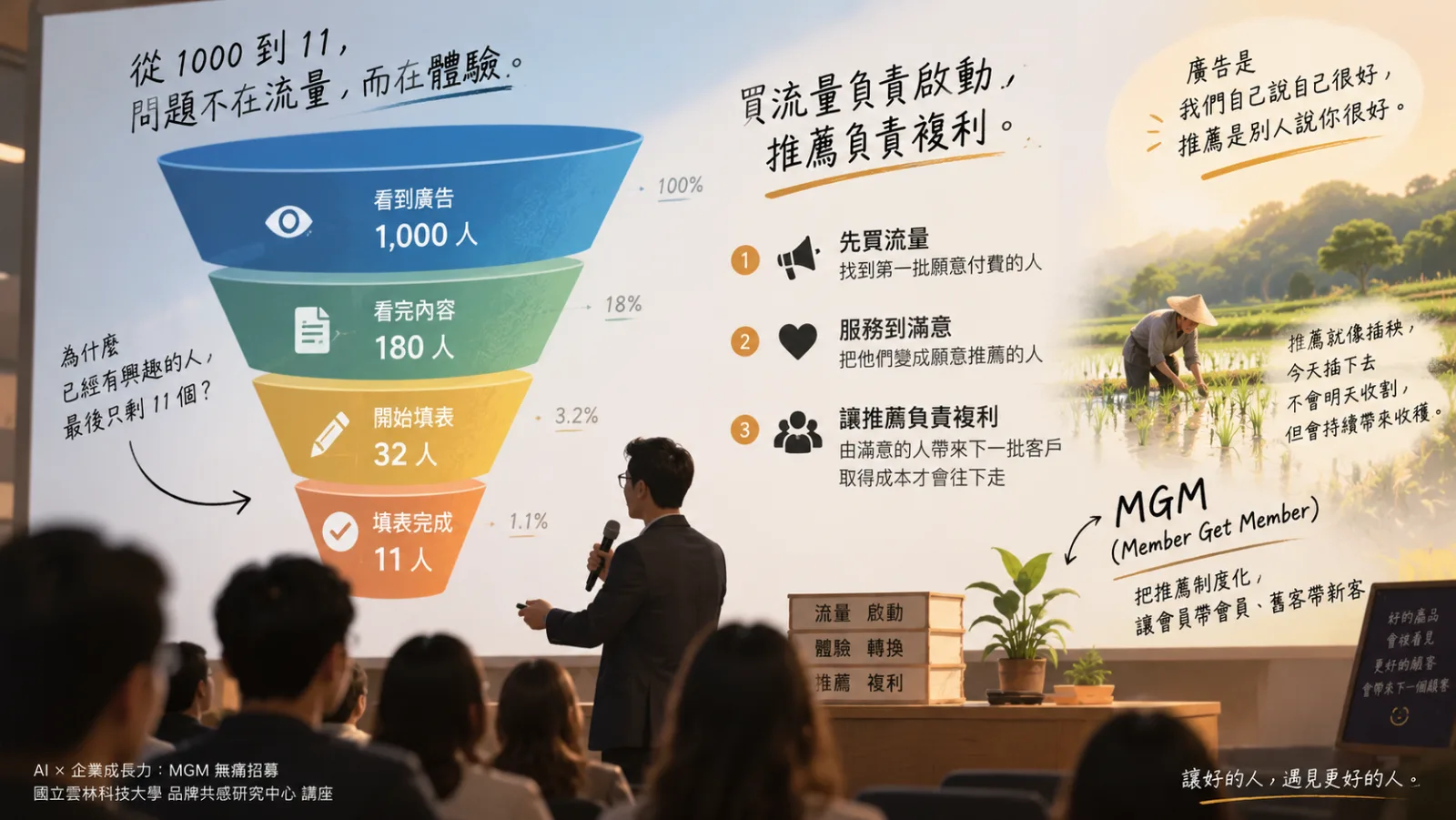
The English official website is ready, but why are overseas inquiries still not coming? The next step for small and medium-sized enterprises to use AI for export sales

High search volume does not mean that someone wants to buy it
This afternoon I participated in the seminar “Bilingual Empowerment and AI Digital Integration Strategies for International Sales of Small and Medium-sized Enterprises (opens in a new tab)” at the Taiwan Economic Research Institute. I was the third speaker to share. Before standing on the stage, I sat in the audience and listened to a fifteen-minute short speech by the CEO of Haoyou Digital Zhang Weirong (opens in a new tab).
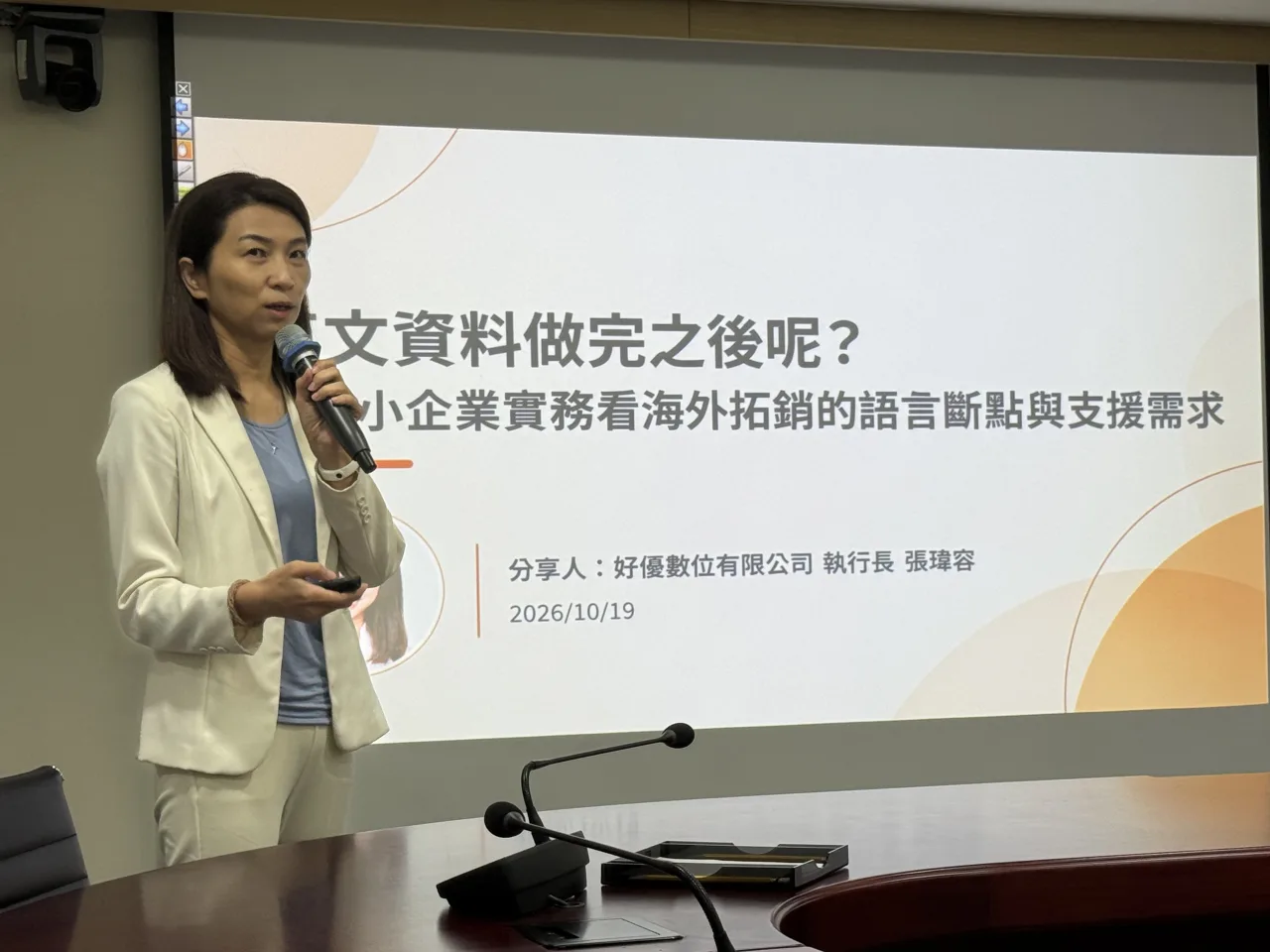 ▲ Haoyou Digital CEO Zhang Weirong shared “What happens after the English materials are finished?”
Wei Rong is a good friend I have known for many years. Her topic is “What happens after the English materials are completed? Language breakpoints and support needs for overseas sales from the practice of small and medium-sized enterprises (opens in a new tab)”. This question itself is very weighty. In the past decade or so, the government and public associations have invested a lot of resources to help small and medium-sized enterprises develop English catalogs, English official websites and English development letters. But now that the information is done, what’s next?
The answer given by Weirong is straightforward: searching for hot spots is not the same as purchasing needs.
She starts by breaking down the blind spots of traditional SEO. Use the tool to search for keywords, and the words that come up are the words with the highest traffic. AI will help you generate a supplier purchasing guide in ten seconds. The traffic of this kind of article is usually not bad, but most of the traffic it attracts is general traffic. For B2B companies, a hundred casual visitors are not as good as one purchaser who is willing to fill out an inquiry form.
I was particularly touched by this passage. I have been running my own website for many years, and I often remind myself when looking at the reports in Search Console: Just because the exposure numbers are beautiful does not mean that those people have a relationship with you.
She goes to Reddit to find answers instead of keyword tools
Wei Rongju’s case is a stainless steel raw material factory that has been operating in Tainan for 40 years and wants to develop the Philippine market.
If you follow the SEO tool’s suggestions, the title will probably be “How to choose a reliable stainless steel supplier in the Philippines.” It seems quite satisfactory, but it is difficult to convert into a specific inquiry or order. What she did was bypass keyword tools and go directly to Reddit and LinkedIn to find real discussions about local sourcing.
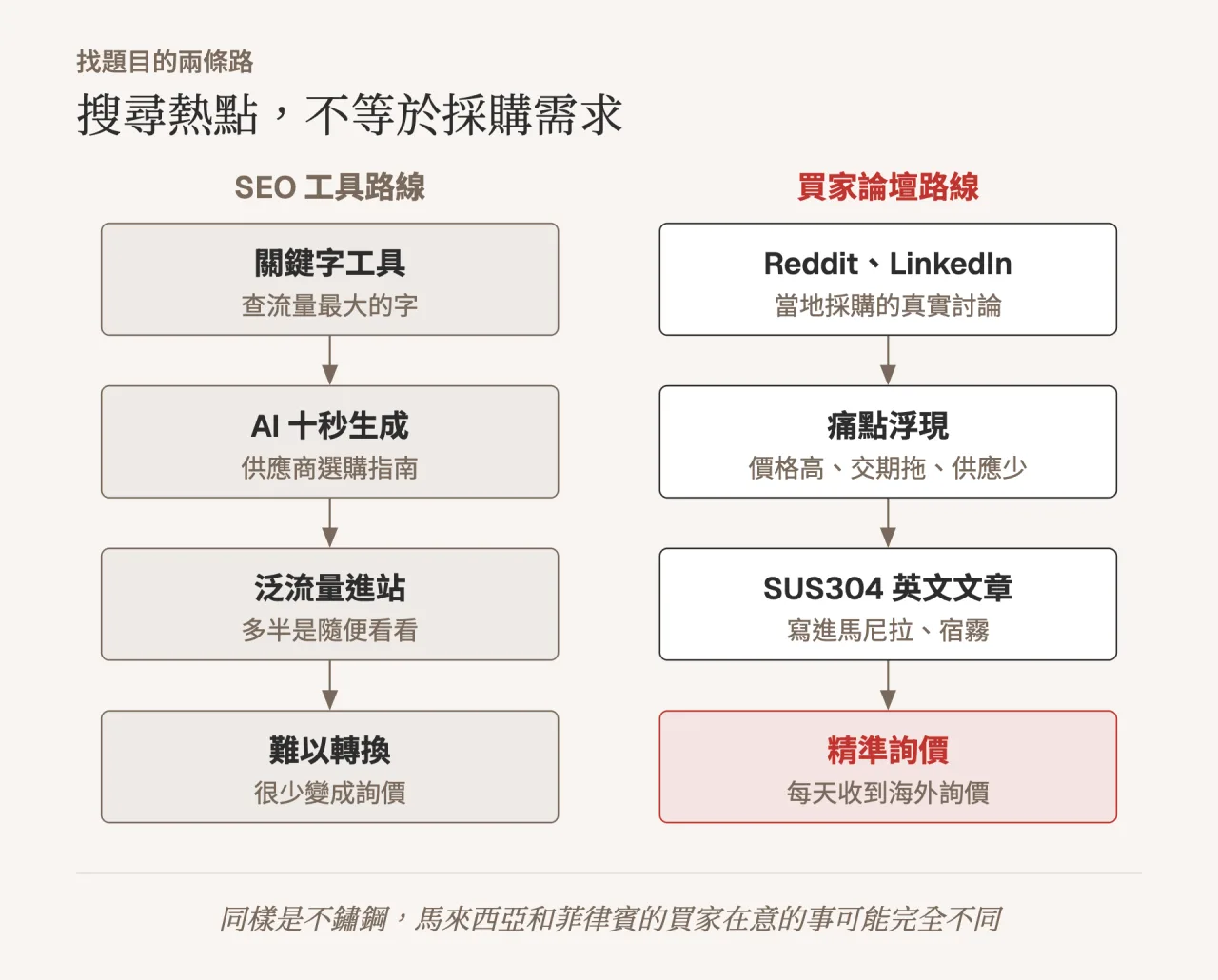 ▲Two ways to find topics: Searching for hot spots does not equal purchasing needs
As a result, she really found a post: Due to the impact of U.S. tariff policies, the price of local raw materials in the Philippines is relatively high. Buyers complained that local supplies are limited and they must rely on imports, and shipping by sea can easily delay delivery. What they want is very simple, that is, suppliers with stable specifications, stable delivery, and prices that don’t keep jumping.
Once you master these pain points, the questions will be completely different. So she helped her client write an English article on the theme of SUS304 stainless steel (commonly known as white iron), including Manila and Cebu, two major engineering procurement cities. The content directly responded to the issues of procurement costs and supply delays.
She also spread out the performance figures for everyone to see. The bounce rate of that article is not high, the dwell time is very long, and customers can receive precise inquiries from overseas every day. Wei Rong did not take the credit, and said with a smile that the foundation of this 40-year-old factory was already very good. She politely said that she just pushed it from the side. But in my opinion, truly powerful consultants do not need to package results; the methods they propose are themselves the best proof.
The same problem looks different in different countries
The most worthwhile thing to take away from this case is actually a sentence she said casually: for the same stainless steel raw material, Malaysian buyers and Filipino buyers may have completely different concerns.
And this quote directly responded to the theme of the seminar. When small and medium-sized enterprises complete the English materials, it only means that the language threshold can be crossed; but what buyers care about still needs to be inquired and scrutinized market by market.
Language threshold is of course an important key. I quoted an NBER study (opens in a new tab) in my presentation: After eBay introduced machine translation, the translation quality only improved by 7%, but the number of exports from US sellers to Latin America increased by 17.5%. The language barrier is a real trade cost. If it is lowered, there will be more business.
But Wei Rong’s case reminds us that language is only the first door. Translation solves the problem of “understanding”, and what buyers want is “after reading it, I feel that you understand it.”
Wei Rong finally condensed the process into five steps, which I briefly recorded as follows:
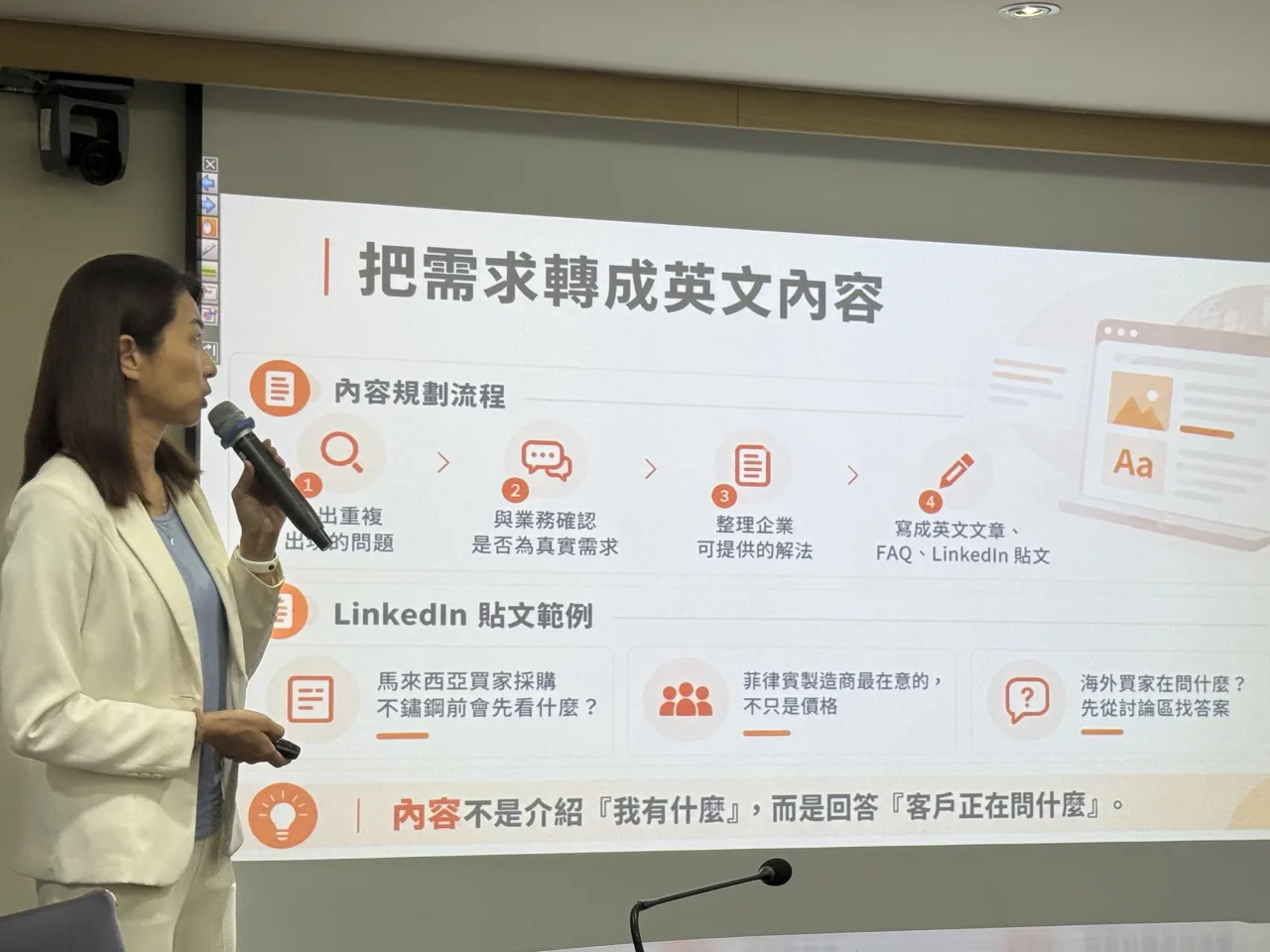 ▲ Wei Rong’s slideshow: Converting requirements into English content
- Identify recurring issues in overseas forums and communities
- Confirm with the local business whether these issues are true.
- Sort out the solutions that the company can provide itself
- Write the content in English and put it on the official website and FAQ
- Rewrite it as a LinkedIn post and cross-expose it with the official website content
I pay special attention to the second step. Crawlers and AI can help you find clues, but before the clues can be turned into content, you still need someone who understands the local market to nod. This step cannot be skipped.
From my perspective: Buyers will also ask AI now
From the position of AI content consultant, I would like to add one more reason.
She’s talking about SEO, but the same logic is only more important when it comes to generative AI search. More and more overseas buyers will open ChatGPT or Perplexity before looking for suppliers and ask: “Where can I buy 304 stainless steel stably in the Philippines? How long will the delivery time be?”
This is not my imagination. Gartner (opens in a new tab) surveyed 646 B2B buyers in 2025. 67% preferred to complete the purchase by themselves without going through a sales representative, and 45% had used AI in their most recent purchase. Another survey showed that 73% of buyers will avoid that supplier once they receive irrelevant development letters.
Since buyers do their own homework first, your English information becomes the first business card to the outside world, and this business card is increasingly read by AI first.
When AI answers this kind of question, it will give priority to referencing pages that actually answer the question. An English introduction that only introduces “what our company has” is difficult to be cited; an FAQ that directly responds to delivery times, price fluctuations, and import procedures has a much greater chance of being cited.
I included an American example in my briefing. Software vendor Threekit (opens in a new tab) began tracking the questions buyers asked in AI searches and then wrote content based on those questions. Within about six weeks, the proportion of AI answers citing its website increased from 48% to 65%. This is a number reported by the manufacturer, and the industry is different from that of steel, but the direction is exactly the same as Wei Rong’s approach: first find the buyer’s problem, and then write the content.
In other words, what Weirong teaches companies is also paving the way for the AI search era. Answering the questions your customers are asking is something that was true in the age of search engines and will only be truer in the age of AI.
What she said happened to be what I was going to talk about next time.
Wei Rong said something in the middle, which made me smile knowingly in the audience.
She said that AI tools that cost $20 a month can now do things that used to cost a lot of translation fees and crawler fees; but if you have to re-enter the command every time you open ChatGPT or Claude, the best way is to write it into the Task Toolkit.
This is exactly the topic I will talk about when I take the stage next: If AI wants to truly help companies with overseas sales, it must move from a single prompt to a task-based workflow.
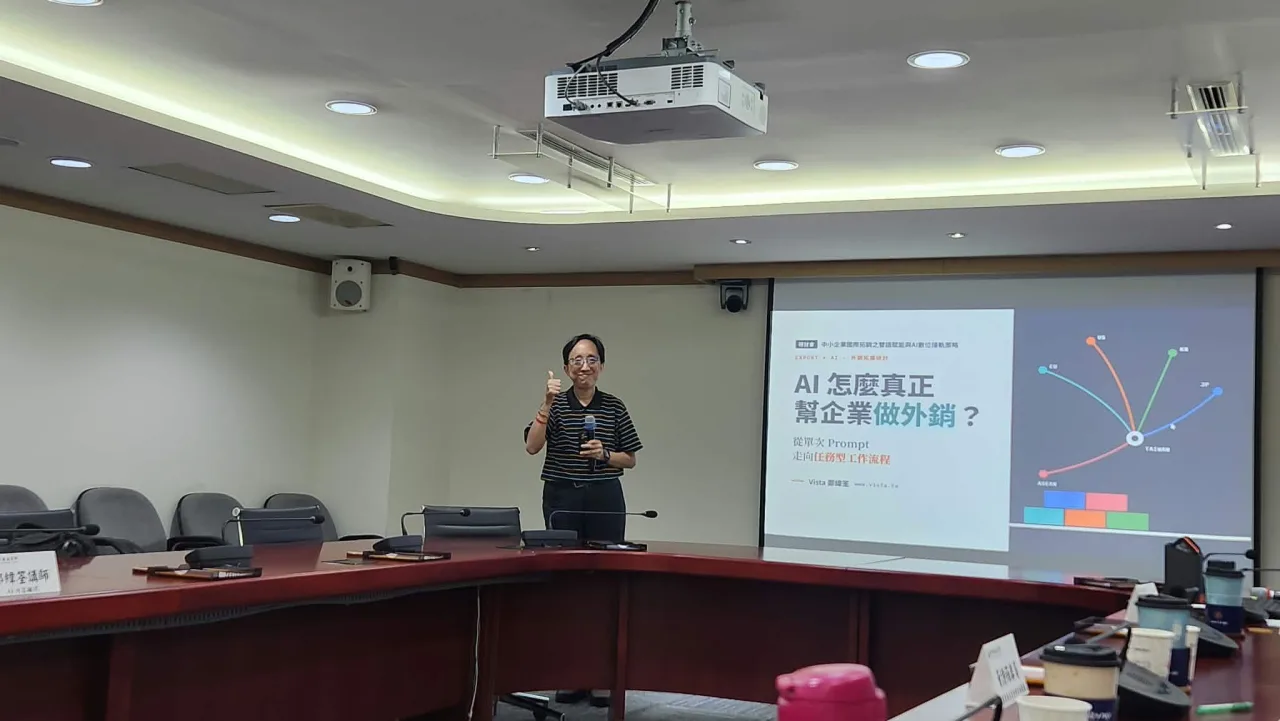 ▲ I then went on stage to share “How can AI really help companies do export sales?”
I throw out a number on the stage first. The Association for Foreign Trade’s first round of this year’s Trade Association Economic and Trade Index surveyed 1,678 Taiwanese business owners and senior managers, and 42.2% still only use free chat-based AI tools. For companies that have budgeted for the introduction of AI agents, the expected index of export prosperity in the next six months is 59.41; for companies that only use free chat tools or do not use AI at all, the index is only 40.9 to 42.3.
This is correlation, not causation. Companies that are already proactive are more willing to prepare budgets. But it illustrates one thing: for every ten companies, the AI of four companies still stops at “asking once and getting the answer once.”
For a company that stops at a single Q&A, the daily routine might look like this: “Help me translate this paragraph into English.” Paste, copy, return to Word for typesetting, and start all over again for the next one. The quality depends on who is using it that day, and it will be reset to zero after it is finished.
Task-based workflows are different. I broke it down into five parts in the brief:
- Trigger: start work as soon as an event occurs, such as receiving an inquiry or uploading a business card
- Input: What fixed data does the AI want to read, such as product master file, glossary, price list?
- Steps: One task card for each step, such as dismantling, comparing, and writing a draft
- Checkpoint: where is the person and what is he looking at?
- Handover: Where to write the results back and who to notify
One less part and the process gets stuck on someone.
Looking back at Wei Rong’s method using these five parts, it is actually a very complete workflow specification:
- Trigger: the decision to develop a new market, or the number of inquiries for a certain product line is significantly reduced
- Input: target country, product specifications, delivery date and conditions that the company can provide
- Steps: Crawling and combing real discussions on overseas forums, summarizing recurring pain points, organizing them into selected topics, and then writing them into English articles and FAQs
- Checkpoint: Confirm with the local business that the pain points are true, and check product specifications and delivery time commitments back to the original data.
- Handover: Post the article on the official website, rewrite it as a LinkedIn post, and look back every month to see which pages generated inquiries.
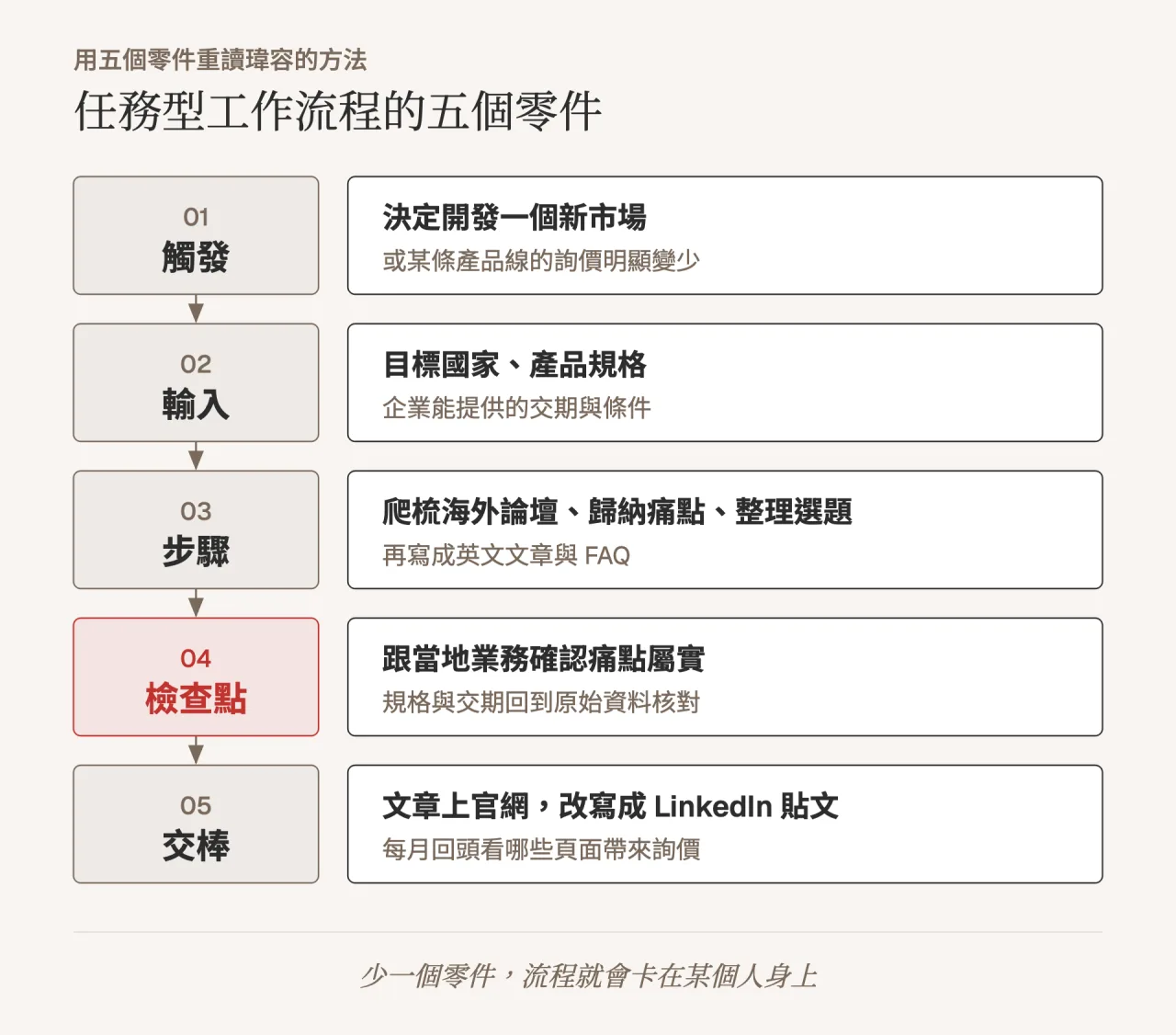 ▲ Use the five parts of task-based workflow to re-read Wei Rong’s method
Once the method is written in a consultant’s head and structured in this way, small and medium-sized enterprises will have the opportunity to repeat it themselves without having to start from scratch every time.
Among the Five Export Sales Stations that I compiled (English information, overseas exposure, buyer matchmaking, formal negotiations, follow-up contact), Wei Rong’s method just fell into the second station of “overseas exposure”. The most common problem on this site is that we write “high-quality precision parts”, but buyers are searching for specific specifications, applications and certifications. My suggestion is to let buyers use their own words to search for you. Each product line corresponds to three frequently asked questions by buyers, and arranged into a monthly plan. Wei Rong used the real results of a steel plant to demonstrate this station more convincingly than my slides.
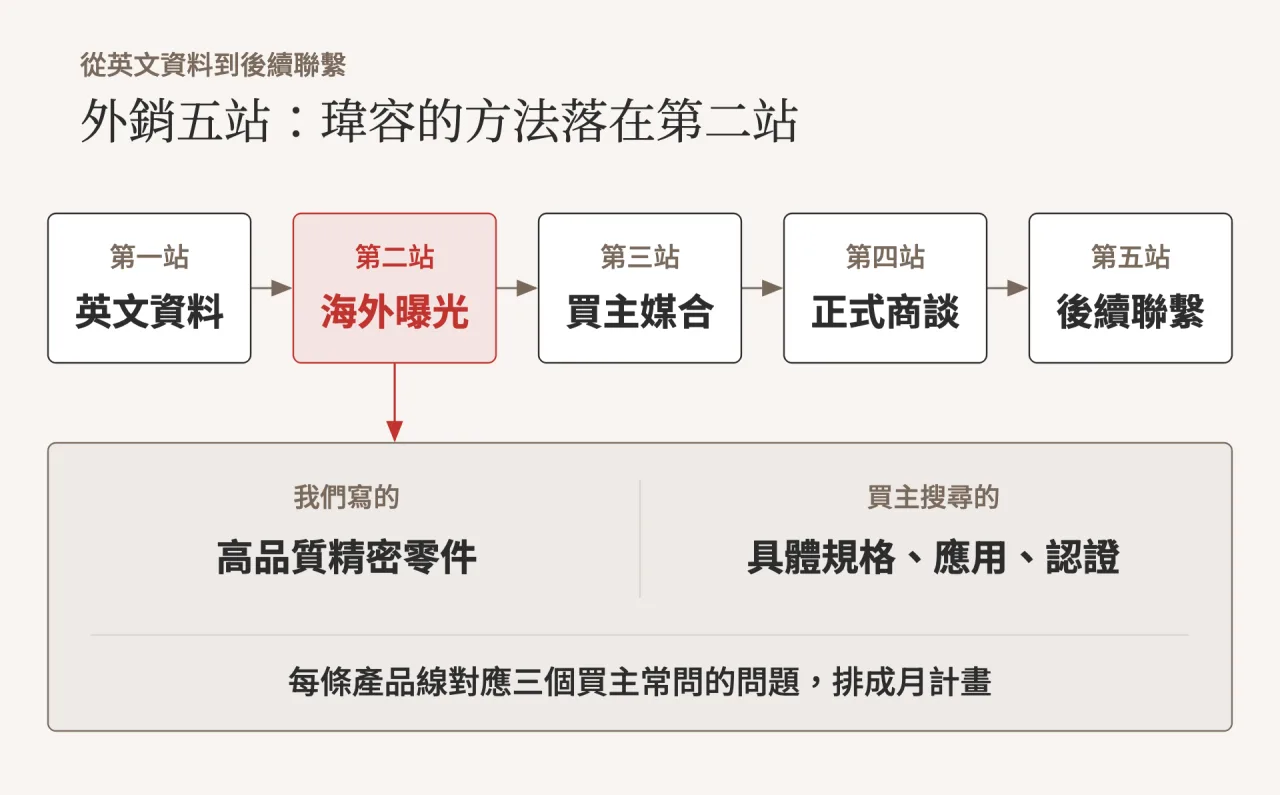 ▲ Five stations for export sales: Wei Rong’s method falls into the second station “overseas exposure”
No matter how deep the string is, people must guard the three passes.
Wei Rong specifically included “Confirm with local business” among the five steps. This step reminded me of the page in the briefing that I care about most: no matter how deep the AI connection is, people must maintain three barriers.
- Facts related: specifications, numbers, and certifications. AI can only refer to the product master file and cannot generate it by itself.
- Commitment: price, delivery date and quality assurance shall all be issued by authorized persons
- Data clearance: customer lists and quotations are not allowed to be included in AI tools that have not been approved by the company.
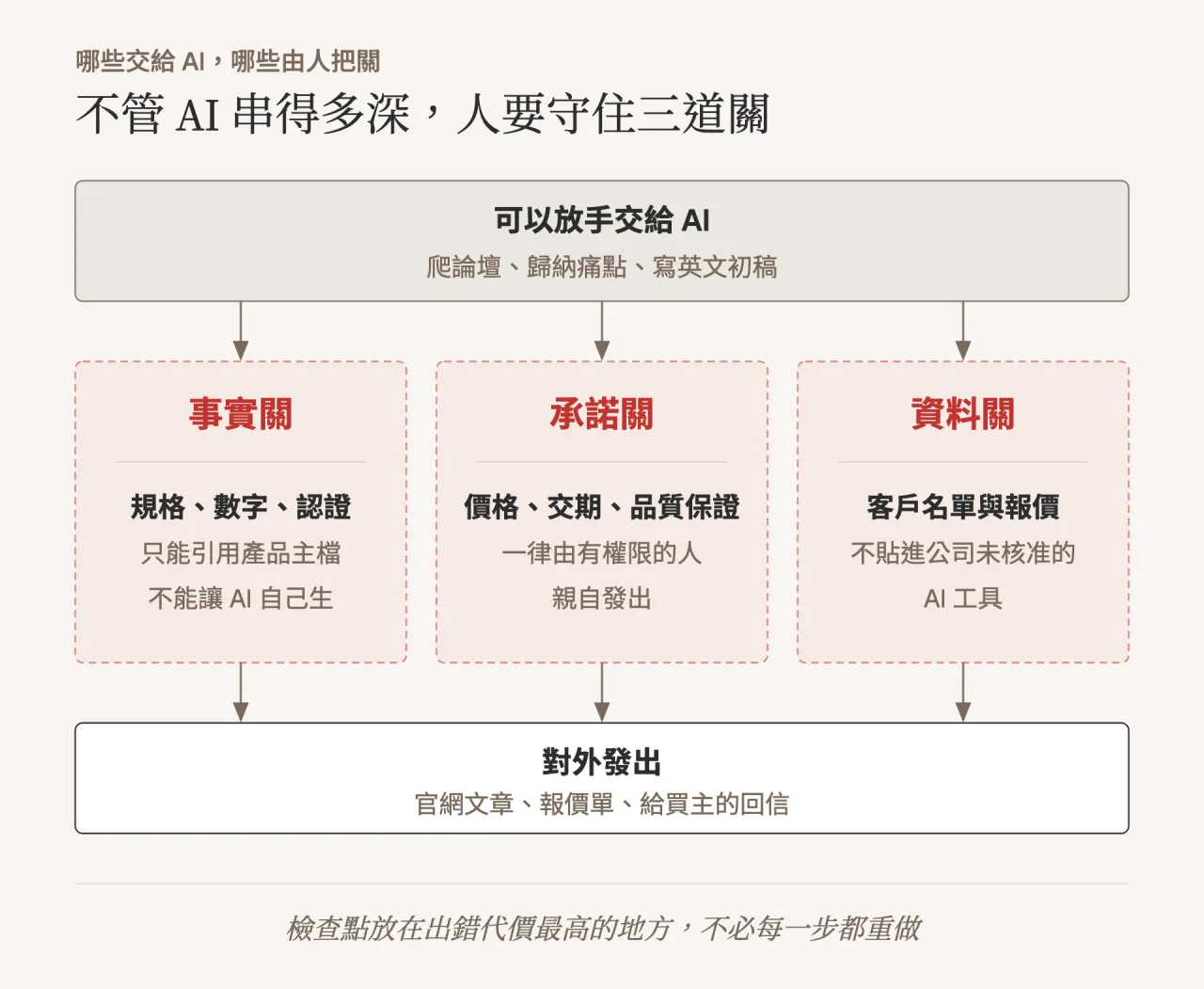 ▲ No matter how deep the AI infiltration is, people must keep the three levels of facts, commitments and information
Applying these three barriers to Wei Rong’s case, it becomes clear which things can be left to AI and which ones cannot. Climbing forums, summarizing pain points, and writing the first draft in English can all be submitted boldly; but not a single word of the 304 specifications, delivery time, and supply capacity written in the article can be imagined by AI. For a steel mill trying to break into the semiconductor supply chain, an exaggerated claim of specifications could cost more than an entire year of no inquiries.
Checkpoints should be placed where the cost of error is highest, so that every step does not have to be redone. This is also the most important thing to think about when designing a mission tool kit.
No matter how many tools there are, someone still needs to take the first step.
The last part of Wei Rong’s talk was about accompanying runners, which was also her deepest experience in ten years of entrepreneurship.
There are actually a lot of government subsidies. For some programs, as long as you meet the qualifications, you can apply for a subsidy of 100,000 yuan. However, the first thing manufacturers say after receiving subsidies is often: “Teacher, how can I start?” There are two hundred AI tools listed on the government website, and companies have no idea which one to start with.
Therefore, she suggested that when planning task tools in the future, consultants’ accompanying and empowering hours should be included in the service items. I agree with this direction and would like to add some observations of my own. The purpose of accompaniment should be to enable companies to eventually eliminate the need for accompaniment. The toolkit is responsible for fixing the method, and the consultant is responsible for taking the company through the first round. When someone within the company can complete the entire process by himself, he can retire with success. The two are relays, rather than replacing each other.
There are already examples of governments doing this in South Korea. KOTRA (opens in a new tab) has set up an AI Trade Support Center in Gyeongsangbuk-do to help small and medium-sized enterprises use AI to create product introductions and short videos in English, and then use overseas trade embassy to check the authenticity of the buyers before making connections. According to South Korean media reports, the center facilitated 277 buyer meetings a year, four times the previous year, and 73 companies completed their first exports. Vivora Labs, a small cosmetics company in Pohang that makes sunscreen and ampoules, saw export sales increase by 294.3% one year after its first export. These are figures self-reported by organizations and reported by the media. The growth cannot be entirely attributed to AI, but it demonstrates one thing: the government can provide tools and accompanying people at the same time, and the two are connected to the same process.
So where should I start with the first line? There are three judgment criteria I gave in the briefing (extended reading “Introducing AI, starting from work pain points”): high frequency, rules, and mistakes can be undone. The time saved can be seen only if the work is repeated several times a week; only when the method can be explained can it be written down as a task card; errors will be stopped by manual checkpoints and will not be sent directly to the customer. Inquiry and dismantling, glossary and catalog, and post-show follow-up all meet these three conditions; letting AI agents negotiate prices with buyers themselves should be postponed.
As for the accompanying schedule, Wei Rong suggested that it be extended from half a year to one year. My version is to run a ninety-day cycle first: in the first month, take stock of the current situation of the five stations, establish a glossary, and write three task cards; in the second month, select a line to string together and set up manual checkpoints; in the third month, compare the response time, number of errors, and follow-up rate before and after, and then decide on the second line.
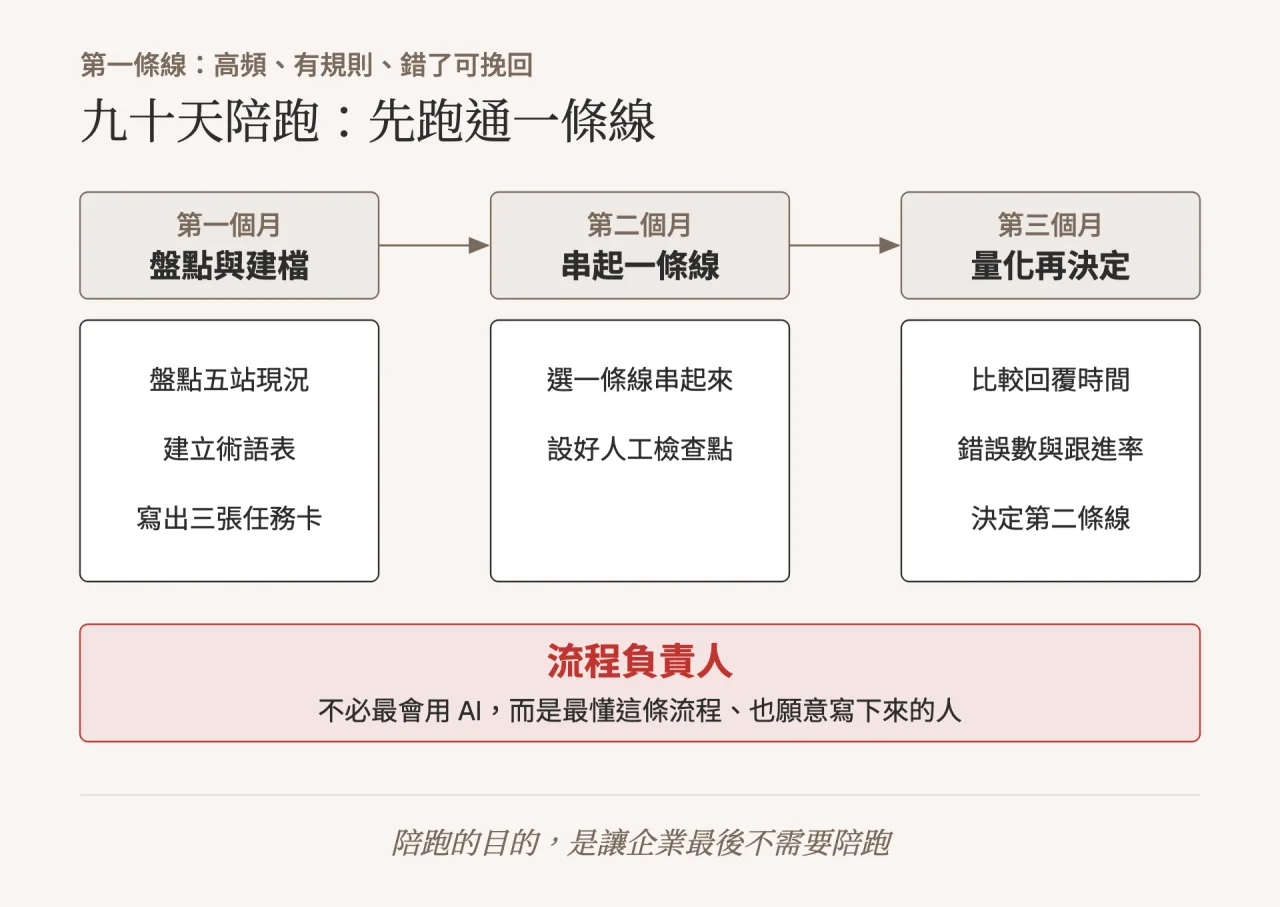 ▲ Ninety-day running: run through one line first, and then hand it over to the internal process leader
There’s one thing more important than tools: having a process owner within the organization. This person doesn’t have to be the best at using AI, but the person who understands the process best and is willing to write it down. After the consultant leaves, whether the process can survive depends on this person.
Three things I took away from these fifteen minutes
First, English information is just the ticket. The language translation has been completed, but the buyer’s question has not been answered. The value of content depends on whose questions it answers.
Second, when looking for topics, go to a place where buyers gather. The keyword tool tells you what people are searching for, and overseas forums tell you what buyers are worried about. The latter is the subject that can be closed.
Third, good methods must be written down. The reason why Weirong’s process has promotion value is that it can be disassembled, written into task tools, and then handed over to more small and medium-sized enterprises for use. This is also the direction this seminar wants to promote.
If your company already has an English official website, you might as well try three things today:
- Go to Reddit or LinkedIn and search for your product name plus your target country to see what locals are complaining about. You will find that your official website may not have answered any of these questions.
- Open the glossary. First collect the twenty most commonly used product words, and ask the salesperson and engineer to read them once each, so as to avoid the same part having three English names in the catalog, official website, and quotation sheet.
- Write the task of finding the topic into a task card: background, input, steps, output, and inspection. Write the five fields clearly so that you don’t have to give instructions from scratch next time.
AI will not do export sales for you; but if you design the process well, it will connect each stop for you. If you still have any questions, you are welcome to discuss with me (opens in a new tab).
Next step
Bring this topic to your team
Vista Cheng speaks and runs workshops on AI workflows, writing and content systems for companies, schools and public agencies.