Internet celebrities exit and craftsmen enter: Five insights from Dan Koe’s “The Age of Experience”

Dan Koe posted a long article (opens in a new tab) on X a few days ago, titled “The influencer is dead. The Age of Experience is here. (opens in a new tab)”. The opening paragraph gave me pause: He said that every day he sees a mother in her forties who is not technologically savvy and sells a simple digital product for over a million dollars in one release. The product might just be a thirty day challenge. She starts with a waitlist, posts proven content around the topic for a while, and eventually sells the list and Instagram.
Readers buy for a simple reason: no one can relate to millions of followers, a luxurious lifestyle, or an unattainable body. What everyone resonates with are people who are in a similar situation to themselves and who have only taken one or two more steps than themselves.
There is a lot of space in the second half of this article to promote his own tool Eden, so you can skip that part for now. But the framework in the first half is of great reference value to those who are running content or want to build a personal brand. The following are my five thoughts after reading the complete theory.
Lesson 1: First figure out what owns you
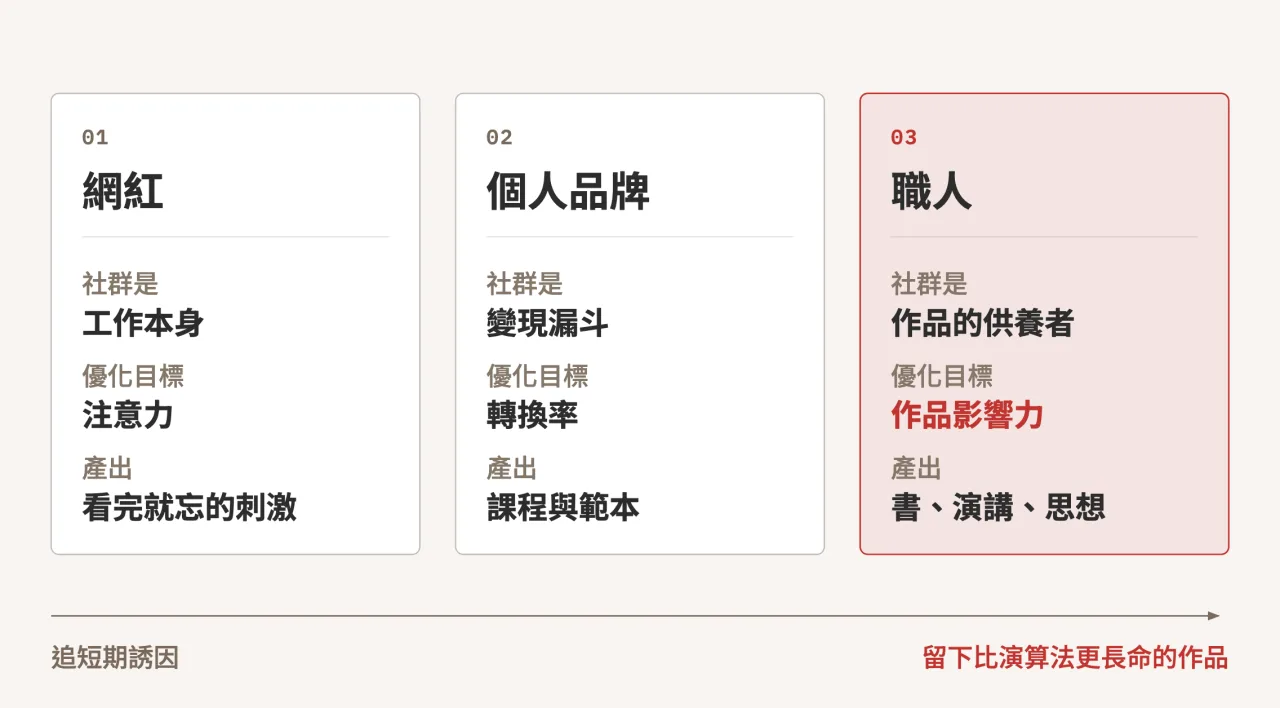
Dan Koe divides creators in the community into three types. His classification is very interesting, looking at “what owns them.”
Internet celebrities regard the community itself as a job. Their reward is attention, so the content is tuned to be a short-lived thrill that is forgotten after viewing.
Personal brand uses community to monetize. Each post is a step in the funnel that leads to a course, template, or solution. This is better than internet celebrity, at least there is a product behind it that really wants to help people.
craftsman (the word he uses is artisan) uses the community to support a set of works. Public intellectuals like James Clear and Jordan Peterson certainly need attention, but what they really care about are books, speeches, research, a set of ideas, things that will outlive algorithms.
After reading this, I looked back at my post (opens in a new tab) and asked a question: Is this content meant to make people remember an idea, or is it meant to make people click on a link? You need both, but the ratio determines who you end up being.
Dan Koe puts it this way: Attention and income, when done right, are byproducts of good work. He did not tell everyone not to make money, but he reminded people not to let short-term incentives take you away from the reason why you started in the first place.
Lesson 2: The last moat in the AI era is opinion
One of his words resonates with me: The last competitive advantage worth paying for is a point of view.
Nowadays, AI can generate 1,500 words of beautiful text in ten seconds, and information is no longer unusual. What can’t really be replicated is your own perspective. You have read hundreds of books, listened to thousands of TV shows, had arguments with strangers, and experienced several major life events. These are intertwined in your mind and become a perspective that only you can see.
The problem is, this perspective is usually invisible, even to you. If you can’t see it, you can’t accumulate it, so you have to follow the hot topics because that’s the only thing you can see clearly.
The metaphor he uses is building a museum for your ideas. To put it bluntly, it is to build a material library (called swipe file in marketing circles): save all the ideas that come to you while taking a shower, the posts that make you feel, and the video notes. He divided the material into two boards: one for posts that have been verified to be popular, and one for ideas that he really likes. Pairing the two sides and rewriting them with your own point of view will make a good post.
Swipe file (inspiration library/material library) refers to a folder used to collect and organize excellent marketing, advertising, design or copywriting examples. It was originally used by advertising giants and marketers to record “proven effective” ideas so that they can be read, referenced and learned at any time when they lack inspiration in the future.
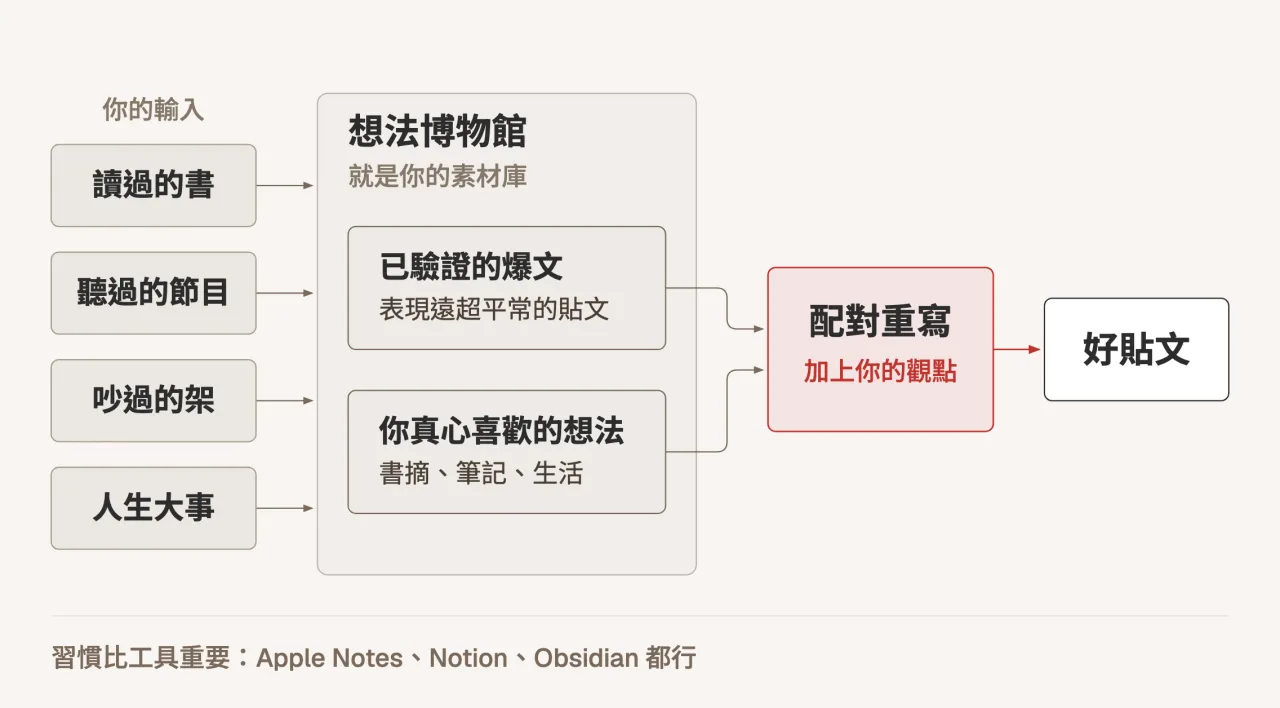
It doesn’t matter what tool you use, Apple Notes, Notion or Obsidian will do. What matters is habits.
Lesson 3: No one owns a theme
Many people who are just starting to write will get stuck on “This topic has been discussed by others.” Dan Koe gave his own example: He wrote an article “How to Stay Ahead of 99% of the People” in 2019, which was changed into a video (opens in a new tab) a few years later and received 1.73 million views. Later Mark Manson (opens in a new tab) made a video with the same title, as did Alex Hormozi (opens in a new tab), and so did Tom Bilyeu (opens in a new tab).
His conclusion: No one owns a subject, you only own your opinion on the subject. People follow perspective, and information is everywhere.
In my opinion, this is especially useful for Chinese creators. We often feel that we are not qualified to write about what has been said abroad and written by our predecessors. In fact, when readers go to social media, they originally want to hear from the people they like what they think about the things everyone is talking about.
Lesson 4: One idea, write five perspectives
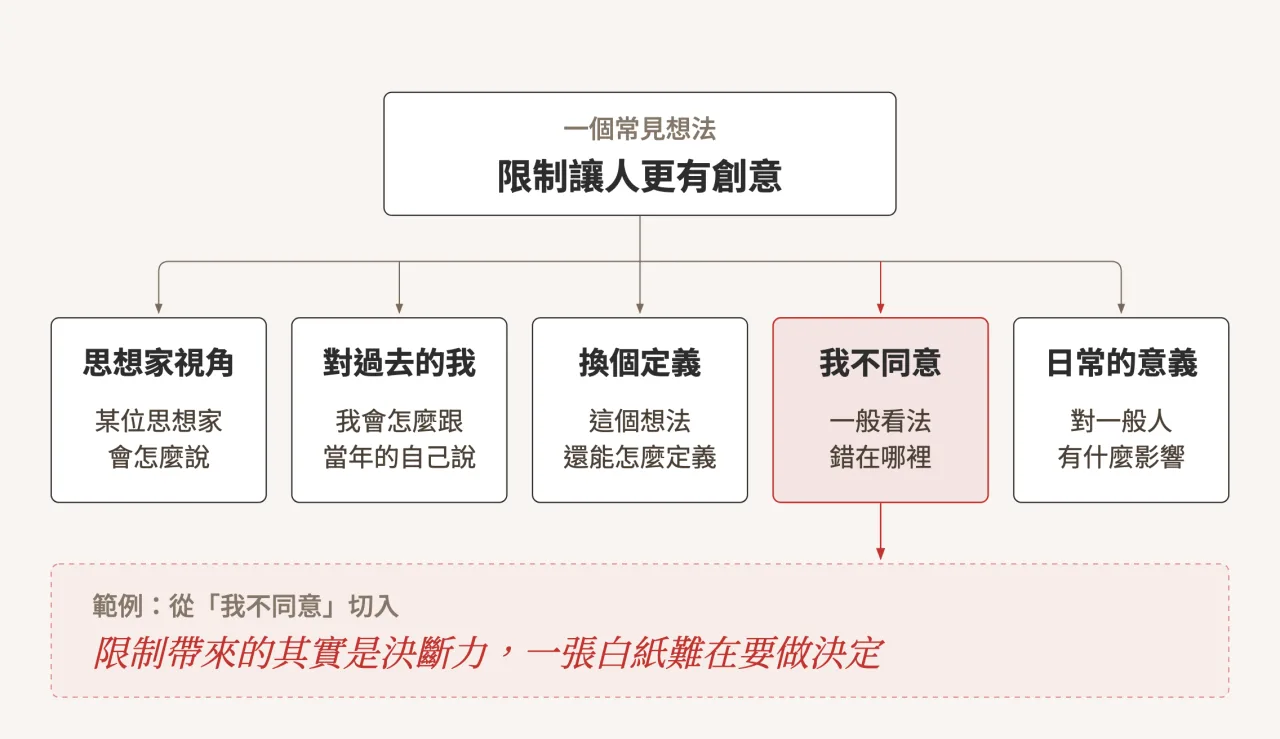
How do you come up with your own opinions? He gives a useful exercise to write five angles on the same idea:
- What would a thinker I admire say about this?
- What would I say to my past self about this?
- Can I change the definition of this idea?
- What do ordinary people think of this matter? Where do I disagree?
- What impact does this incident have on ordinary people?
His example is the old saying “restrictions make people more creative”. If you disagree, you can write: What restrictions actually bring is decisiveness, because the difficulty in facing a blank sheet of paper is making decisions, but we mistakenly think that what we lack is inspiration. In this way, what you say is what only you can say, and the same topic can be written in eleven different ways this month without repeating it.
There are also things to pay attention to when looking for reference objects: pick three medium-sized creators, don’t look for celebrities. Celebrities have millions of views on each post, and it’s hard to see what content is actually effective. Study their explosive articles to learn the principles behind them, not copy their ideas. Every creator starts with reference works.
Lesson 5: Content is the best market research
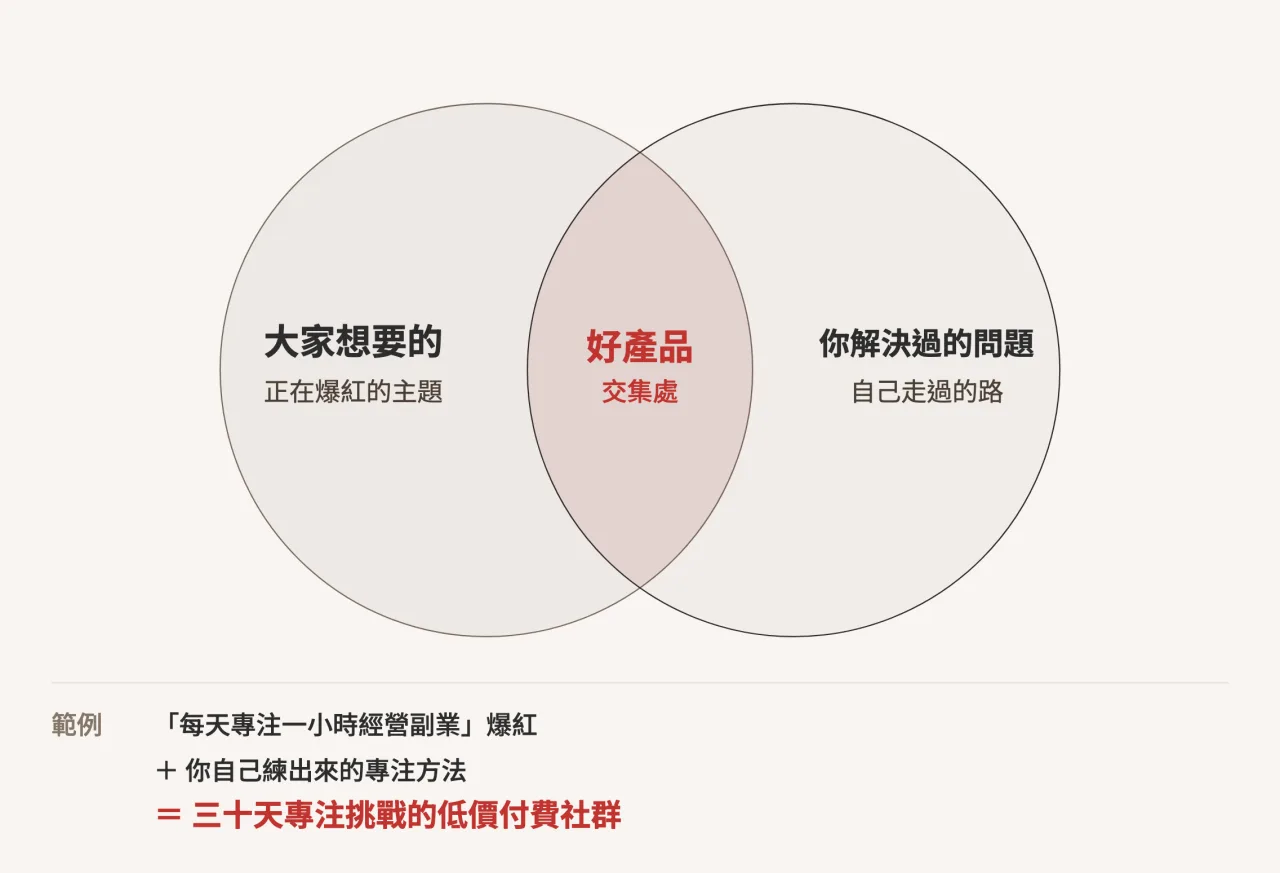
Finally, he connected content and products: the best-performing products come from the intersection of two things, one is what everyone is already signaling that they want, and the other is the problems you have solved in your own life.
So when you research content and see that a certain topic has become popular repeatedly, that is the most convenient market research. He gives an example: If you write about focus and productivity and find that posts like “Focus on one hour a day to run a side business” have gone viral again and again, you can create a low-cost paid community to take everyone to run a thirty-day focus challenge, with a simple tracking form.
He also reminded that most people fail to realize their products because they don’t have an audience that is likely to buy. Keep writing good content and this problem will be solved.
How to start thirty days
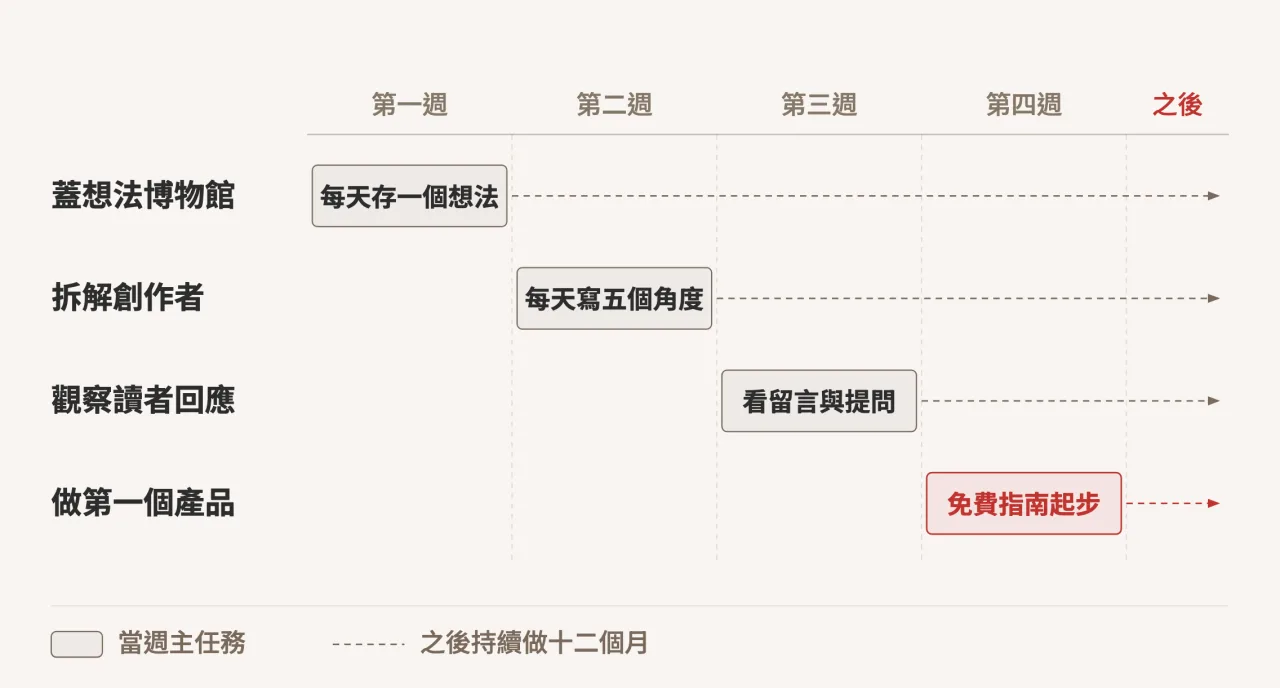
He condensed the entire method into a one-month action list, which I copied and slightly localized:
- Week 1: Build a museum. Set up a note area on your phone, list five creators you often read, and save at least one idea every day.
- Week 2: Taking apart others. Find three medium-sized creators and analyze their top-performing posts. Pick an idea and write about it from five angles every day, and send out the best.
- Week 3: Observe responses. Keep posting and pay attention to which posts attract the most comments and questions.
- Week 4: Make the first product. Pick a question most frequently asked by readers, write it as a one-page free guide in exchange for email, and then expand it into a paid version.
Then, continue doing this for twelve months.
My reservations
This article is worth reading, but also with a little distance.
First, a considerable proportion of the paragraphs in the article promote Eden, including exclusive prompts and thirty-day courses. The method itself is not tied to tools, so we don’t have to register it in order to follow it. If you really like Eden, just sign up again.
Second, the opening of “Forty-Year-Old Mom on Sale for Millions” is a typical survivor narrative. He did not give specific numbers or case sources. When reading it, just treat it as a trend observation, not a guarantee that it can be replicated.
Third, he is talking about the English market. The audience size, payment habits and platform ecology of the Chinese market are all different, so the 30-day product launch rhythm may not be suitable for everyone. However, the two core concepts of “views are the moat” and “using works to drive attention” are applicable everywhere and hold true no matter which market it is in.
Conclusion
At the end of the article, he summarized it this way: Internet celebrities pursue attention, personal brands pursue conversion rates, and craftsmen accumulate works one idea at a time and one project at a time, and then let the community pay for it.
For those who are still hesitant to start, I think the greatest value of this article is to relax. You don’t need to be famous, live a luxurious life, or say something new that has never been done before. You just need to go one or two steps further than your readers, and be willing to save and write down your own way of looking at things bit by bit.
If you want to do it, don’t just finish reading
After reading this kind of article, the most common ending is to save it as a bookmark and never open it again. Dan Koe said that in the fourth week “make the first product”, many people are stuck and don’t know where to start.
If you want to use a week to actually make a gadget with your own hands and use it as the first brick of your work, welcome to join Seven-day Challenge Camp: Make your first AI gadget in seven days (opens in a new tab). One task per day, no programming background required, and on the seventh day you will have something in your hand that can be used by others.
Next step
Bring this topic to your team
Vista Cheng speaks and runs workshops on AI workflows, writing and content systems for companies, schools and public agencies.