163,000 subscriptions in two years: Breaking down Charlie’s mental model for content entrepreneurship in “The Entrepreneurial Compound”
▲ From zero to 163,000 subscriptions in two years, what Charlie demonstrated was not a traffic explosion, but a set of replicable content entrepreneurship mental models. (Photo/Produced by Vista)
Opening: What are we really watching when we watch talk shows?
I believe that everyone who makes content will have a subtle feeling after watching this episode - on the surface, it talks about interview skills, traffic growth and business realization, but what the bottom layer is really dealing with is how an ordinary person can redefine himself in the age of information explosion.
Charlie is quite young. In just two years, he turned a channel that had no one subscribed to 163,000 subscribers, and a single episode brought in millions of revenue conversions. He is not an artist, not the son of a celebrity, and does not have an innate traffic base. What he does even seems a bit old-school: sending letters, invitations, interviews, editing and publishing. But in this old-school cycle, he developed a fantastic business model, which is to let the most powerful people in Taiwan pay to appear on your show and teach you their lifelong know-how.
For me, the value of this episode is not to teach people how to make a podcast, but to lay out the complete mental model of a content entrepreneur. Including: how to choose a track, how to develop unfamiliarity, how to design interviews, how to manage trust, how to expand the content matrix, and more importantly - how to live comfortably, long-term and rhythmically in this industry that is prone to burnout.
Below, I extract the insights from the six levels that I think are worth chewing over and over again, and propose the next steps that can be taken directly from my own creative and teaching experience.
▲ Before entering the six-layer extraction, it is recommended to read this interview first - many details cannot be fully restored in words.
The first level of extraction: track thinking - “a big track in a small track” is an expert choice
Charlie once said something that is easy to be dismissed easily, but is actually very profound: “I choose the big track among the small tracks.”
What does it mean? Entrepreneurship as a whole is a small field compared to gender, health or entertainment. But in the small track of entrepreneurship, most Taiwanese creators choose the more niche and high-end path of “new venture/fundraising/IPO”. Charlie deliberately avoided this path and instead chose “business” - this is actually the bigger part of entrepreneurship, the one that resonates with the most people, and the easiest to get started with.
This selection logic is extremely inspiring for those of us who run on the track of knowledge content.
| Level of thinking | Ordinary people | Experts |
|---|---|---|
| First level | I want to do the mass market | I will choose a niche track first |
| Second level | I want to be a niche track | I am looking for a relatively largest sub-market in the niche track |
| Third level | I want to be the first in this sub-market | I want to be the first in this sub-market and then step out |
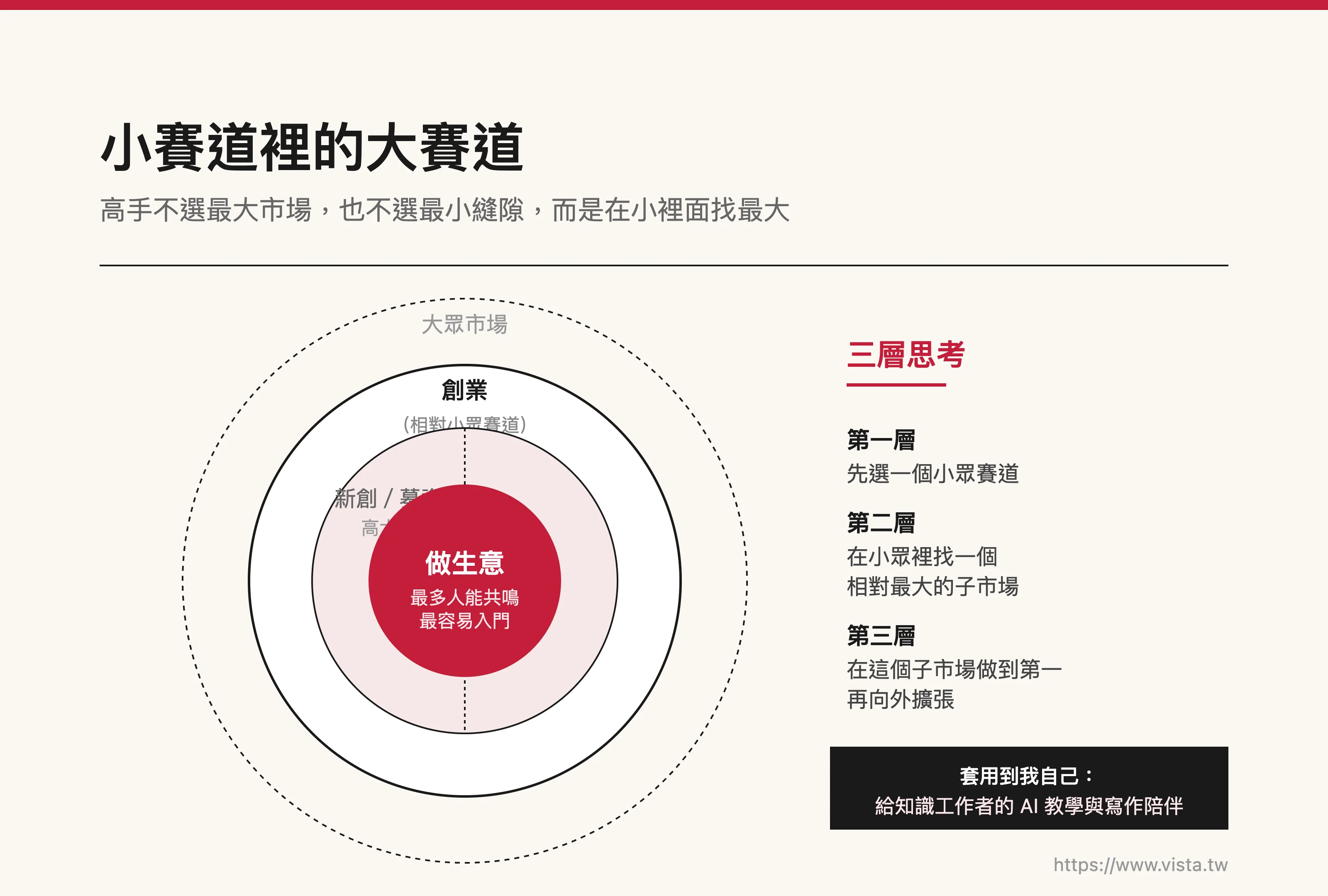 ▲ Experts do not choose the largest market, but choose the relatively largest sub-market in a small track - be the first and then step out.
Many writers, lecturers, or knowledge workers get stuck not because they don’t work hard enough, but because they choose a sub-track that is too small or too large at the beginning. Too big, such as “I want to teach everyone writing”; too small, such as “I want to teach Chinese abstract rhetoric for academic papers.” The former cannot be searched or remembered; the latter’s pool is too small to support long-term operations.
A reminder to myself: In the track of AI writing and AI content creation, I already have solo.tw, content.tw and writing companion plans for these brand positions. What we should really think about next is not to expand into a larger market, but to carve out a medium-sized submarket in this small track where I can be the first and can support the business model - such as “AI teaching and writing companionship for knowledge workers” or “AI academic writing workflow for PhD and master’s students.” This is ten times more accurate than “I want to teach everyone how to use AI.”
Second level of extraction: Unfamiliar development - a seriously underestimated skill of content people
Charlie said in the interview that when he first started, he only had 2,000 subscriptions, so he dared to invite Ke Yirou. The moment Ke Yirou’s reply came in, he jumped up in front of the computer.
When many creators hear this, they may think: “This is because he is lucky.” But I think this is precisely a seriously misunderstood ability - the essence of unfamiliar development is not courage, but business mentality.
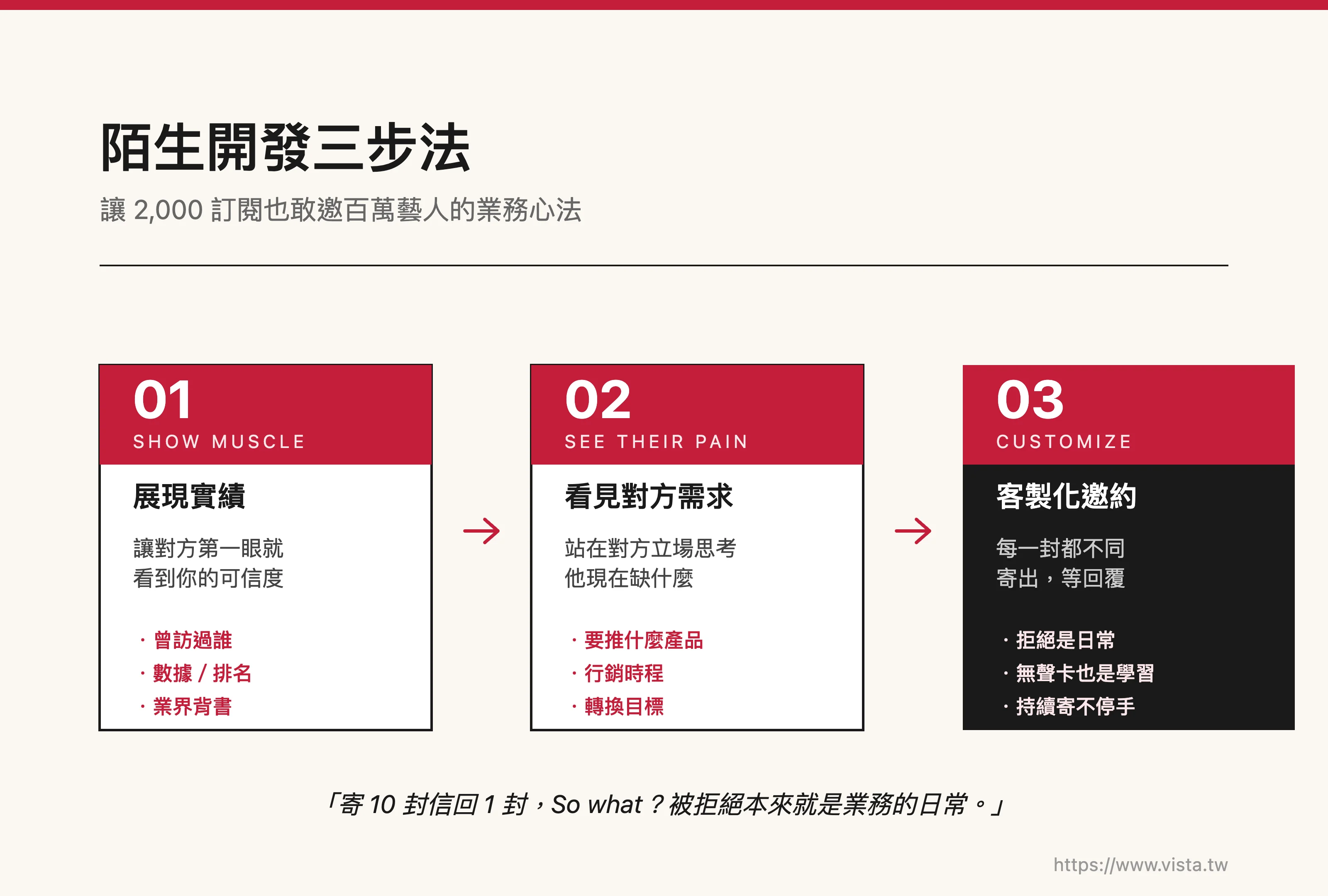 ▲ Stranger development is not about sending letters and hoping for luck, but about showing muscle → seeing each other’s pain points → a three-step process of customized proposals.
Charlie is very generous. He broke down the process very carefully:
Step one: Show muscle (show performance)
You must first let the other party see, who have you visited in the past and what have you done? This is not to show off, but to reduce the psychological friction of the other party. When a stranger writes a letter, the first question in the other person’s mind is “Is this person reliable?” If you give the answer directly, the other person doesn’t need to spend time evaluating you.
Step 2: See the other party’s pain points and marketing needs
This is the most critical and most easily overlooked. Most people write invitation letters from the perspective of “I” - “I hope my channel has such content”, “I want to invite you to share”. But Charlie did the opposite: “What products do you want to launch recently?”, “Is your fundraising cycle about to start recently?”, “Can I help you expose your franchise needs?” He first sees what the other party wants, and then designs a proposal.
Step 3: Customized proposal, send letter and wait for reply
Each letter must be customized and cannot be sent in bulk using a template. You may only get 1 reply out of 10 sent, but So what? Being rejected or receiving a silent card is a normal part of business.
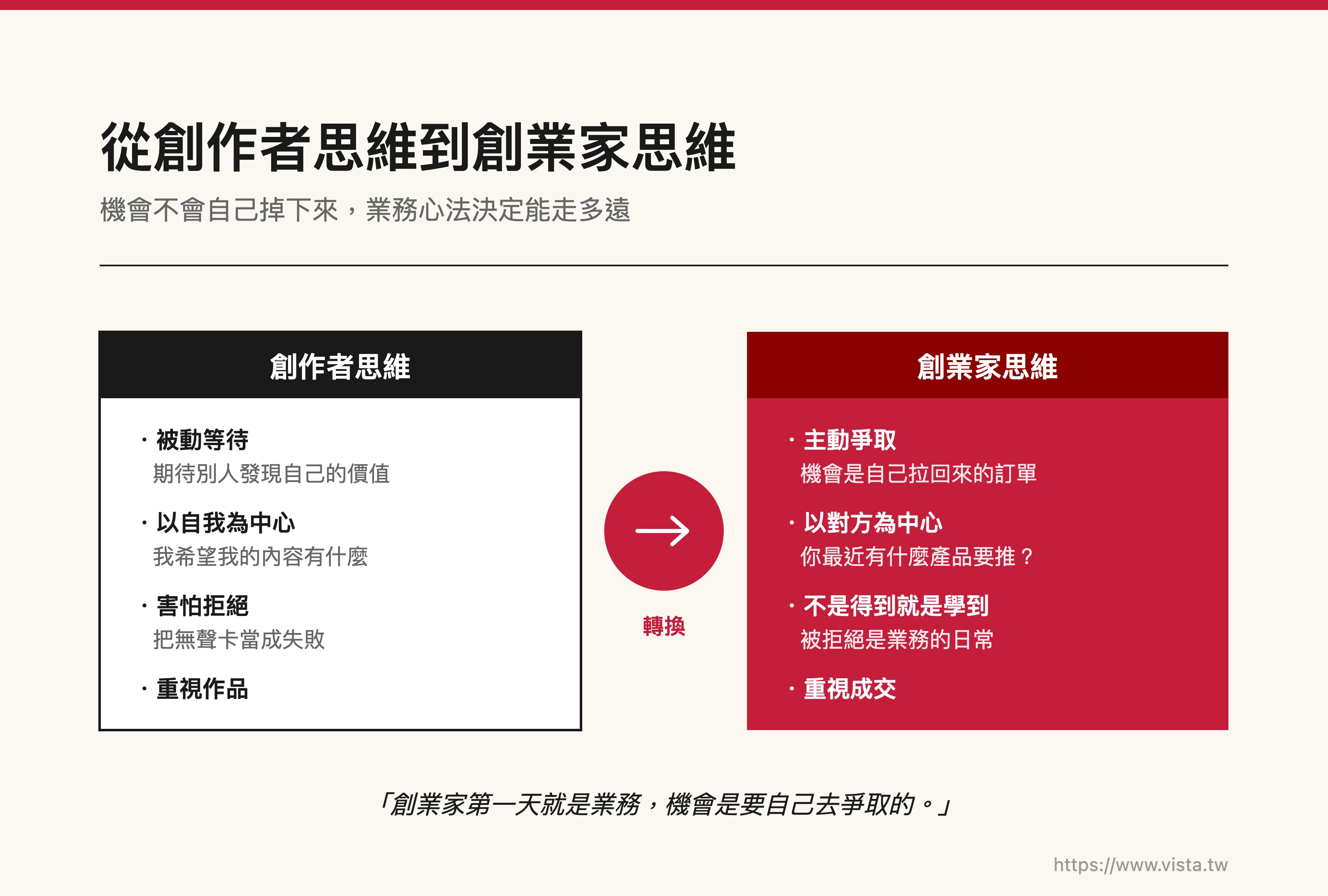 ▲ A creator’s thinking puts himself at the center, while an entrepreneur’s thinking puts the other person at the center—the difference is not in the mentality, but in the first sentence of the letter.
This idea is very simple to explain, but more than 90% of the content is impossible for people to do. The reason is - the core of a creator’s thinking is “let the other person appreciate me”, while the core of the entrepreneur’s thinking is “what can I help the other person achieve”. The former puts himself at the center, and the latter puts the other party at the center. The difference is not in your mentality, but in how you open the first sentence of the letter.
For me, this method doesn’t just apply to interview invitations. It can be used in:
- Invite big names to be co-hosts or guests in your online courses
- Invite enterprises to cooperate in AI writing training (this is exactly the direction that vistacheng.com has been accumulating)
- Invite scholars to participate in my book recommendation or review
- Invite media to cooperate with columns or interviews
Every cooperation invitation is essentially business development. Doing this well is equivalent to expanding your network radius tenfold.
The third level of extraction: The essence of interviews is value exchange, not content production
Charlie said something that I think is worth reading over and over again: “An interview is very much like an information session, a Pre-OPP, a process for strangers to get to know the guest. The role of the host is to help gain insight into his beauty, and amplify his beauty, so that this trust can be transferred from me to the guest.”
This passage reveals a truth that too many people fail to see clearly - interviews are not content production, but trust transfer.
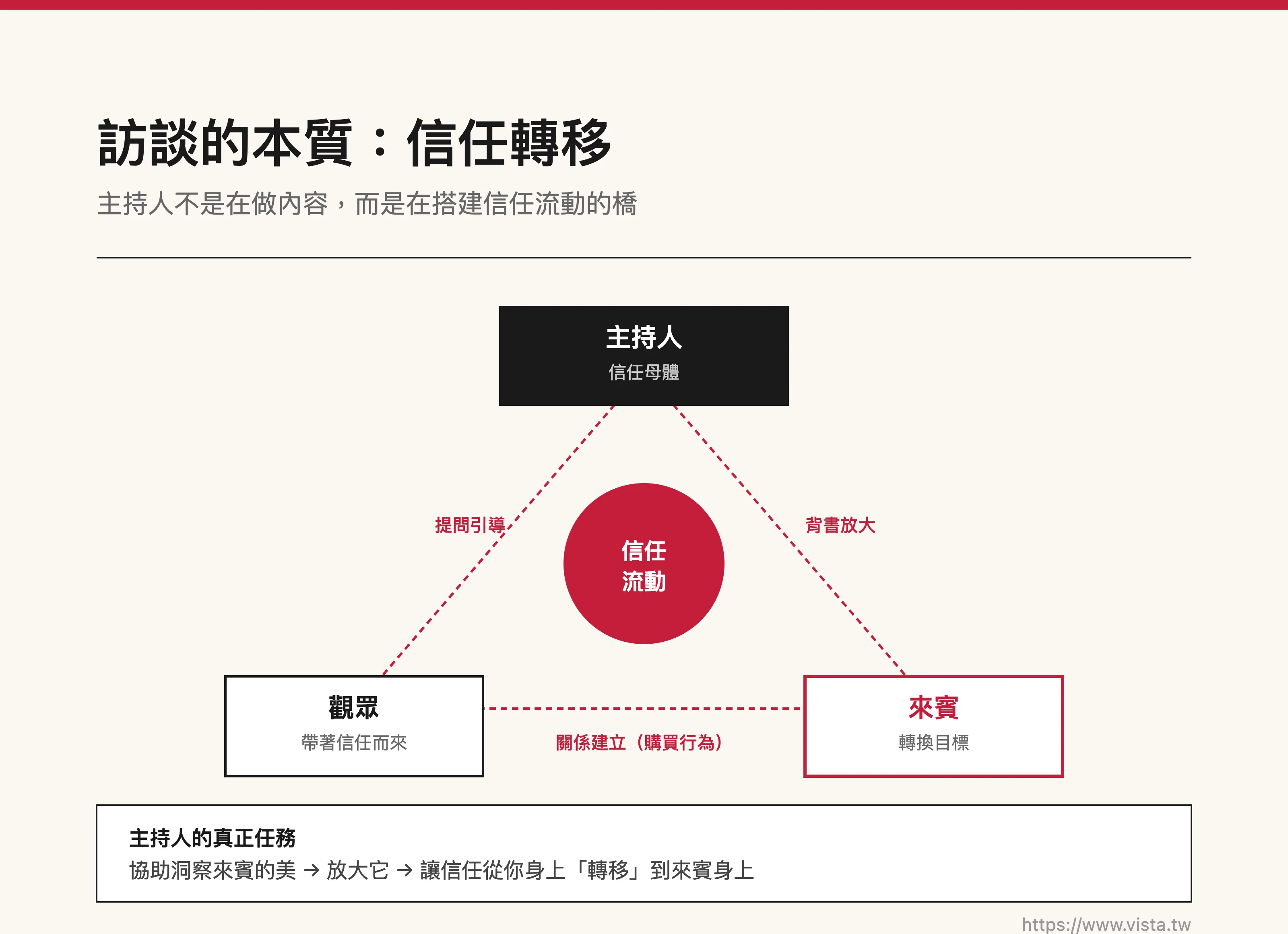 ▲ The audience comes to the show because they trust the host. The host transfers trust to the guests by asking questions, and finally the guests’ products complete the business closed loop.
In this structure:
- Audiences come to the show because they trust the host
- The host lets the audience see the beauty of the guests through questions and designs
- Trust is transferred from the host to the guests
- The audience completes the relationship building with the guest by “purchasing the guest’s product”
In other words, the core action of this triangle is not content, but transfer. Content is just a carrier, and the flow of trust is the real business model.
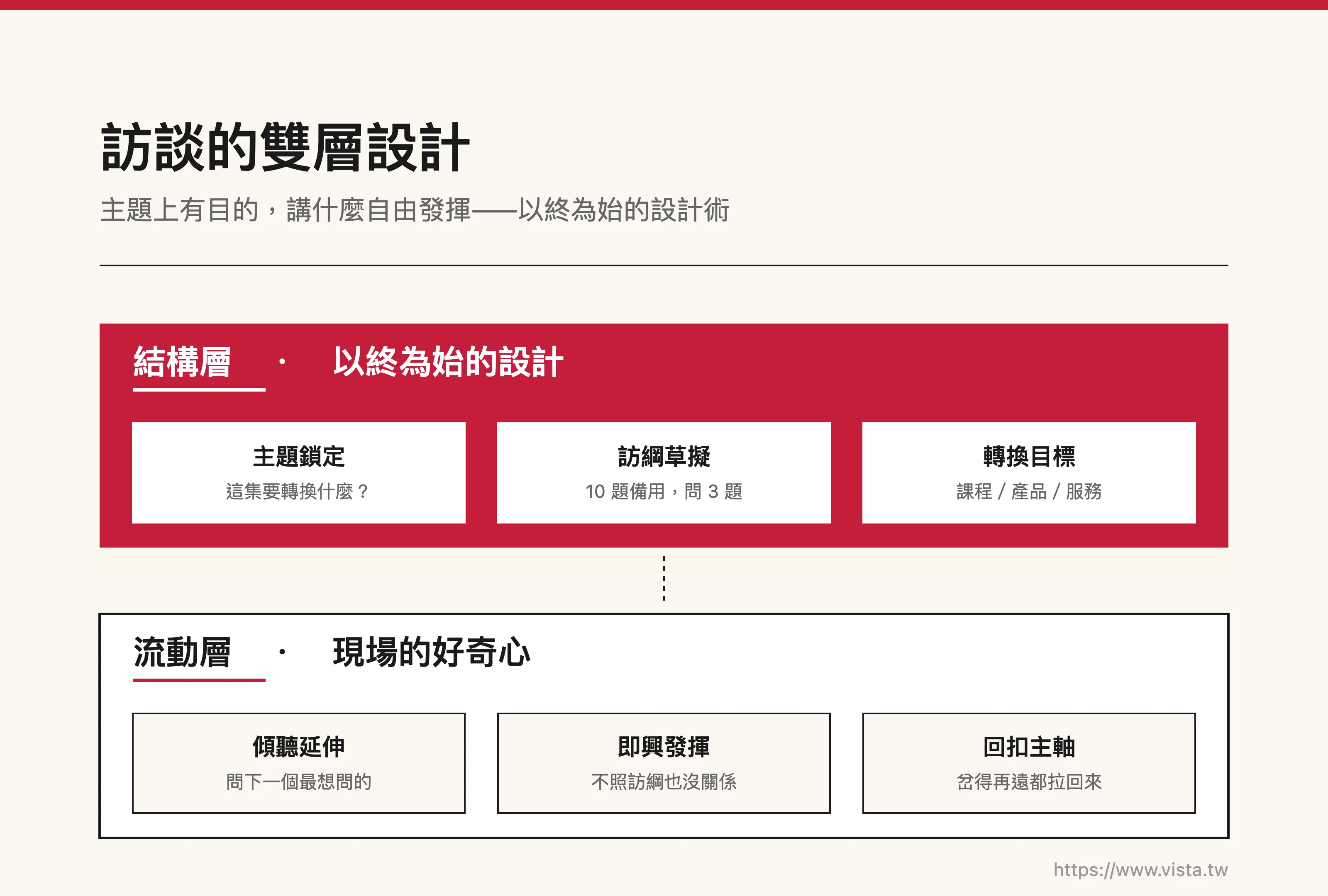 ▲ The surface layer is doing interview content, and the bottom layer is doing trust transfer and business design - the two layers operating at the same time are the real moat of Charlie Channel.
This perspective may change many people’s understanding of dialogue. I have seen many people hosting lectures, doing podcasts, or participating in podcast interviews. They often focus on “did we talk in depth?” and “did I show my knowledge?” But Charlie tells everyone - a good host is the one who lets the guests shine, not the one who steals the guests’ limelight. You may suffer a loss in the early stage because personal brand building is slow; but after two years, all guests will become your decentralized brand assets.
Inspiration for me: If I want to plan my own interview program in the future (for example, for knowledge workers, lecturers or AI users), the core KPI should not be how much I spoke, but how many sales did the guests sell from me? This is the underlying logic of this business model.
The fourth level of extraction: expansion logic of the content matrix - concentric circles centered on people
In the interview, Charlie shared his expansion blueprint: from entrepreneurship → investment and financial management → health → future family relationships, parent-child. This trajectory looks natural, but there is a very important design principle behind it:
All expansion topics are the next topics that the same group of people will care about.
It’s not “I’ll jump to that track if the traffic is good”, but “What do the entrepreneurs I serve care about at different stages of life?” This difference is very critical.
| Expansion logic | Traffic-driven | User-driven |
|---|---|---|
| Motivation | Do whatever is popular | What is the next need of my core users |
| Result | Audiences come and go, and it is difficult to establish deep relationships | Your audience grows with you, and LTV continues to expand |
| Business model | One-time traffic monetization | Multiple product matrix |
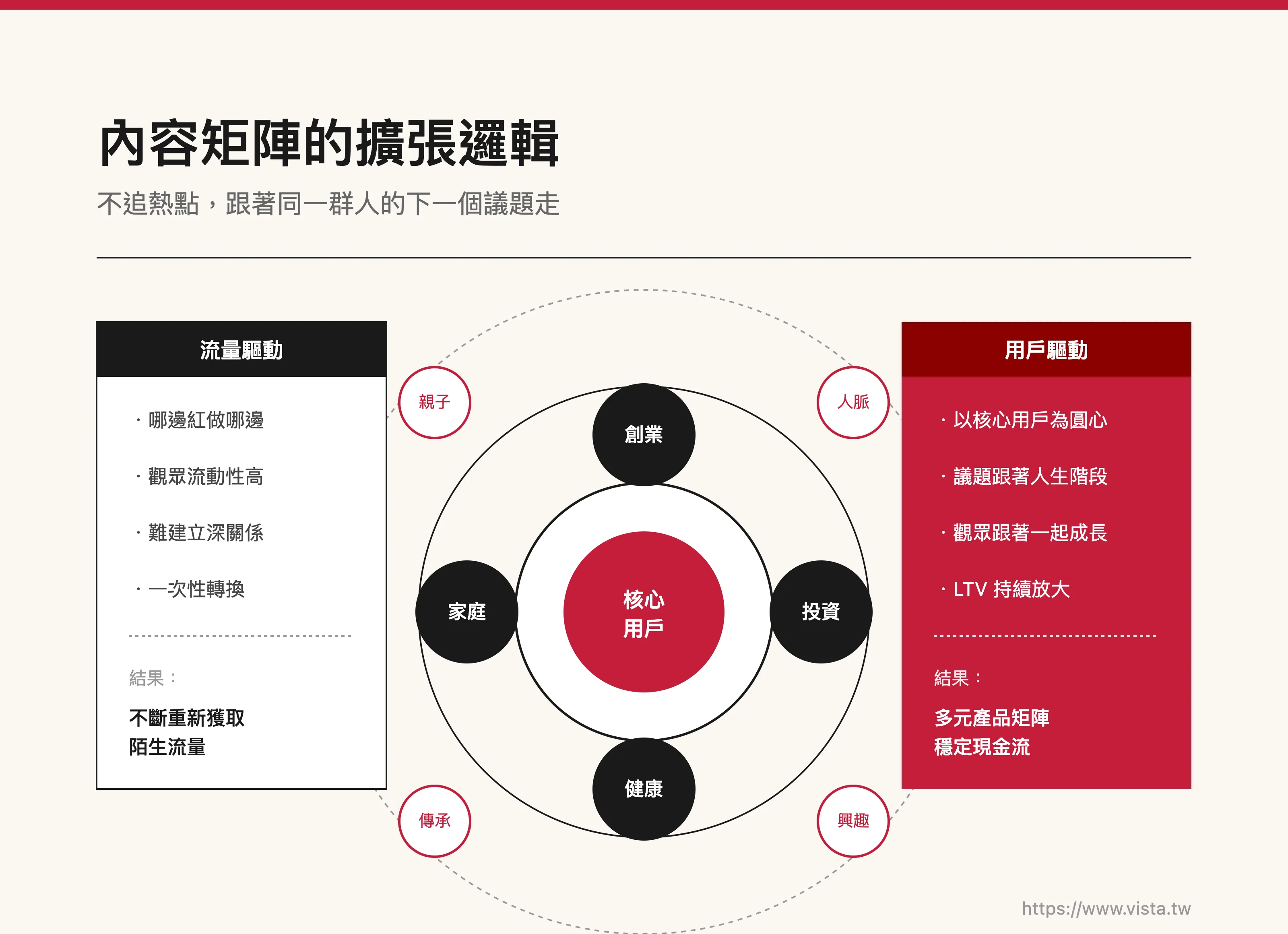 ▲ The user-driven content matrix is an expansion of concentric circles with core users as the center, rather than a leap-forward expansion that pursues hot spots.
This principle, to me, once again confirms the user-centered content strategy. The core users of my services—creators, knowledge workers, lecturers, or PhD students—they care about not just AI writing, but also:
▲ The user-driven content matrix is an expansion of concentric circles with core users as the center, rather than a leap-forward expansion that pursues hot spots.
This principle, to me, once again confirms the user-centered content strategy. The core users of my services—creators, knowledge workers, lecturers, or PhD students—they care about not just AI writing, but also:
- How to monetize writing (personal branding, payment for knowledge)
- How to use AI to improve academic research efficiency
- How to design online courses and training
- How to maintain human irreplaceability in the AI era
- How to manage time, focus, and energy
- How to avoid burnout for a long time
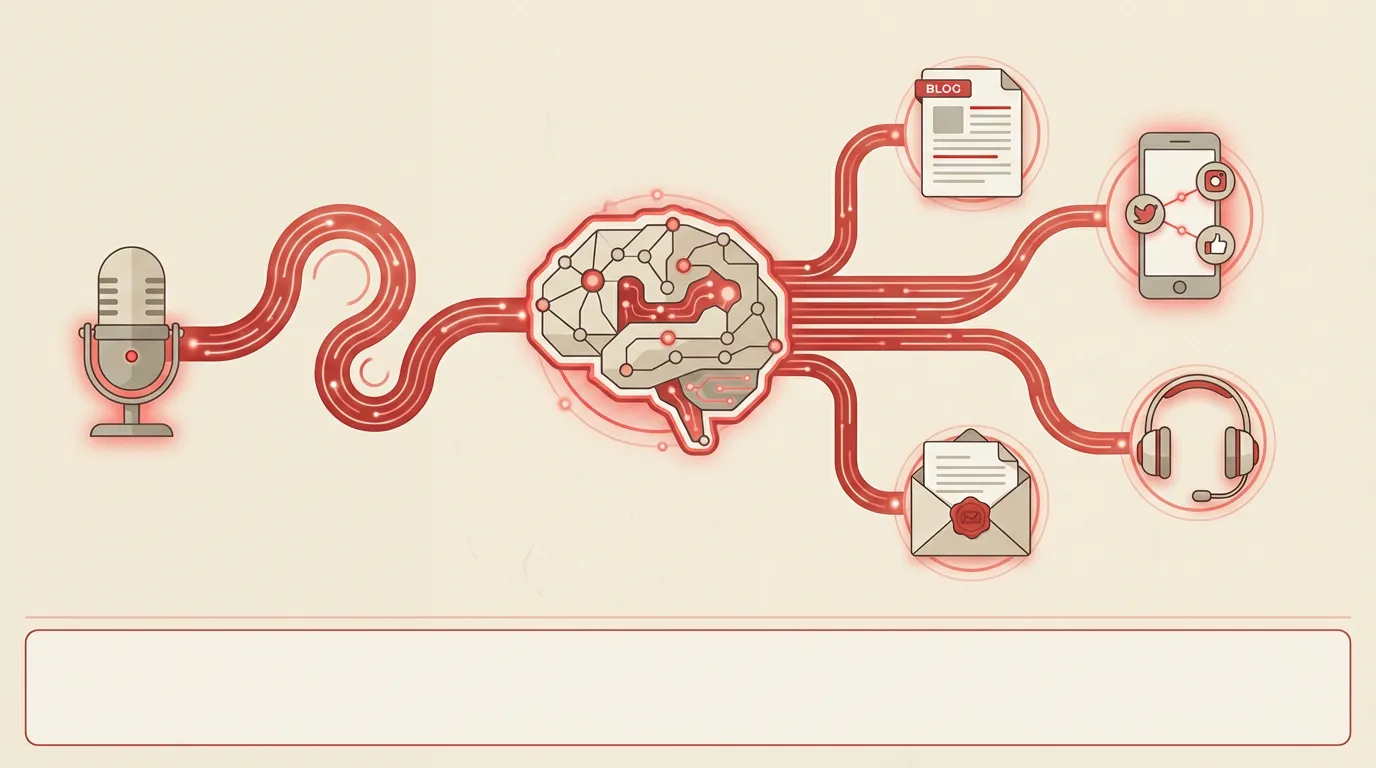
Each one is my next content satellite. If I use Charlie’s expansion logic to look at it, my vista.tw should not just be a personal website in Vista, but a content matrix mothership that serves knowledge workers. I have shared similar observations before in “AI Content Factory System” - a core material runs in six formats, which is essentially another way of displaying the concentric circle matrix.
📡 Want to turn the concentric circle matrix into a content production line that you can run every week?
The “people-centered concentric expansion” demonstrated by Charlie sounds beautiful, but its real implementation requires a stable content production system. The “AI Content Production System Workshop” I designed is to embody this set of logic - one material can be produced in six formats, from e-newsletters, communities, podcasts to courses, a complete content funnel, so that your core users can be connected to the same story line at different stages.
👉 Learn about the course content now: solo.tw/courses/ai-content
The Fifth Level of Extraction: Muscle Memory of Interview Skills—Four Key Actions That Are Easily Overlooked
When Charlie talks about interviewing techniques, there are a few details that I think are extremely practical for anyone doing conversations, interviews, or moderation. I organized it into four key actions:
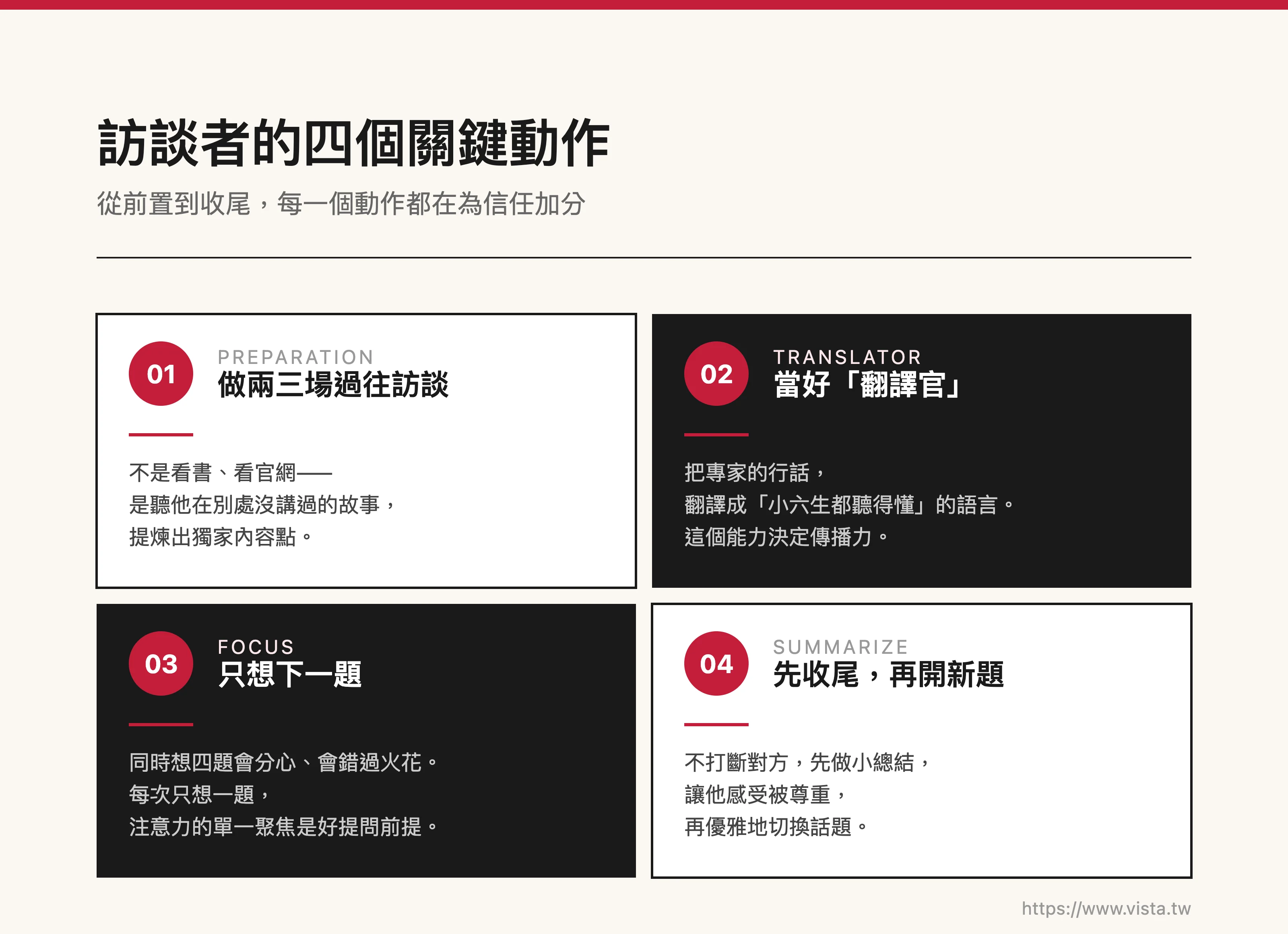 ▲ Listen to two or three past interviews, focus on the next question, finish the questions before starting new questions, and be a good translator - these four actions are the interviewer’s muscle memory.
Action 1: Listen to two or three past interviews and then do your homework
Charlie will listen to the guest’s two to three past interviews, not to copy the questions, but for two purposes: first, to become familiar with the other person’s voice, speaking speed and speaking rhythm, so that the scene will be falsely familiar; second, to find out the other person’s story that has not been told elsewhere or has only been told once. This is your exclusive interview.
What this means to me is: when visiting any important guest in the future, the standard for preparatory homework is not to have read his book or his personal website, but to have I listened to more than three interviews with him? This difference will upgrade your interview from repetitive content to completely new content.
Action 2: Think of the next question while listening, but only one question
Many people get stuck in interviews because they are thinking about four questions ABCD at the same time. Charlie’s approach is: every time a guest answers, he only concentrates on the next question he wants to ask. This way you won’t get distracted and miss the spark of the moment.
This technique isn’t just for interviews. This applies when we are leading discussions in class, moderating in meetings, and asking questions in 1-on-1s. Single focus of attention is the prerequisite for good questioning.
Action three: wrap up the questions first, then open new questions
When the topic needs to be changed, Charlie will not interrupt directly. Instead, he will wrap it up with a short summary before opening a new question. In this way, the other party will feel that “what I said is respected and heard”, and they will naturally accept the topic change.
The essence of this action is to “let the other person feel understood first, and then provide guidance.” It’s not just interviewing techniques, but universal principles for high-quality communication.
Action 4: Make a summary and be a good translator
Charlie particularly emphasized the importance of summarizing. Experts often use too many industry terms in their speeches, and the host’s task is to be the translator and translate them into a language that even sixth-grade primary school students can understand. The better the role, the more powerful the content will be.
Inspiration for me: When I teach writing, I have actually been doing the work of a translator - translating writing from the professional fields of literature, linguistics and journalism into a methodology that knowledge workers can practice. But in conversational formats like interviews, podcasts, or films, I can reinforce that identity more intentionally.
The sixth level of extraction: Energy management is the most important ability after passing the survival stage.
Later in the interview, Charlie said something that particularly struck me: “I have been working for a week straight, and I have to eliminate everything all day long.”
This sentence sounds very common, but for a young entrepreneur to persist in doing it, it requires a strong sense of self-consciousness. Most entrepreneurs will be overwhelmed by work during the survival stage; a few people are still burning themselves during the expansion stage. But Charlie said that when you pass the survival stage, what really limits you is not time, but energy management.
I organized this thinking into a matrix:
| Concentrated high pressure | Allow for expansion | |
|---|---|---|
| Short term | Sprint, output, execution | Recovery, thinking, insight |
| Long term | Burnout, repetition, stagnation | Creation, breakthrough, cross-domain |
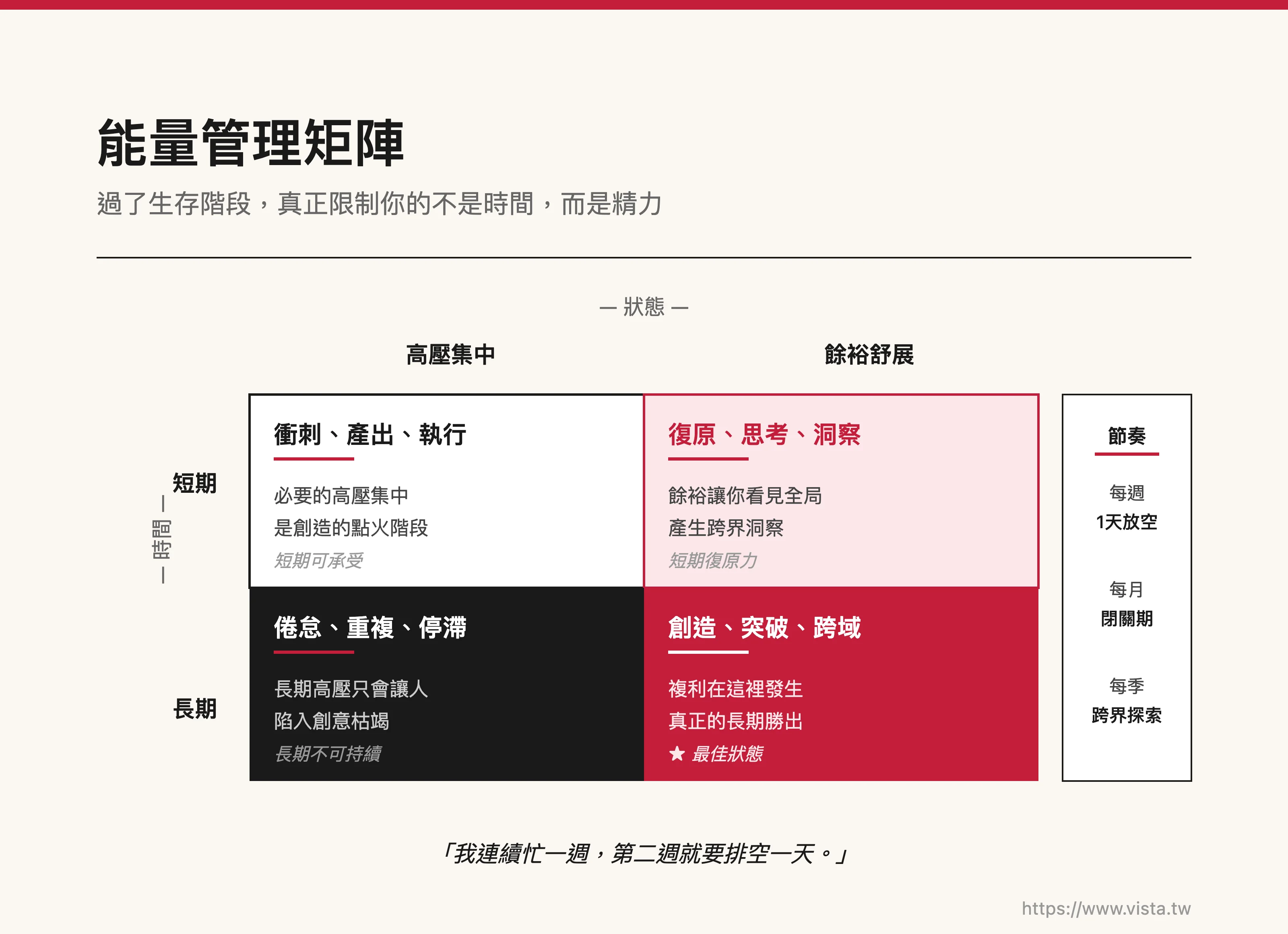 ▲ Short-term high-pressure concentration is necessary, but the long-term accumulation of compound interest is the “spare and stretch” quadrant - it gives you space to think about the next step.
Short-term high-pressure concentration is necessary, but long-term maintenance will only lead to burnout. What can really accumulate compound interest is a state of surplus and relaxation - it gives you space to think about the next step, see new possibilities, and generate cross-border insights.
Chen Xiuping revealed in this episode that after filming 6 consecutive episodes of the podcast, he was exhausted. Later, he went to Jiufen to rent a B&B for a day to relax and regain his condition. This status management is actually the creator’s battery life management.
This was a strong reminder to myself. In the past year, I have been simultaneously advancing research projects, publishing new books, conducting workshops, writing columns, teaching university courses, and running communities - a lot of output, but I have definitely accumulated signs of burnout. The lesson from Charlie is not to work harder, but to rest better.
Viewed from my own perspective: a career blueprint that can be used as a reference
After reading the entire interview, I extracted the career blueprint that is most meaningful to me into five levels:
The first level: positioning - what I want to do is not the content, but the conversion system
The reason why Charlie’s channel can be monetized is because he not only creates content, but also creates a trust transfer system. My vista.tw, solo.tw, content.tw and writing companion plan - the real value of these platforms is not what Vista writes, but the people, books, courses and tools recommended by Vista, which will be trusted.
This change in positioning will make me re-view all cooperation invitations, recommendations and joint names. The reason is simple, because every recommendation strengthens or depletes this trust asset.
Second level: Expansion - concentric circle expansion with core users as the center
My core users are knowledge workers (including creators, lecturers, or PhD students). The topics they care about range from near to far: Writing → Knowledge Management → AI Application → Personal Brand → Course Design → Academic Research → Time/Energy Management → Cross-border Transformation.
Therefore, in the next two years, my content, courses, and community activities should all focus on these issues, rather than chasing hot topics. This also echoes what I emphasized in “Five Things AI Can’t Do: 5C Framework” - humans’ unique soft power will become the key to determining the gap in the AI era.
The third level: product line - from selling content to selling conversion
Charlie demonstrated one thing: interviews, podcasts, videos or communities, these are not products, but conversion vehicles. The real products are the subsequent online courses, subscriptions, physical activities and corporate training.
To me this means:
- vista.tw (content mothership) → Accumulated trust, SEO entrance
- Writing Companion Plan, Easy Use of AI (Online Course) → Mid-price conversion
- Private community → Recurring income, deep relationships
- vistacheng.com (corporate training, on-campus lectures) → High price, high ROI conversion
- Future high-end solutions (small classes, 1-on-1, annual membership) → high LTV
Each product line should have a clear role, rather than a stack of silos.
Level 4: Expansion Node - Find my next format
Charlie’s two fixed formats are: weekly interview episode + spoken word and graphic production. These two formats support his entire business model.
What is my fixed format? Currently it is:
- Weekly long articles (vista.tw, solo.tw)
- SVG graphics card (with long text to share with the community)
- Workshops, corporate training or university lectures (physical output)
The next format I could add might be:
- Interview columns - such as “Vista Conversations with Knowledge Workers”, interviewing a creator, lecturer or researcher every week
- Video SVG explanation - turn existing picture cards into short videos by adding spoken explanations
- Subscription-based e-newsletter - serving readers who do not want to join the community but want to follow up in depth
Level 5: Rhythm - schedule breaks as a non-negotiable core activity
What I want to do in the future is not to wait until I finish my work before taking a break, but to schedule my rest first and then my work. Set aside at least one idle day every week, set aside a retreat period every month, and set aside one week every quarter for cross-border exploration (reading new fields, meeting people in different fields).
This rhythm is not to be more comfortable, but to be sharper.
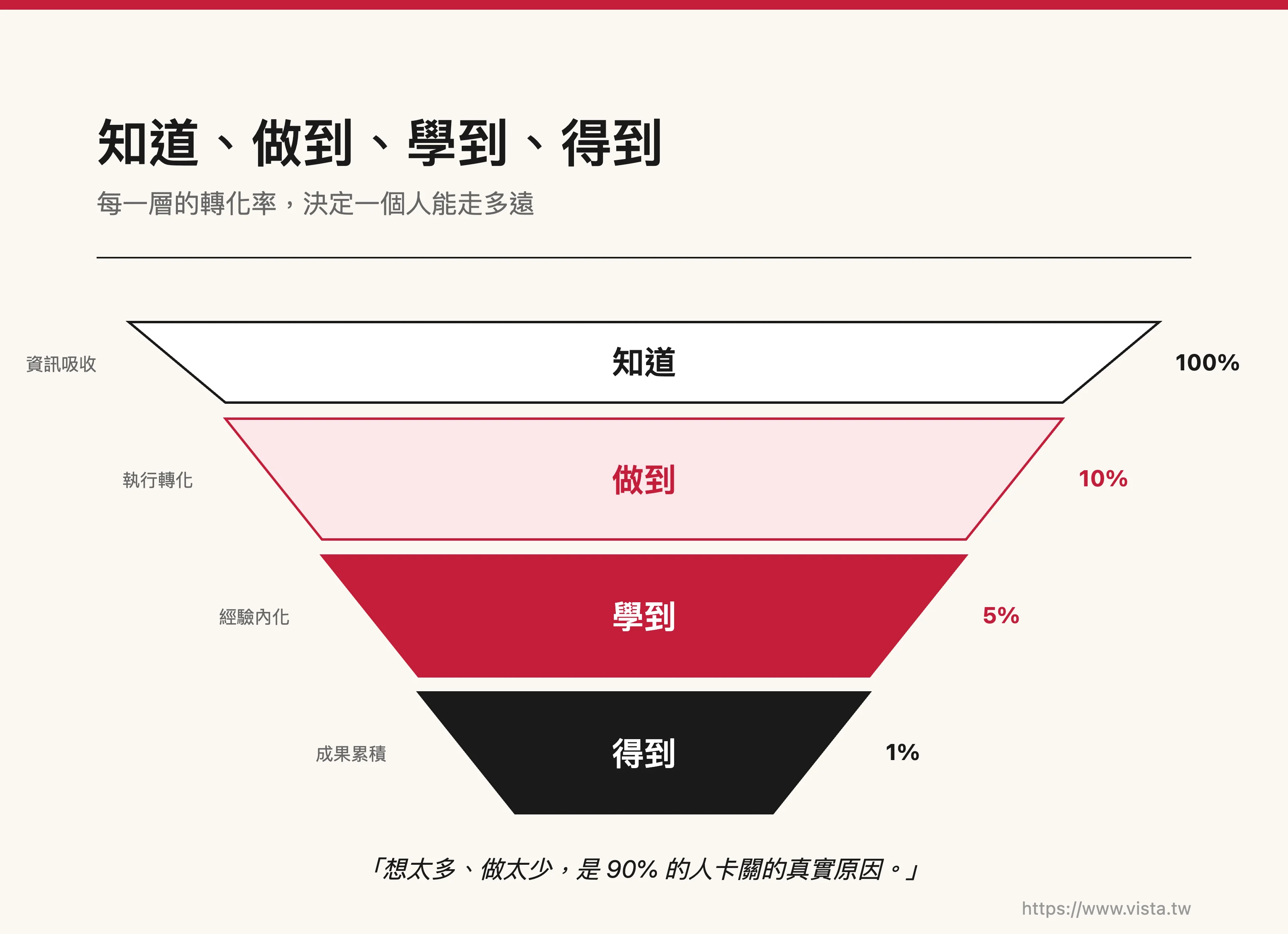 ▲ Knowing is the first step, doing it is the second step, learning is the third step, and obtaining is the fourth step - most people think they have learned it when they stop at “knowing”.
90-Day Action Plan: Turn Insights into Actionable Progress
The value of this episode of interviews would be lost in three days if only read in its entirety. I turned it into a 90-day action plan to give myself a clear next step:
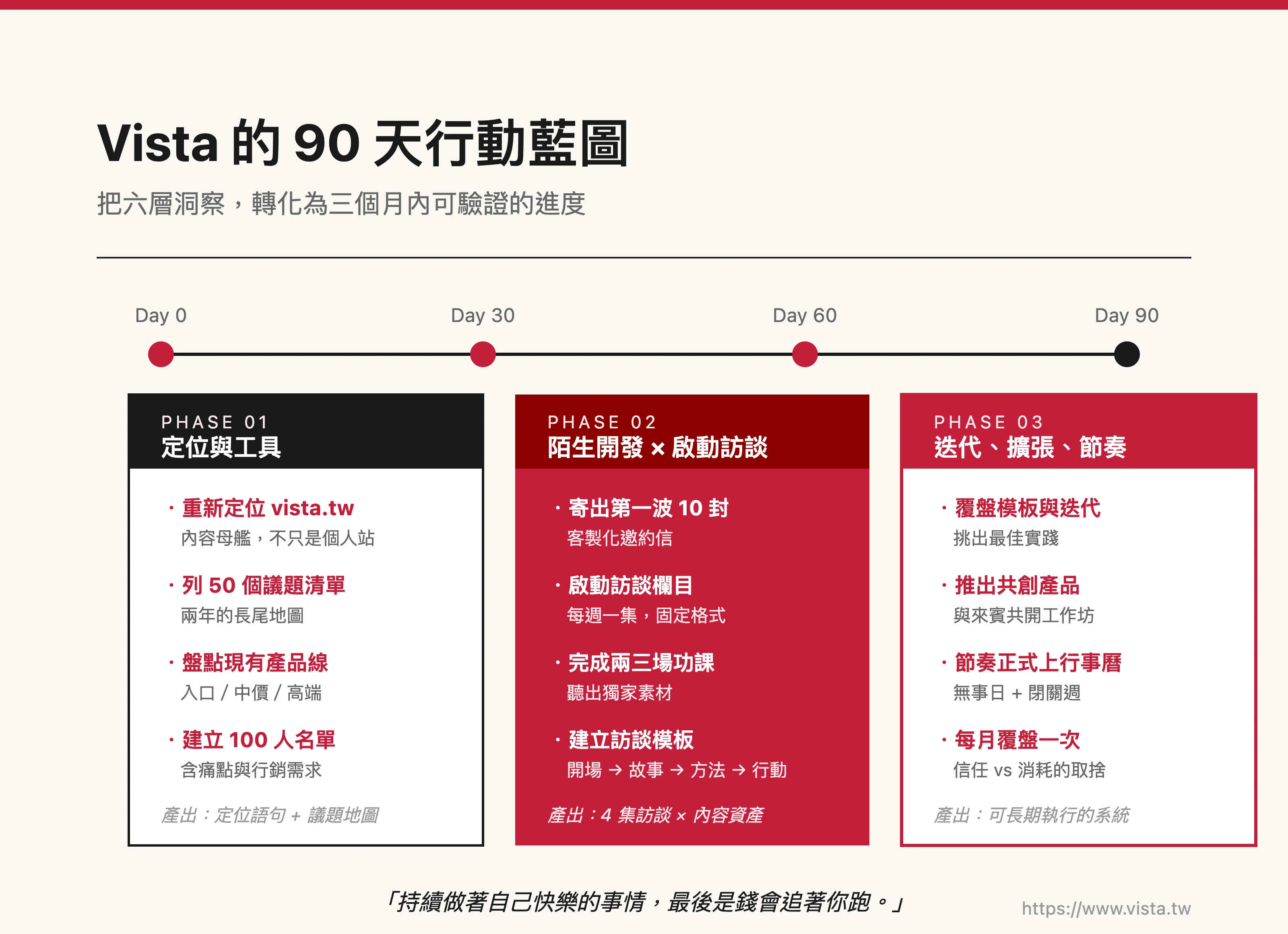 ▲ From positioning, unfamiliarity development to rhythm establishment - transform six layers of extraction into verifiable 30/60/90-day milestones.
Days 1–30: Positioning and Tools
- Redefine the core positioning statement of vista.tw (from “Vista’s personal website” → “content mothership serving knowledge workers”)
- List my “50 Issues List for Core Users” as a long-tail map of content for the next two years
- Take stock of the roles of existing product lines (which one is the entrance, which one is mid-price, which one is high-end)
- Create a “list of 100 people I may work with/interview”, including their recent pain points and marketing needs
Days 31–60: Unknown Development and Interview Column Launched
- Select the first 10 people from the list of 100 people to send customized invitations
- Launched the “Vista Conversations with Knowledge Workers” interview column, one episode per week
- Before each interview episode, do a complete listening exercise of two to three past interviews
- Design a fixed format for interviews: opening → past stories → core methodology → specific suggestions for knowledge workers → closing summary
Days 61–90: Iterate, scale, build cadence
- Pick out best practices from the first 4–8 episodes of interviews and iterate on the interview template
- Start converting the interview guests’ know-how into small workshops or learning topics created by Vista and the guests
- Formally schedule weekly free days and monthly retreat weeks on your calendar without compromise
- Review once a month: Which activities bring about the accumulation of trust assets, and which ones just consume energy
Conclusion: Real scarcity is the ability to do one small thing right for a long time
At the end of the interview, Charlie said something that I especially appreciated: “Keep doing things that make you happy, and money will chase you in the end.”
It sounds like chicken soup for the soul, but behind it is actually a very serious business judgment - in an era where AI is becoming more and more powerful, what cannot be replaced is not technology or knowledge, but stories, relationships, trust and connections, which are accumulated over time.
It took Charlie 17 months to reach 10,000 subscribers, and he reached 30,000 in the 18th month. This curve illustrates one thing: compound interest is not linear, it needs to survive a long horizontal line first. Most people give up at the horizontal stage, so they never see the moment when compound interest really starts.
For those of us who are engaged in content, teaching, and knowledge monetization, the greatest value of this episode of interviews lies not in the new tricks it teaches, but in the demonstration that an ordinary person, relying on simple business mentality, interview skills, and rhythm management, can turn a seemingly inconspicuous path into his own broad road.
And our responsibility is to internalize every movement on this road into our own muscle memory, and then walk it again on our own track.
Further reading:
- AI Content Factory System: One material can be produced in six formats
- Five things AI cannot do: LinkedIn CEO personally teaches the 5C framework
- Stop collecting AI tools: four-step design workflow
- Make good use of AI Agent digital clones to upgrade from mid- to senior-level executives to Agent Commander-in-Chief
External resources:
- Chen Xiuping’s “Master Business School” interview with Charlie Entrepreneurship Compound (YouTube)
- AI Content Production System Workshop (solo.tw)
- content.tw: AI Chinese content workflow
- Vista Consulting and Corporate Training Services (vistacheng.com)
📖 深入探索相關主題