Reloading the boss’s worldview: a complete upgrade from systematic thinking to the underlying business logic

Introduction: Things we think we understand but never really understand
Having worked as a corporate consultant and trainer for more than fifteen years, I have seen too many bosses talk about strategies, visions, and missions in conference rooms, only to fail miserably at the execution level. We have also witnessed countless entrepreneurs who entered the market with full enthusiasm, only to end up floating in the whirlpool of cash flow.
Over the years, I have been thinking about a question: Why are some people unable to break through the bottleneck even though they work hard? Why do some companies always fail to sell even though their products are very good? Why do some teams fail to achieve results even though they are full of talented people?
It wasn’t until I listened to Mr. MJ’s sharing about business power and the boss’s worldview at the ramen club last night that I suddenly realized: the problem is not that we don’t work hard enough, but that we are using the wrong map to navigate. Just like you are holding a map of Taipei from ten years ago and trying to find the newly opened MRT station - it’s not that you have a bad sense of direction, it’s that the tools in your hand are outdated.
The shock that this lecture gave me was not an earth-shattering new theory, but a feeling of recalibration. It made me realize that many of the business ideas we take for granted are no longer suitable for this era of drastic changes.
In today’s article, I want to use my own perspective to reorganize teacher MJ’s core views. It’s not just a paraphrase, but the observation and reflection I have accumulated in the consulting field over the years. I hope it can help more friends who are struggling in business to re-establish a set of boss worldviews suitable for after 2025.
Overall, top performance depends not on eloquence, but on the underlying business logic. This course summarizes nearly 30 years of front-line business experience, from economic trends, business models, financial thinking to customer psychology, to help you build a systematic business understanding. It not only teaches you “how to sell”, but also allows you to understand “why you need to sell like this”. ——MJ Lin Mingzhang, “Sales Mindset for Top Businesses (opens in a new tab)”
Back to the original point - what is the real key in the workplace and business?
At the beginning of the lecture, Mr. MJ did something very interesting: He asked everyone to type in the chat room what are the most critical abilities in all walks of life?
Obviously, the answers are naturally diverse: responsibility, results orientation, problem-solving ability, management ability, execution ability, communication ability, learning ability, business ability or financial ability…
As I looked at these answers, I suddenly felt both familiar and unfamiliar. The reason why I am familiar with it is that I have heard these words countless times at corporate training sites; as for the reason why I am unfamiliar, it is because I found that none of these answers seems to be related to quantifiable achievements.
But what are the values that have been instilled in us since childhood? It’s the result.
The KPI of teachers is student performance, the KPI of parents is children’s performance, the KPI of cram school is enrollment rate, and the KPI of peers is competition. The entire education system has spent more than ten years training us into a machine that pursues scores.
Then when we enter the workforce, start a business, or start running a business, we suddenly realize: the rules of the game have completely changed.
No one cares about your college score. What they care about is whether you can solve problems, create value, and sell things.
This gap has caused confusion and loss for an entire generation.
Systemic problems require systematic thinking to solve
Teacher MJ throws out the first core point here:
Systemic problems must be solved with systematic thinking.
This sentence sounds simple, but the meaning behind it is very profound.
What is a systemic problem? They are those problems that are not caused by a single cause, cannot be solved by a single method, and affect the whole body.
For example: If a company’s performance declines, it may appear that the business team is not working hard enough. However, in-depth analysis may reveal that: product positioning deviates from market demand, marketing strategies have not kept up with changes in consumer behavior, internal processes are too cumbersome resulting in too slow response, and competitors are using lower prices to steal the market…
These problems are intertwined. If you only solve one of them, other problems will still drag you down.
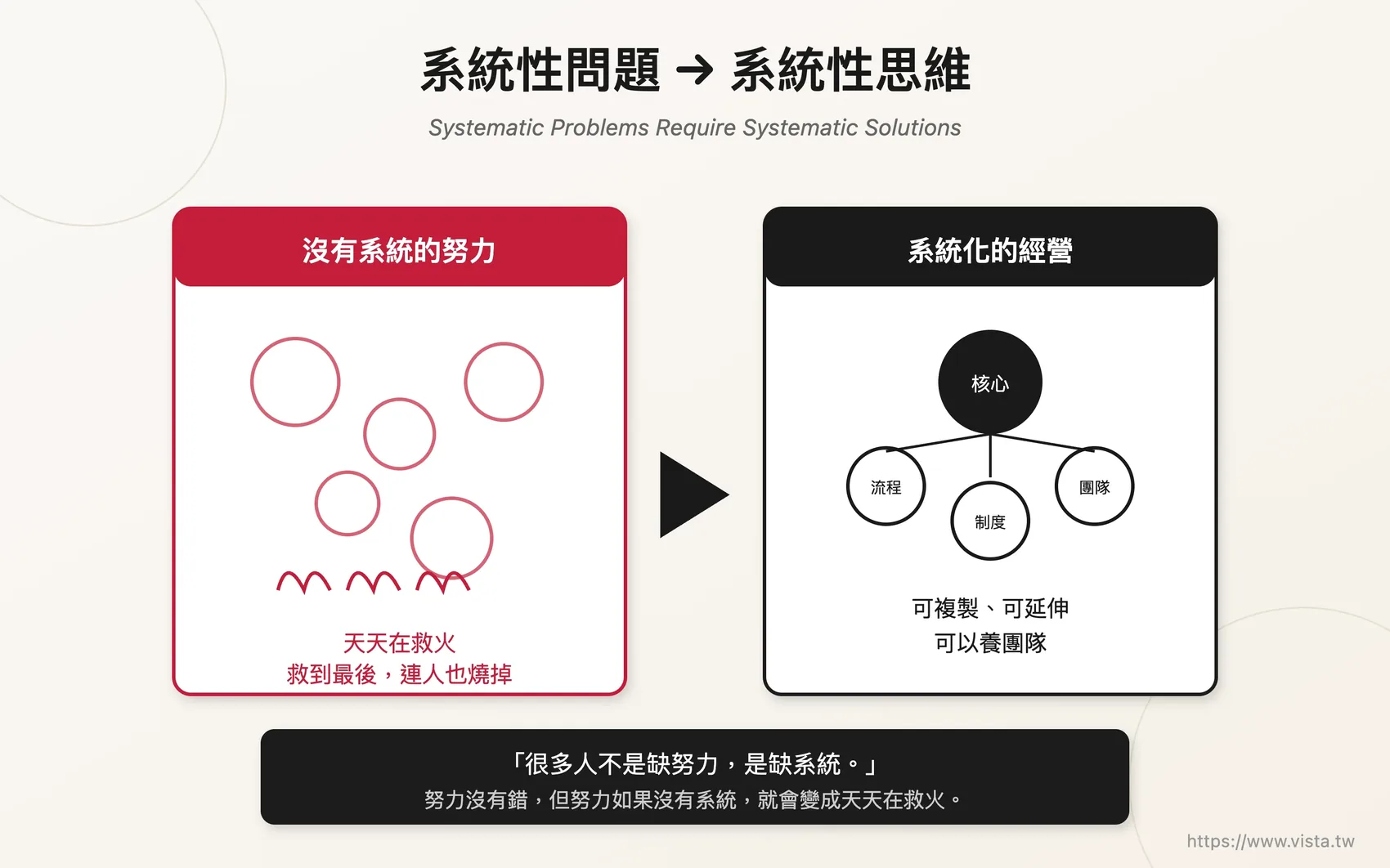 *▲ From fragmented problem symptoms to systematic solutions. *
So Teacher MJ said: The so-called sales does not mean that I can sell things, but whether you can use the system to turn sales into a replicable, scalable and team-building capability.
This passage is particularly touching to me. Because whether I was a reporter interviewing entrepreneurs in the past, or later I joined a company to provide guidance, I have seen too many entrepreneurs who have strong personal abilities and are successful in one-on-one sales, but they just can’t pass this skill on to their teams. As a result, the company’s size is always stuck there because the boss’s time and energy are limited.
Without systematic efforts, it’s like building a castle on the beach - when the tide comes, nothing is left.
Boss’s World Map—The Economic Dashboard You Must Understand
Next, Teacher MJ did something that I found very interesting: he drew a map of the world that the boss needed to understand.
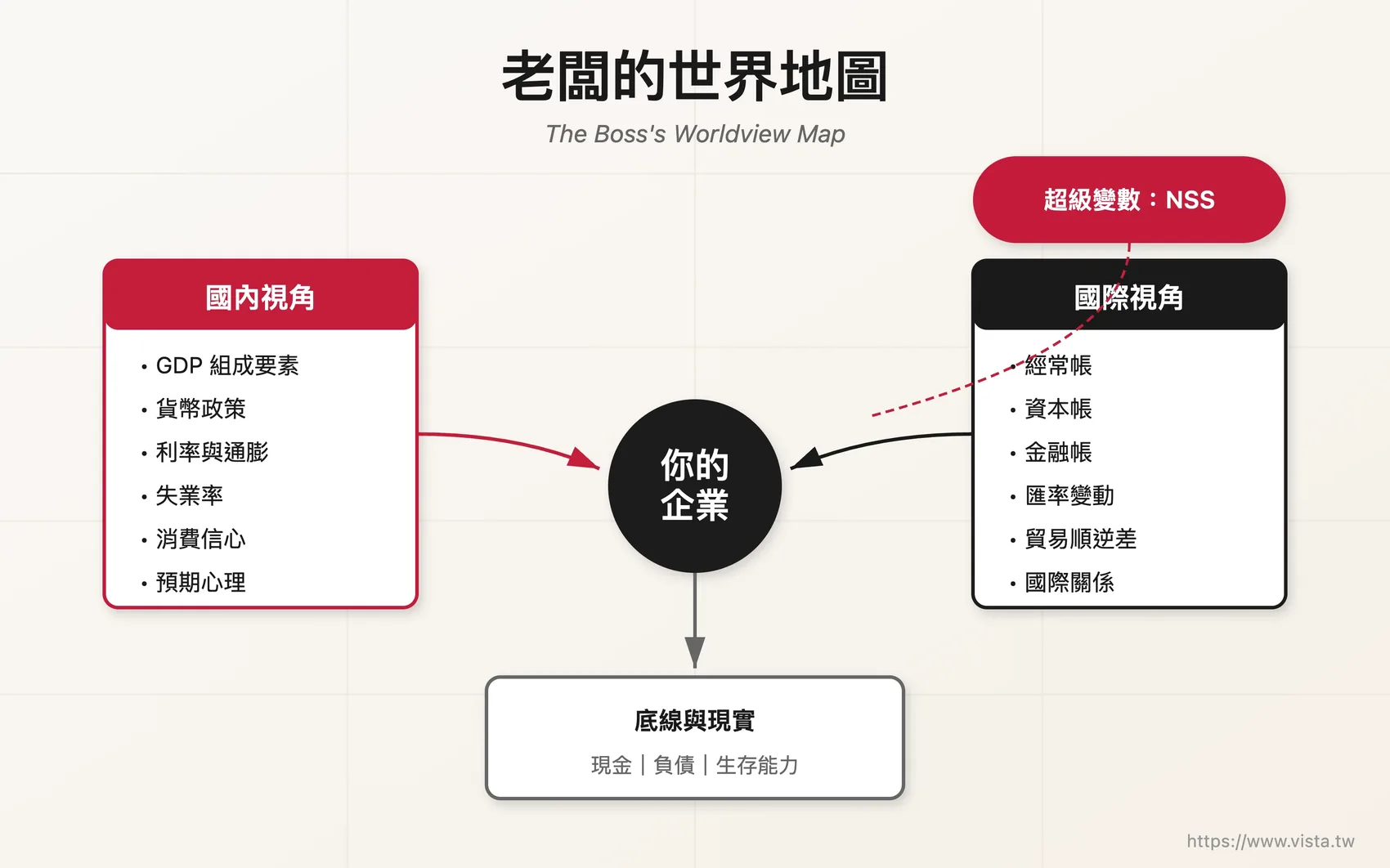 *▲ The boss’s world map: a complete view from macroeconomics to microexecution. *
The structure of this map is clear:
- On the left is the domestic perspective: GDP (opens in a new tab) composition, monetary policy, interest rates, inflation, unemployment rate, consumer confidence
- The right side is the international perspective: current account, capital account, financial account, exchange rate, trade surplus and deficit
- Above are the key indicators: the macro variables that affect your business
- The upper right corner is the super variable: National Security Strategy (NSS) and geopolitics
- Here’s the bottom line and reality: your cash, your liabilities, your ability to survive
Domestic perspective: GDP is not an exam question, it is a business dashboard
Teacher MJ directly asked everyone to remember this formula:
GDP = C + I + G + (X − M)
- C: Private consumption (Consumption)
- I: Private investment (Investment)
- G: Government expenditure (Government)
- X−M: Exports minus imports (net exports)
Simply put, this formula is the most commonly used method for measuring a country’s gross domestic product (GDP), called the expenditure approach (Expenditure Approach). It represents the total market value of all final goods and services produced within a country during a certain period of time.
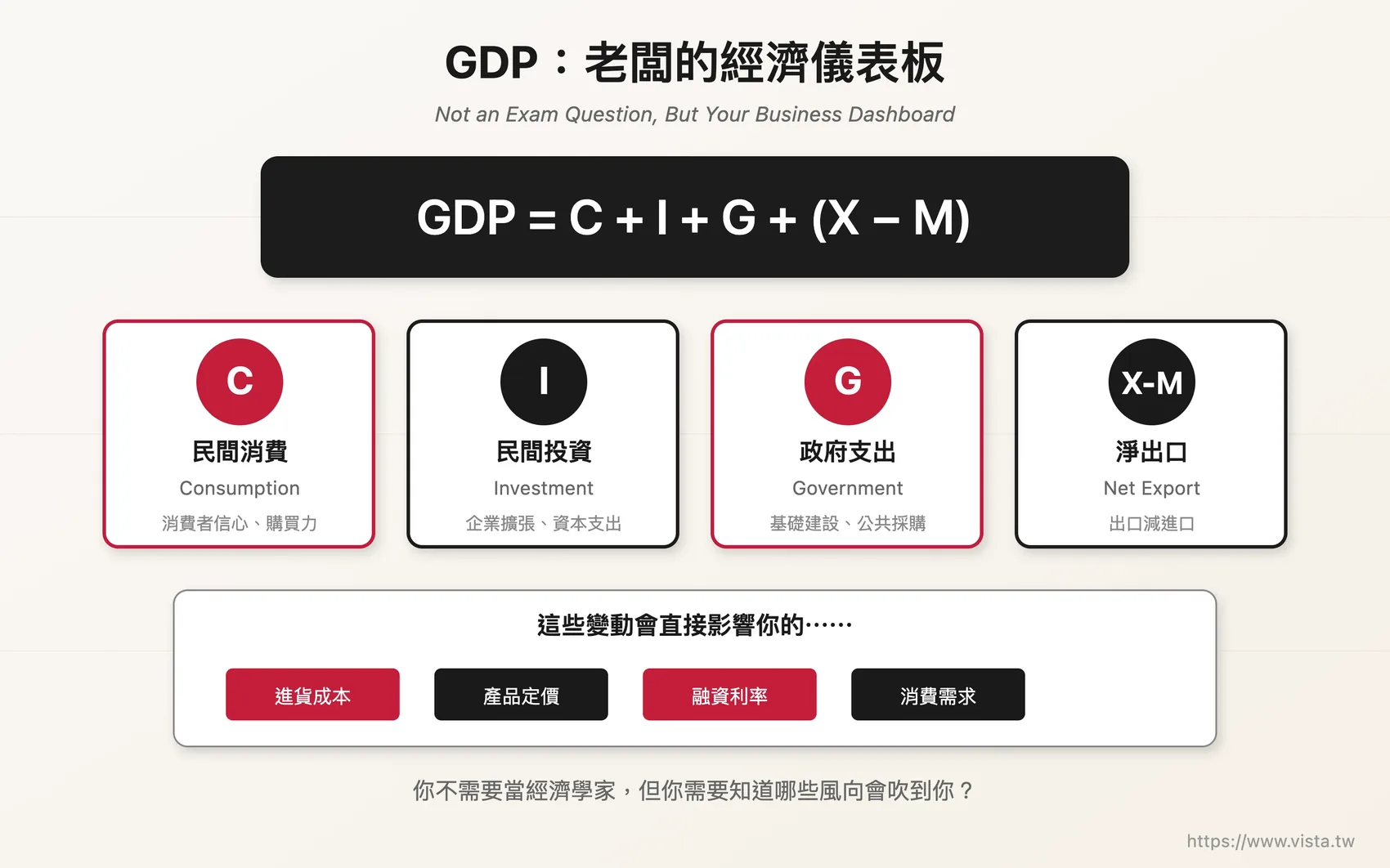 *▲ Use GDP and related indicators to grasp the economic pulse and business opportunities. *
The point he emphasized was not that everyone should memorize formulas—that was students’ thinking. What he wants to convey is: when money supply changes, interest rates adjust, inflation rises, unemployment changes, or consumer expectations change… these macro factors will directly affect your purchase costs, product pricing, financing interest rates, and consumer demand.
Let us use a practical case to illustrate: Global inflation will soar in 2022, and the U.S. Federal Reserve will quickly raise interest rates. What impact will this seemingly distant decision have on the many small and medium-sized enterprises in Taiwan?
- The US dollar appreciates and the New Taiwan dollar depreciates: If you do import business, the purchase cost will directly increase.
- Global funding crunch: Financing becomes more difficult and expensive
- Consumer confidence declines: People start to shrink their hands and reduce unnecessary consumption
- Inventory pressure increases: things cannot be sold, but the goods have been received
At that time, many bosses had similar confusion: “My products have not changed, my services have not changed, and my prices have been kept as low as possible. Why can’t I increase my performance?”
Teacher MJ put it bluntly: It’s not your problem, it’s the entire environment’s problem. But if you don’t understand the environment, you will take all the responsibility on yourself and make wrong decisions—such as discounting wildly, overextending, or borrowing more money to survive this crisis…
International Perspective: Changes in exchange rates and trade order determine the difficulty of your life
Economic exchanges between countries are mainly recorded through three accounts:
- Current account: import and export of goods and services, investment income, international remittances
- Capital account: transfers of non-financial assets (relatively small amounts)
- Financial account: direct investment, securities investment, other investments, foreign exchange deposits
These things sound like things that often appear in financial textbooks. What impact do they have on actual operations?
Let me give you an example: If you are a cross-border e-commerce business, you often need to send goods from Taiwan to the United States, Europe or Southeast Asia. When the exchange rate fluctuates, it will directly affect your profit margin.
When the New Taiwan dollar rises from 28 to 32 to the U.S. dollar, your U.S. dollar revenue is converted back into New Taiwan dollars, which directly increases your income by 14%. Sounds great, right? But if your raw materials are imported in US dollars, the cost will also rise at the same time.
This is why Teacher MJ said: Those regulations and policies that you think are far away from you are actually affecting you every day.
It is true that when doing business, you can’t just look at your own small circle. You have to raise your head and look at the wind direction outside. Not to become an economist, but to know which winds will blow you?
Super variable in the upper right corner: The end of the free trade era?
This is the most warning passage in the entire lecture.
Teacher MJ mentioned the concept of NSS (National Security Strategy). His interpretation is: We are gradually moving from the free trade narrative we were familiar with in the past to a new era in which national security, technological competition, supply chain restructuring, and economic security are all tied together.
Well, what does this mean?
In the past thirty years, we have become accustomed to a globalized world view: produce wherever the cost is low, and sell wherever the market is large. The decision-making logic of enterprises is very simple, mostly to maximize efficiency and minimize costs.
But now, this set of logic is being replaced by another set of logic, such as: safety first, supply chain autonomy and technology not leaking out. Behind the news, such as the U.S.-China technology war, chip export controls, embargoes on key raw materials or cross-border restrictions on data, represent a whole new set of game rules.
What does this mean for SMEs?
- Your supplier may suddenly be out of stock: because he is included in a sanctions list
- Your customers may suddenly be unable to place orders: because there is a problem with cross-border payment
- Your production base may suddenly become a risk zone: due to geopolitical tensions
- The platform you are accustomed to may suddenly be disabled: due to data security considerations
This is not alarmist, this is reality that is already happening.
Therefore, Teacher MJ reminds everyone:
What are your strategic goals? Who do you want to be? What to do? That’s your North Star. The goals are different, the people you look for, the process (Process), the organizational structure (Structure), and the rewards (Reward) are different.
I think the meaning of this passage is: In this era of increasing uncertainty, you must first figure out where you want to go, and then allocate resources accordingly. Instead of following the crowd and following what others do.
A business framework to embed yourself into a large system without being crushed
Teacher MJ organized his business structure into a simple framework. The great thing about this framework is not how cool it is, but that it connects the common pain points of entrepreneurs in a logical system.
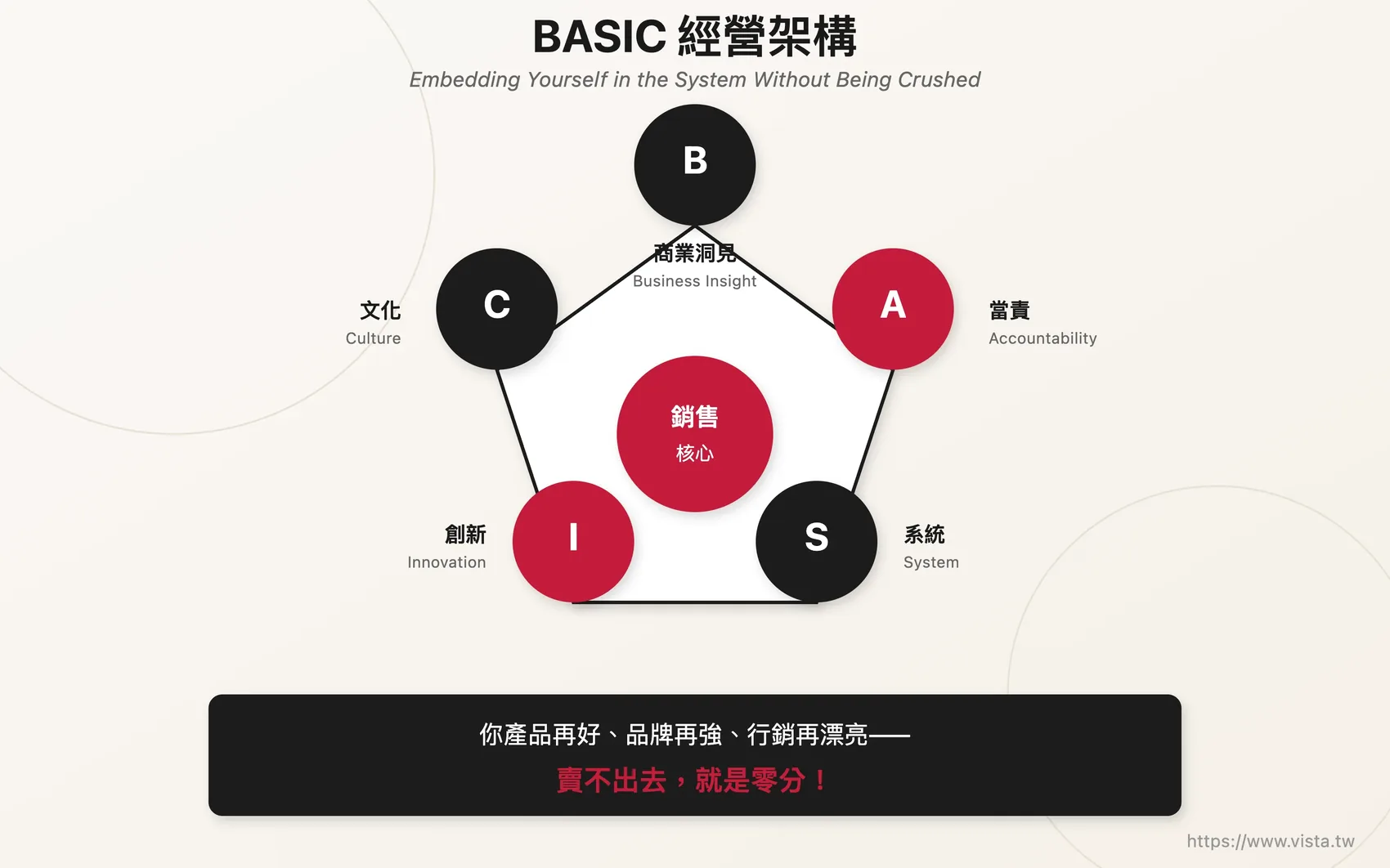 *▲ BASIC Business Structure: Five dimensions used by bosses to diagnose corporate health. *
Next, let me use my own understanding to try to dismantle this framework:
B: Business Insight
This is where it all starts. You have to understand: Where is the market? What do customers want? What are competitors doing? Which direction is the trend going?
The problem that many entrepreneurs have is: they love their product so much that they forget to ask the market if they want it?
The reason is simple. Just like many restaurant owners, they think the food they sell is delicious, but this does not mean that customers will pay for it.
Business insights are not innate, they can be developed. The method is: observe more, ask more questions and verify more. Don’t stay in the office and imagine the market, go out and talk to real customers.
A: Accountability
The word “taking responsibility” is often talked about in the field of business management, but there are very few people who actually do it.
What is responsibility? It’s not that it’s over with “I’m responsible for this matter”, but “I’m responsible for this matter to the end. No matter what obstacles are encountered in the way, I will find a way to solve it until the goal is achieved.”
What is the opposite of responsibility? It’s “It’s not my problem”, “I’ve tried my best”, “It’s all because of XXX, so there’s nothing I can do about it”. When an organization is permeated with this mentality, no matter how good the strategy is, it will not be able to be implemented.
S: System
This is the core point that Teacher MJ repeatedly emphasizes: Don’t be a screw in the system, be the commander in the system.
Well, what does this mean?
If you are the boss and your main job every day is to deal with things, then you are a screw. You are driven by the system, not you driving the system.
A real operator should be designing the system, optimizing the system, letting the system run on its own, and then using his or her time on higher-value matters.
This is why many small companies never grow—because the boss turns himself into the biggest employee, not the designer of the system.
I: Innovation
Innovation is not about inventing new things, but about solving problems and creating value in different ways.
Sometimes, innovation is changing the function of the product; sometimes, innovation is changing the way of sales; sometimes, innovation is changing the process of interacting with customers; sometimes, innovation is changing the mode of internal collaboration.
The point is not whether there is innovation, but whether innovation creates value for customers. Innovation for the sake of innovation is just a waste of resources.
C: Culture (culture)
What is culture? Simply put, what do your employees do when no one is watching?
Many bosses spend a lot of money on consultants, systems and processes, but their employees just don’t follow them. Why? Because the culture is not established.
Culture is not a slogan posted on the wall, but a pattern of behavior formed over time. It comes from: how does the boss make decisions, how does the company reward employees, how does the team handle conflicts, and how does the organization face failure?
SALE: FINAL INSPECTION OF ALL FRAME
Teacher MJ has brought sales to the core of the entire framework. His point of view is very direct:
No matter how good your product is, no matter how strong your brand, and no matter how beautiful your marketing is - if it doesn’t sell, you’ll get zero points.
He gave an example of a jacket, which impressed everyone.
“Everyone knows what a jacket is and what its functions are. But how many people actually buy it?”
This sentence is like a knife, directly cutting through the fantasies of many brand people:
Awareness does not equal sales.
Traffic does not equal conversion rate.
Volume does not equal cash flow.
You can have a lot of people know about you, but if they don’t buy into it, you still won’t survive.
This is why I keep emphasizing: No matter you are making products, services or content, in the end you have to come back to one question - “How do people pay you?”
If you can’t answer this question, everything else is empty talk.
Six survival tips for bosses in 2026 – The art of balancing defense and offense
This is the most serious part of the lecture that I remember, because it is not an empty inspirational speech, but practical advice with a strong sense of crisis.
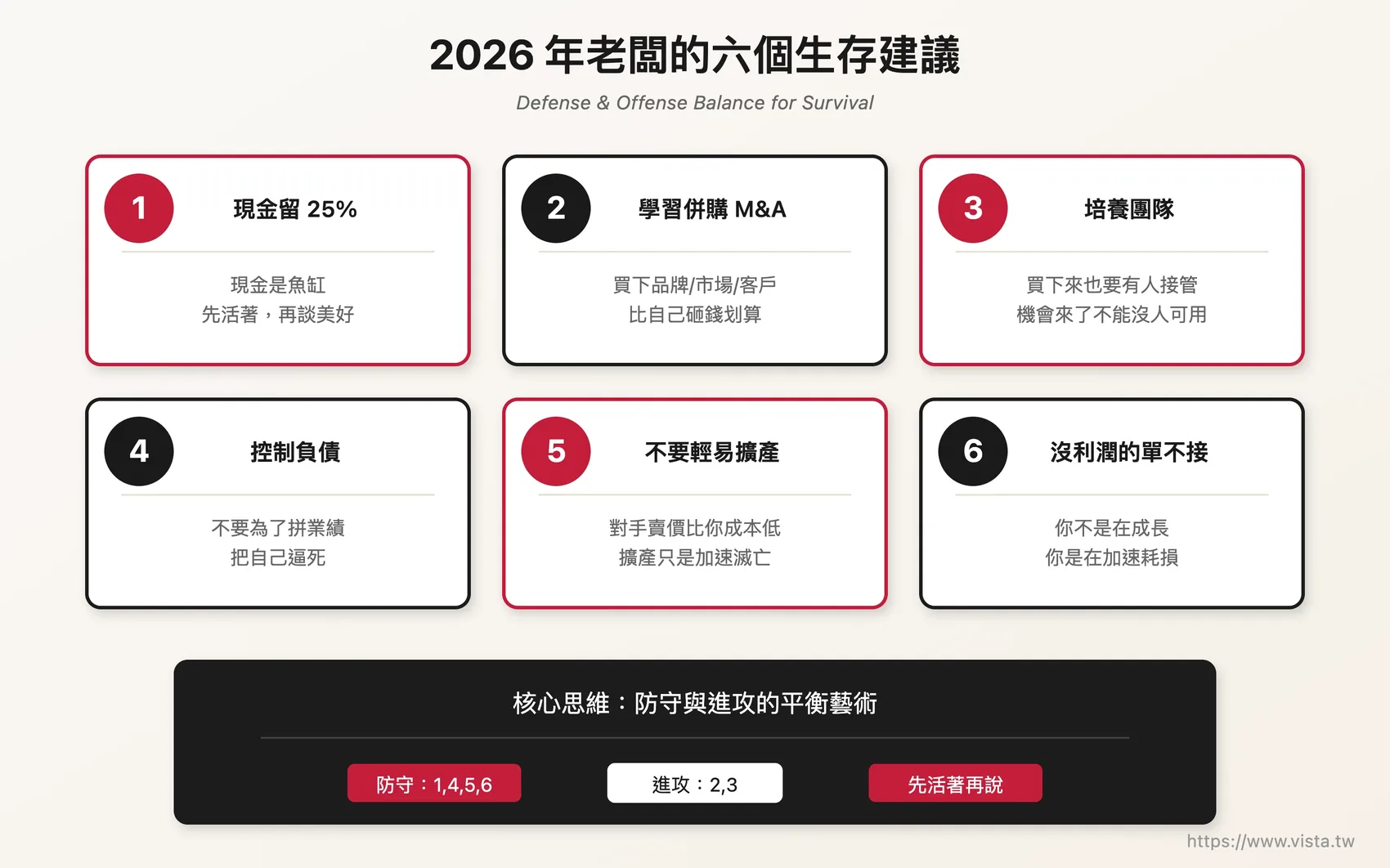 *▲ In uncertain times, six survival rules that bosses must master. *
Suggestion 1: Keep 25% in cash - living is a great existence in itself
Teacher MJ said it very directly: “Cash is a fish tank. The fish must be alive and there must be water in the tank.”
This metaphor is so accurate.
The problem of many bosses is that as soon as they make money, they rush to expand, invest and expand production. As a result, when the economy reversed and cash flow broke, the company collapsed.
25% is a reference benchmark, which means: you must have enough cash on hand to enable the company to survive for at least three to six months without revenue.
This is not conservative, this is the basic skill of survival.
Suggestion 2: Start learning mergers and acquisitions (M&A)—grow in a smarter way
Teacher MJ mentioned a very interesting point: Sometimes it is much more cost-effective to buy other people’s assets than to do it yourself.
Well, what does this mean?
Let’s say you want to enter a new market. You can:
- Invest in building your own brand, advertising, and cultivating customers (it may take three years and burn millions)
- Or, find a small company already operating in that market and buy it outright
Obviously, the latter is probably faster, cheaper, and less risky.
He used the case of World Gym to illustrate: Rather than slowly opening a gym yourself, it is better to directly buy an existing brand that already has members, venues and teams.
The thinking behind this is: In the next few years, many companies will not be able to survive. When others are clearing their positions, it is the best time for you to enter the market.
But the premise is: you have to have cash, and you have to be able to evaluate what is worth buying.
Suggestion 3: Cultivate a team - because if you buy it, someone needs to take over.
M&A does not end when the purchase is completed, but begins after the purchase is completed!
If you buy a company, who will run it? Who will integrate it? Who will manage the people who are not your employees?
If you don’t have a team, even if you buy a bargain, you won’t be able to digest it.
Therefore, teacher MJ’s advice is: start cultivating talents now, don’t wait until the opportunity comes and find that no one is available.
Suggestion 4: Control debt – don’t push yourself to death just to achieve performance.
This is indeed the tragedy I have seen most on the consultant site, that is, the revenue is very good, but the company feels like it is dying.
how so?
Because in order to improve their performance, they borrowed a lot of money, stocked up like crazy, and opened stores everywhere. The numbers look great on paper, but the cash flow is negative. Once there is any disturbance, such as delayed payment by customers, increase in raw material prices or rent increase, the entire capital chain will be broken.
Teacher MJ reminds everyone: Debt is not impossible, but it must be controlled within what you can bear. Don’t push your company to the brink of bankruptcy in pursuit of growth.
Suggestion 5: Don’t expand production easily—especially in areas where you compete head-on with Chinese companies.
This is a very realistic and even cruel suggestion.
The teacher made it very straightforward: In some industries, the selling price of Chinese companies may be lower than your cost.
This is not because they are more efficient than you (although some are), but because they may have subsidies, economies of scale, or simply not calculate full costs.
In this case, if you follow the expansion of production without knowing the reason, it will only accelerate your demise.
The smarter approach is to wait until they can no longer hold on, and then buy the production capacity at a lower price.
This sounds a bit like waiting for others to die, but that’s how business is - either you die or I live. Rather than die together, it is better to conserve your strength and wait for the opportunity.
Suggestion 6: Don’t take orders without profit
I would like to send this sentence to all the bosses who are extremely busy but have not become rich:
You are not growing, you are accelerating wear and tear.
Many bosses have a myth: think about momentum first, then when you measure up, profits will naturally follow.
But the real situation is often: for the sake of momentum, you have to lower the price; after lowering the price, the profit is almost non-existent; without profit, there is no way to invest in optimization; without optimization, you can only continue to lower the price… This is a vicious circle.
Taking an unprofitable order means not only that the order is unprofitable, but also that you have invested the company’s resources (time, manpower, and production capacity) in a place that will not generate returns. These resources could have been used on more valuable things.
Therefore, sometimes saying no is more important than saying yes.
The era of double rolls - the double attack of inner and outer rolls
Teacher MJ used a very graphic word to describe the current competitive environment, that is, the double-volume era.
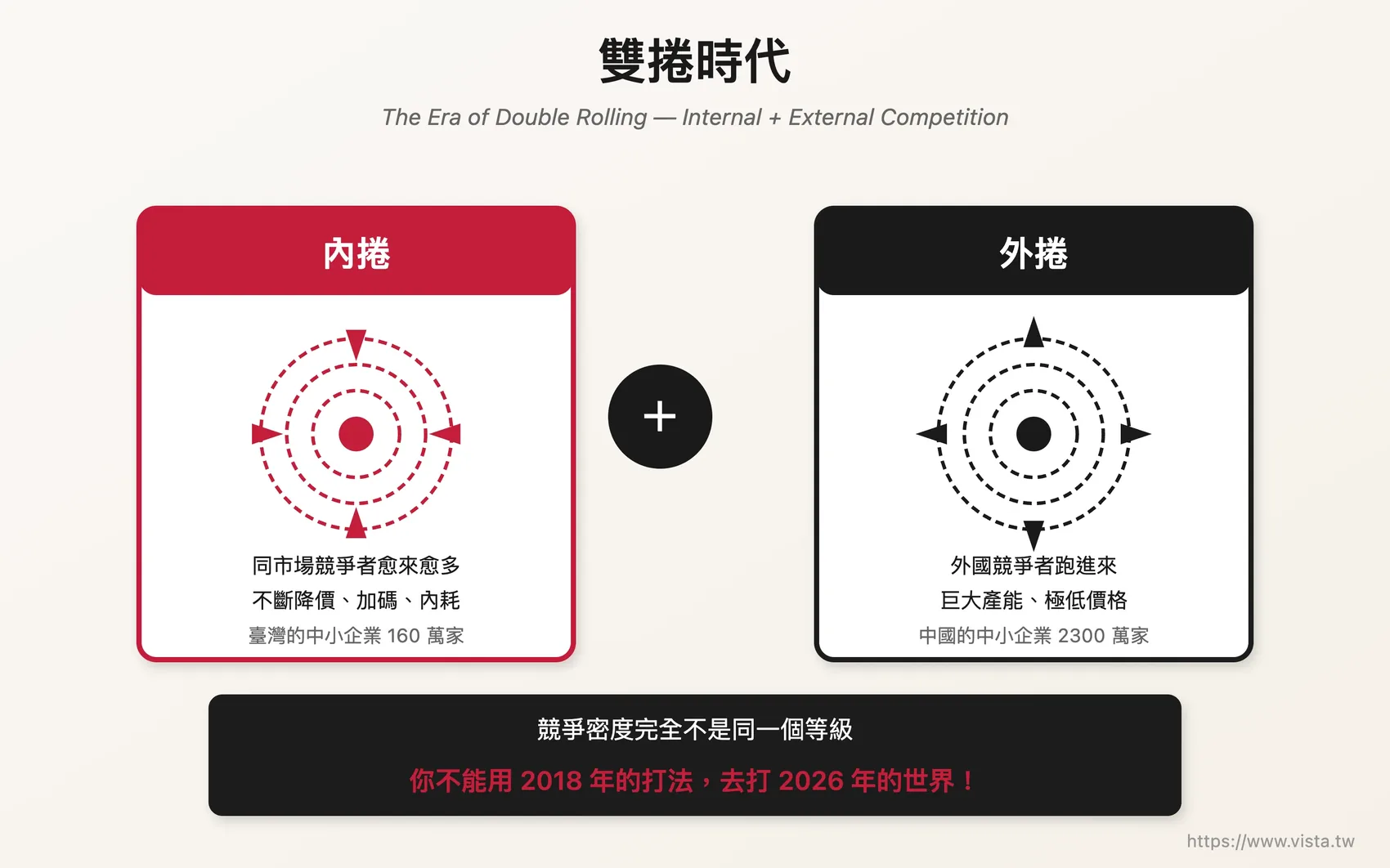 *▲ The era of double volumes: the double impact of inner and outer volumes. *
Well, what is a double roll?
Involution: There are more and more competitors in the same market. In order to grab customers, everyone has to keep lowering prices, increasing prices or internal friction.
External volume: Competitors from different markets have also come in, especially Chinese companies going overseas, with huge production capacity and extremely low prices, directly competing for your business.
He used numbers to visualize this pressure:
- There are approximately 1.6 million small and medium-sized enterprises in Taiwan
- There are about 23 million small and medium-sized enterprises in China
The order of magnitude difference alone is more than ten times greater. Now everyone is going overseas and looking for international markets, and the intensity of competition is not at the same level at all.
This analysis is not meant to make you panic, but to make you sober. It means that we can no longer use the style of play in 2018 to fight the battle in 2026.
What to do?
Teacher MJ did not give a standard answer, because there is no standard answer to this kind of question. However, he gave a direction for thinking:
- Find your differentiation: don’t compare with others who are cheaper, compare with others who are unique
- Increase switching costs: Make it difficult for customers to leave you
- Build brand trust: In an era of information overload, trust is the scarcest resource.
- Continuous learning and evolution: The world is changing, and you must change with it.
These may sound a bit cliché, but the point is not whether you know it or not, but whether you actually do it?
Learning methodology - keywords, disassembly, reorganization and modeling
During the second half of the lecture, someone asked Teacher MJ a question that I was also very curious about: “Teacher, you learn so many things, how do you learn them?”
His answer was very concise, just four words:
- Grab keywords
- Disassembly
- Reorganization
- Modeling
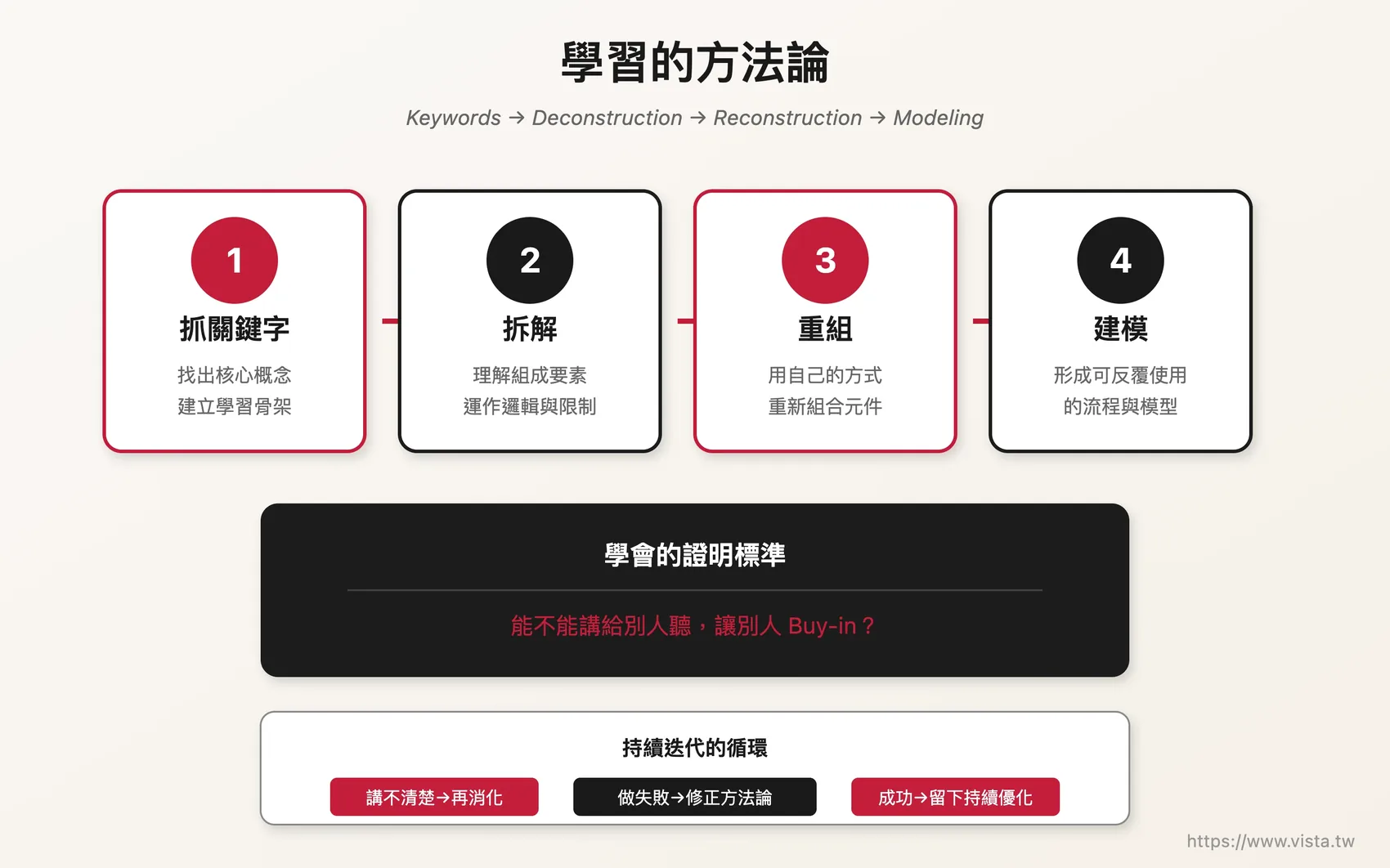 *▲ Methodology for effective learning: the complete cycle from input to output. *
Next, let me use my own understanding to explain these four steps:
Step 1: Grab keywords
When you come into contact with a new field or concept, the first thing to do is not to read all the information from beginning to end, but to find out the core keywords first.
What are core keywords? It’s one of those concepts where if you don’t understand it, you can’t understand anything else.
For example, if you want to learn “Business Valuation”, the core keywords may be: discounted cashflow model (DCF), price-to-earnings ratio (P/E), net worth (Book Value, also known as book value or shareholders’ equity), growth rate or risk premium…
First capture these keywords, and you will have a learning skeleton.
Step 2: Disassembly
After catching the keyword, the next step is to take it apart and look at it.
What’s the meaning? It is to understand the components, operational logic, applicable situations and constraints of this concept.
Continuing with the business valuation example: What are the components of the discounted cash flow method? Forecasting future cash flows, setting discount rates, and calculating terminal values…each element can be broken down further.
The purpose of disassembly is to turn a vague big concept into clear small components. When you understand each small component, you understand the whole.
Step 3: Reorganization
After taking it apart, the next step is to put the components back together in your own way.
This is the most critical step in learning and one that many people skip.
Why is it important? Because other people’s frameworks are other people’s and may not be suitable for your situation. You have to recombine these components into your version based on your own needs, your own background, and the problem you want to solve.
It’s like Lego bricks: the same parts can make a castle, a plane, or something completely original.
Step 4: Modeling
The final step is to build what you reorganized into a model that can be used over and over again.
What is a model? It is a set of input → processing → output process.
For example, let’s say you build a model for evaluating investment opportunities:
- Input: financial data, market information, competitive status of the target company
- Processing: Analyze using the assessment framework you designed
- Output: investment decision (invest/not invest/wait and see)
With models, you don’t have to start from scratch every time you encounter a similar problem. You can apply the model directly, get conclusions quickly, and then use the saved time on more important things.
The standard of the society: whether you can let others buy-in
Teacher MJ also added something more cruel:
The proof of learning is not that you think you understand it, but whether you can tell others and let others buy-in.
I completely agree with this statement.
If you can’t explain a concept to laypeople in simple language, it means you haven’t really digested it.
If you do it once and fail, it means there is something wrong with your methodology and it needs to be corrected.
If you are halfway successful, keep the effective parts and continue iterative optimization.
This method is actually what I call the consultant brain:
- Input is not for collection, but for output
- Output is not to show off, but to form a replicable process
- The process is not fixed, but needs to continue to evolve iteratively
Integrity of body, mind and soul - the most easily overlooked thing on the road to entrepreneurship
At the end of the lecture, Teacher MJ shared a piece of content that I found very heartwarming.
He said: People who start a business will be lonely, wronged, betrayed, and encounter many unfair things. These are inevitable, not that you are unlucky.
But he emphasized:
You can fail, but you cannot lose your integrity. You cannot allow yourself to become a dark version full of resentment and negative energy.
*▲ Entrepreneurs must learn self-protection techniques to protect themselves from risks. *
This passage reminds me of some of the bosses I have seen on the consultant scene over the years.
Some people, even if the company encounters difficulties, still maintain a positive attitude, actively look for solutions, and treat employees and partners well. Their performance may not be as good as others in the short term, but in the long term, they can often make a comeback.
Some people start to blame the government, the market, employees or customers when they encounter setbacks. They may be able to hold on for the time being, but their energy is getting lower and lower, and people around them are becoming less and less willing to get close. In the end, it is often not eliminated by the market, but dragged down by one’s own negative emotions.
Teacher MJ shared three words of self-encouragement, which I think are very practical, because they are not chicken soup, but get you back to the rhythm of action:
- Imagine a better future
- Make a pragmatic plan
- Do something different today and make it happen
The order of these three sentences is important:
First have a vision (where do you want to go), then a plan (how to get there), and finally implement it into action (what do you want to do today).
The problem for many people is: there is only the first step (daydreaming all day long), or only the third step (working around without knowing why), or only the second step (making a lot of plans, but never executing them).
These three steps must be in place and must be connected together to truly produce change.
My three core conclusions - a map, a system, and a magic
After listening to this lecture, I left three core points in my mind. Next, let me rephrase it in my own words:
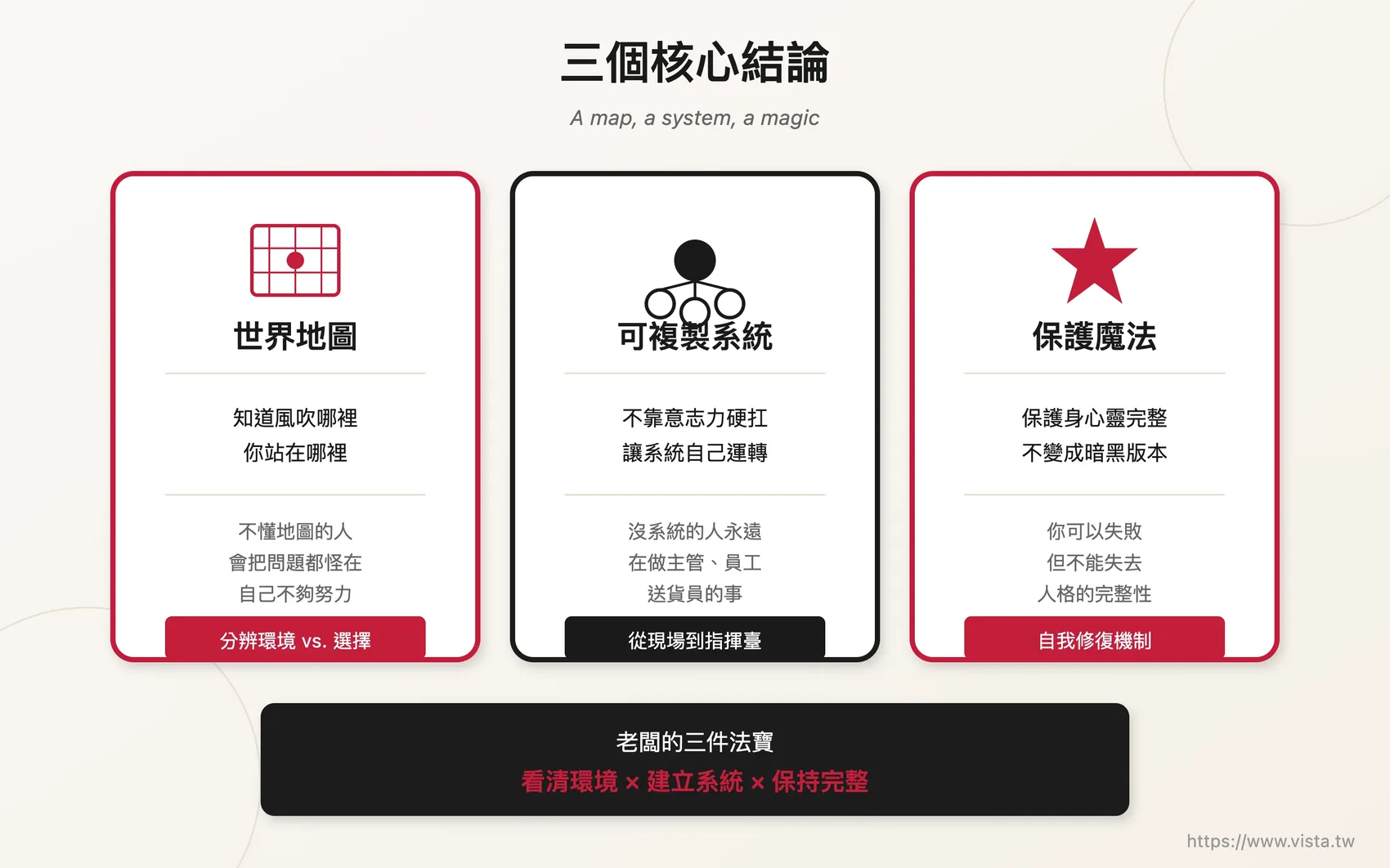 *▲ Three core conclusions about the boss’s worldview. *
Conclusion 1: You need a world map
People who don’t understand maps will blame all problems on their own lack of hard work.
People who understand maps will know which are environmental variables (which you can’t change) and which are strategic choices (which you can decide).
This map doesn’t need to be very detailed, but it should at least include:
- Fundamentals of the domestic economy (GDP composition, monetary policy, consumption trends)
- The general direction of the international situation (trade relations, exchange rate trends, geopolitics)
- The competitive situation of your industry (who are your competitors, what are they doing, and where are the trends heading)
- Your own position (where are the strengths, weaknesses, opportunities, and risks)
With this map, you can make realistic decisions instead of living in your own imagination.
Conclusion 2: You need a replicable system
People without a system are always doing things like supervisors, employees, or even delivery people. They live their lives as the busiest people in the company, but the company will never grow.
A systematic person will streamline repetitive work, document successful experiences, and delegate decision-making power to trusted people. They pull themselves back from the scene to the podium and focus on matters that really require their boss’s judgment.
The system is not built in a day, but is built slowly over time. But you must have this awareness: every time you do something, you are thinking about whether it can be turned into a system?
Conclusion 3: You need a magic to protect yourself
On the road to entrepreneurship, you will encounter many setbacks, grievances, betrayals and unfairness. This is inevitable, and it is not your unlucky fate.
You need a self-healing mechanism so that you can stand up and keep walking after being knocked down.
This mechanism can be:
- A word of self-encouragement (like the three sentences shared by teacher MJ)
- A supportive community (friends in the industry, business partners and family)
- A habit that recharges your batteries (exercise, reading or traveling)
- A set of thinking framework for viewing setbacks (treating failures as learning and difficulties as tests)
Whatever it is, you need something to pull you back when you’re at your lowest.
Conclusion: Action List - Turn this lecture into implementable results
At the end of this post, I want to wrap up with an action list.
If you finish reading this article and want to make yourself really strong, you don’t need to do anything big, you just need to do three small things - but you have to do it very seriously.
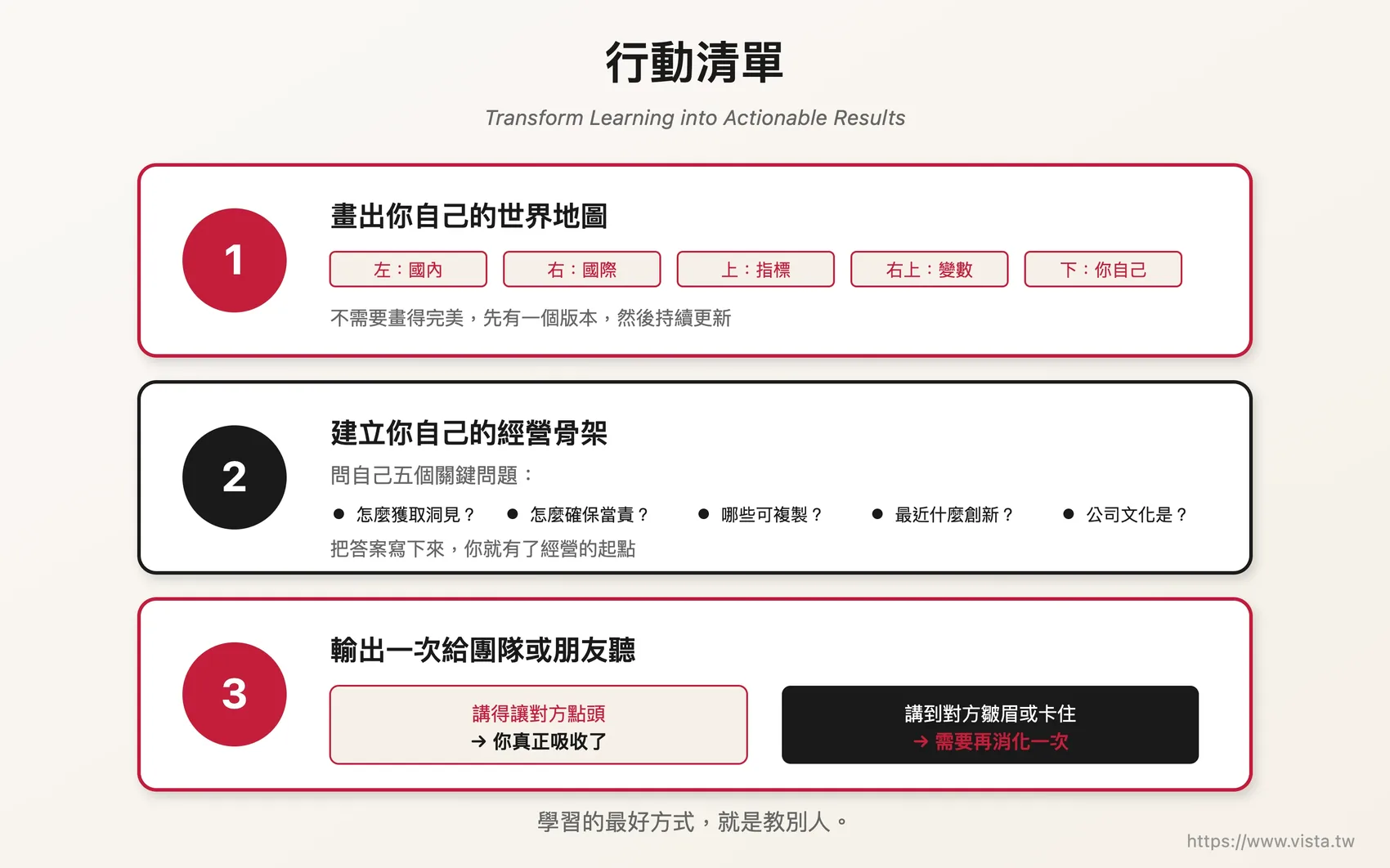 *▲ A list of immediately actionable actions, from knowing to doing. *
Action 1: Draw your own world map
Find a piece of paper and use Teacher MJ’s framework:
- On the left is domestic: What are the domestic factors that affect your business?
- On the right is international: What are the international factors that affect your business?
- There are indicators above: What economic or industry indicators should you pay attention to?
- List of variables in the upper right corner: What black swans might hit you?
- The lower left corner is yourself: where is your current position? Advantage? Disadvantage?
It doesn’t have to be perfect, try to plan out a version first and then keep updating it.
Action 2: Build your own business framework
You don’t have to apply MJ’s framework, but you need to have your own business system.
Ask yourself:
- How do I gain business insights? What sources of information do I have?
- How do I keep my team accountable? What is my reward and punishment system?
- What systems do I have that I can replicate? What things are still managed by humans?
- What innovation have I done recently? Has new value been created?
- What is my company culture? What do employees do when no one is watching?
Write down the answers to these questions and you’ll have a starting point for your business.
Action 3: Output once to your team or friends
Find someone you trust and tell them the key points of this lecture.
If you talk and make the other person nod, it means you have truly absorbed it.
If you get stuck in the middle of speaking, or the other person doesn’t understand, it means you still need to digest that part.
The best way to learn is to teach others.
Postscript
This article has nearly 10,000 words and is my complete reflection after listening to Teacher MJ’s lecture. I dare not say that I fully understand what he means, but I have tried my best to integrate what I heard, what I thought, and the observations I have accumulated in the consultant field over the years in this article.
I hope it can be of some help to you who are struggling on your business journey.
We are all learning, evolving, and trying to find better ways to live in this increasingly complex world.
Let’s encourage each other.
Further reading:
- Financial Awakening of Knowledge Workers: Upgrading of Thinking from “Selling Time” to “Selling the System”
- The Beauty and Sorrow of Product Managers in the AI Era: Functional Change from Coordinator to Builder
- My podcast note-taking workflow: a complete methodology from listening to writing
Further reading
Next step
Bring this topic to your team
Vista Cheng speaks and runs workshops on AI workflows, writing and content systems for companies, schools and public agencies.