BCG’s new research, a must-read for bosses and supervisors: Companies that are ahead of the curve in AI are changing the way they work.

At around seven o’clock this morning, my AI secretary helped me finish my morning briefing and reminded me: a certain website has a database permission, which was originally scheduled to be closed next Monday.
I ask it to first evaluate whether it is necessary. It checked the code and official databases and reported that this permission no longer served a legitimate purpose and that leaving it in would allow people to bypass server-side checks. I just replied “Do it now”, and it wrote the migration, applied it, verified the two paths, deleted the test data, updated the specification, and finally removed Monday’s calendar reminder.
The whole thing took me less than five minutes. There are only two things I do: judge whether to do it or not, and confirm the results of it being done.
I just happened to read the study “Five Ways That AI Front-Runners Change How Work Gets Done (opens in a new tab)” published by the BCG Institute at the end of September this week. After reading it, I felt like this: Although this report mainly talks about the transformation of large companies, as far as I am concerned, it is also experienced every day.
What is this study talking about?
The BCG Institute conducted interviews with chief human resources officers, chiefs of staff, founders and department heads at more than 50 companies it classified as AI leaders between March and August 2026. The sample includes 23 AI-native companies, 18 digital platforms with AI as the core engine, and 9 traditional companies that are being transformed department by department.
The report begins by quoting figures from another BCG study: companies that use AI to redesign jobs and talent have annual industry-adjusted shareholder returns that are more than 11 percentage points higher than their peers. The key is the second half of the sentence: these companies are not stacking AI tools on top of old processes.
In other words, using more AI does not mean getting ahead. The first paragraph of the report explains that the leaders’ AI usage does not necessarily break records. What they do is to transform their operating models and dismantle existing layers and processes.
The research team summarized five directions, and 80% of the companies surveyed achieved more than three at the same time:
| For | Traditional practices | Practices of AI leading companies |
|---|---|---|
| Purpose of work | Duties and tasks assigned by above | The direction is set by the above, and results are the responsibility of individuals and teams |
| The work itself | People produce, machines assist | Machines produce, people give instructions and make evaluations |
| Decision-making structure | Decision-making is centralized upwards, and seniority determines authority | Distribution is based on whether the decision can be redeemed, and it is delegated downwards |
| Work coordination | Routine meetings, progress synchronization, and layer-by-level sign-off | Routine synchronization is handed over to AI, and people meet to make decisions and build relationships |
| Reward system | Look at seniority, amount of activity, and output | Look at results, look at judgment, and look at how much leverage you can get from AI |
Next, let me pick three aspects that are most interesting to Taiwan’s small and medium-sized enterprises to talk about.
The decision-making power is irreversible and has nothing to do with rank.
This is the section in the entire report that I most want to draw a line under.
In traditional organizations, decisions are made upwards, dispersion of information forces centralization of power, and seniority brings authority. The approach of leading AI companies is to hand over decisions with clear rules to the agent, delegate decisions that are recoverable and low-risk to the people closest to the problem, and only keep irreversible decisions at the top.
The report cites the example of the engineering platform Jellyfish (opens in a new tab). Their integration code is highly repetitive, and the same modifications need to be made hundreds of times. In the past, each time had to be signed off by the program leader outside the team. After the introduction of AI programming, the amount of modifications increased dramatically, and review became the biggest bottleneck. The current practice is: the engineer who writes the modification approves it himself, adheres to the guardrails agreed upon once, and does not need to submit it for review every time. Modifications that originally took three days can be completed in one day. The price is also clearly stated: you can go online on your own, but if it breaks, you will be responsible.
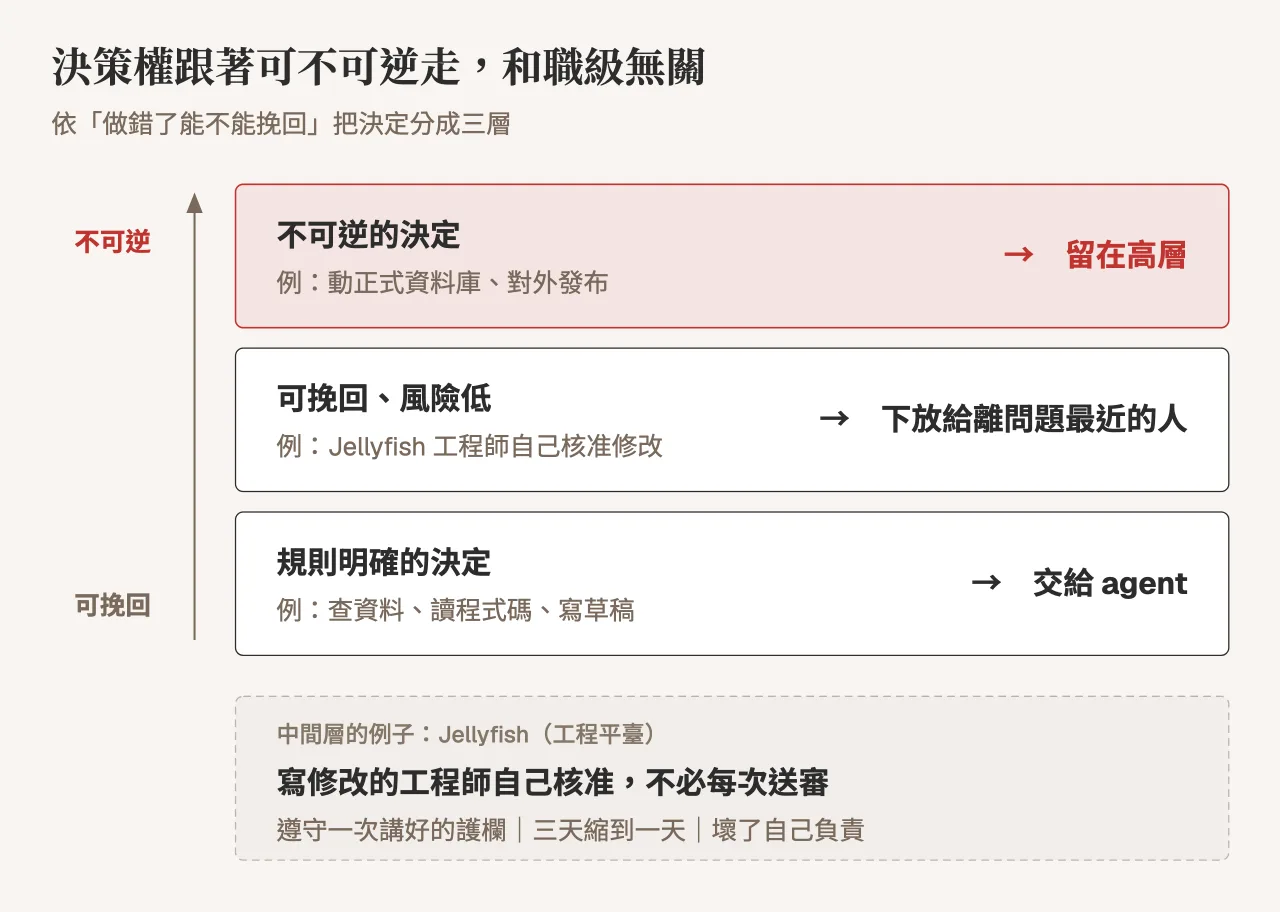
I laughed when I read this, because the work rules I wrote for AI are almost the same logic.
My Claude Code profile says: Ask me first for actions that are irreversible or will be published to the public; see clearly the goal before deploying, deleting, or overwriting online content. On the other hand, for things like checking information, reading program code, and writing drafts on this machine that can be undone at any time, it can just make its own judgment without having to ask at every step.
The database permissions this morning were the result of this division of labor. The evaluation is left to AI, because there is no loss if the evaluation is wrong; it is up to me to decide whether to touch the formal database, because that is irreversible. After the decision is made, execution and verification are handed back to it.
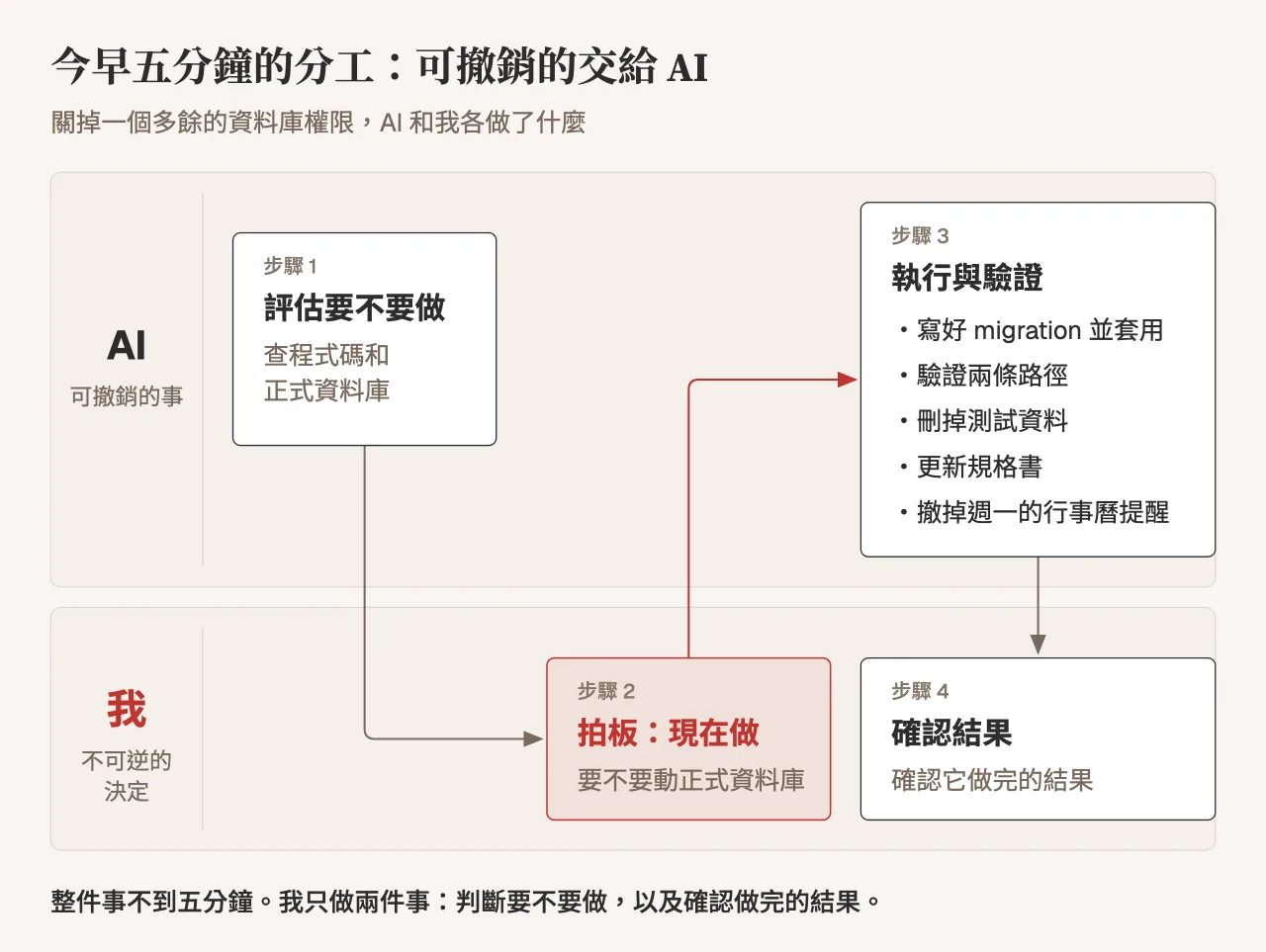
Many bosses told me that the biggest problem after introducing AI is not letting go. I think the problem is not whether you dare or not, but rather that you don’t categorize your decisions first. What mistakes can be corrected? What things once done cannot be taken back? Draw this table first, then you will have a basis for letting go.
Write down what is in the minds of experts, and experience will compound.
The report sorts out five new roles that are emerging in leading AI companies. One of them is called Domain Anchors, which refers to people who write expert knowledge into a form that can be reused. Four of the five families are doing this: sorting out what the strongest experts know and making it available to the entire organization, not just the people sitting next to them.
The insurance technology company Reserv allows employees to serve as AI agents on a self-built platform. Each person’s expertise is written into the agent’s operating methods, and then the entire company can reuse it. The more the agent does, the results begin to compound: developing a new training course was shortened from 18 months to four weeks; responding to regulatory changes was shortened from about three days to about an hour.
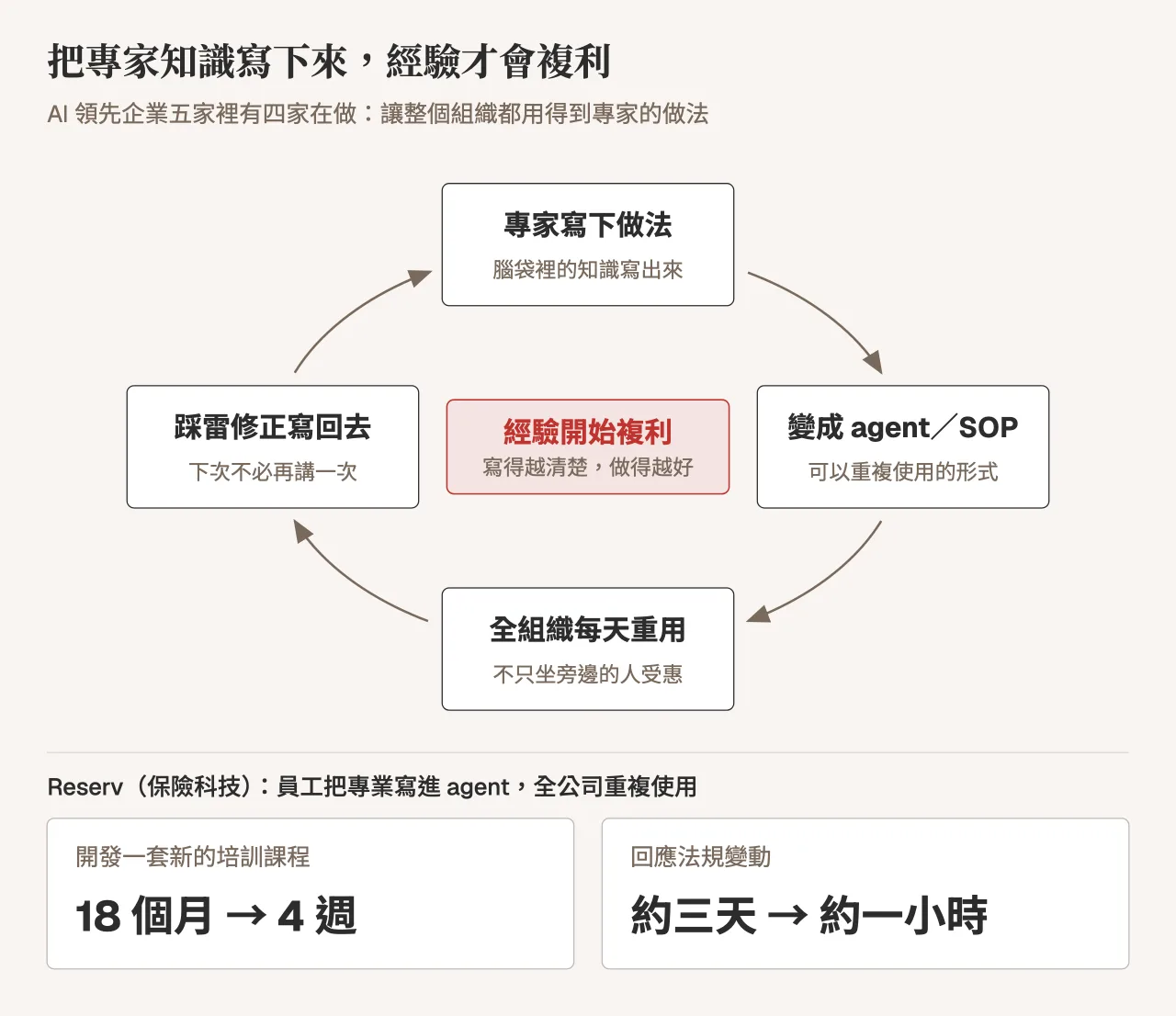
Walmart’s approach is also worthy of reference. Their employees change positions approximately every 18 to 24 months. In order to prevent experience from leaving with them, experts will write down various versions of how the work is actually done and create a digital clone of their position.
I feel very much about this part. The reason why my AI secretary team can operate is not because of how smart the model is, but because I spent more than half a year writing down the way I do things one by one: the writing style file records my tone and banned sentence patterns; the memory file records every time I step on the trap, such as which deployment pipeline has pitfalls and which API will fail silently; the morning briefing process is written as a standard operating procedure, and even the pre-calculation of the week next to the date is written in it, because it was once marked wrong.
To put it bluntly, this is the one-person company version of knowledge management. The difference is: in the past, SOPs were written for newcomers, and no one often read them after they were written; now, what is written down will be followed by AI every day. The clearer it is written, the better it is done. This is the most direct feedback I have ever seen on knowledge management.
The report also mentioned a very practical problem: in traditional enterprises, experts are often reluctant to share knowledge for fear of becoming replaceable. The solution for leading AI companies is to turn sharing into a path to promotion. What Writer praises in the all-hands meeting are those who have made things that are used by others; just because the amount of AI used is high, they will not be able to get on the stage.
The evaluation depends on the quality of thinking, and what is handed over comes second.
The fifth aspect is about rewards and rewards. There is a sentence in it that I want to copy to every supervisor: AI is very good at creating activity. A person can use the tool very violently and end up accomplishing nothing. This is Zapier’s observation, so they evaluate employees based on results: whether they improve business metrics, customer relationships, or make teammates’ jobs better.
About three-quarters of the companies surveyed prioritized judgment over activity. The specific method is to move the assessment from paper to on-site: explain your plan before starting the work, and after finishing the work, point out where you overturned the answers given by the AI.
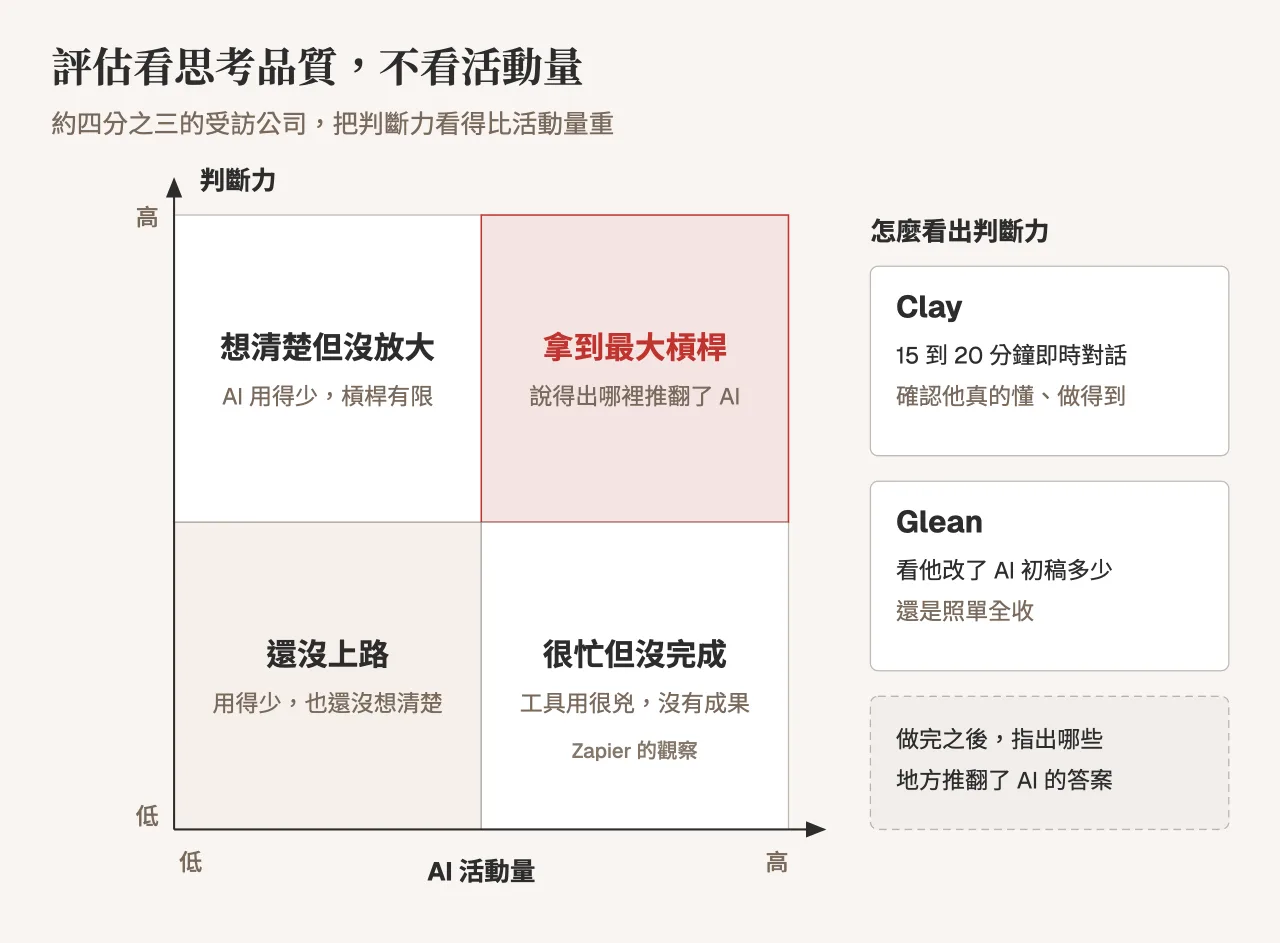
Information platform Clay (opens in a new tab) often uses 15 to 20 minutes of real-time conversations to confirm that a person really understands what he proposes and has the ability to implement it. The reason is straightforward: AI-assisted output can look beautiful, but the person may not have really thought it through.
Glean (opens in a new tab) The way of interviewing business people is also very interesting. Give the applicant three or four potential customers, and ask him to use AI and his own judgment to decide which one to pursue first, and then write a development letter. There are three key points in the evaluation: his intuition about the client’s strategy, his judgment on when to use AI, and how much he changed the first draft of the AI, or whether he accepted it as written.
This reminds me of another rule I have set for AI: the agent doing the work does not inspect its own work. Acceptance requires a different pair of eyes and a different awareness of issues. The same goes for people. When output becomes easier, what the supervisor wants to see is no longer how many things have been handed over, but whether the person can explain clearly: why he did it, where he did not listen to the AI, and who is responsible for the mistakes.
Limitations of this report: Keep this in mind when reading
As a researcher, I would also like to remind you of a few things so that everyone will not just copy it after reading it.
First, this is a qualitative study. 50 companies, semi-structured interviews, the interviewees are supervisors rather than front-line employees, describing the organization in the eyes of leaders, not necessarily the actual daily life of employees. The research team conducted a rigorous process: only things that the interviewee described as “already doing” were scored, not things in the plan. This is worthy of recognition.
Second, the sample is biased toward specific genres. 63% are in North America, half are in software and services, and 23 are AI-native companies. For a mechanical parts factory in Taichung, Cursor’s marketing staff wrote their own application to replace the entire agency, which has limited reference value.
Third, the 11 percentage point gap in shareholder returns comes from another BCG study and is only a correlation, not proof of causation. It is very likely that companies that are already doing well are able to make such a transformation.
Fourth, the sample is a single leader. Those companies that did not succeed are not visible in the report.
These limitations don’t make the report less valuable, but they do serve as a reminder: treat it as a road map, not a guarantee.
For Taiwan’s small and medium-sized enterprises: starting from a beachhead
At the end of the report, the roadmap for traditional enterprises is divided into three sections: laying the foundation, proving it in one place, and then spreading it to the whole company. I translated it into a version that small and medium-sized enterprises can do:
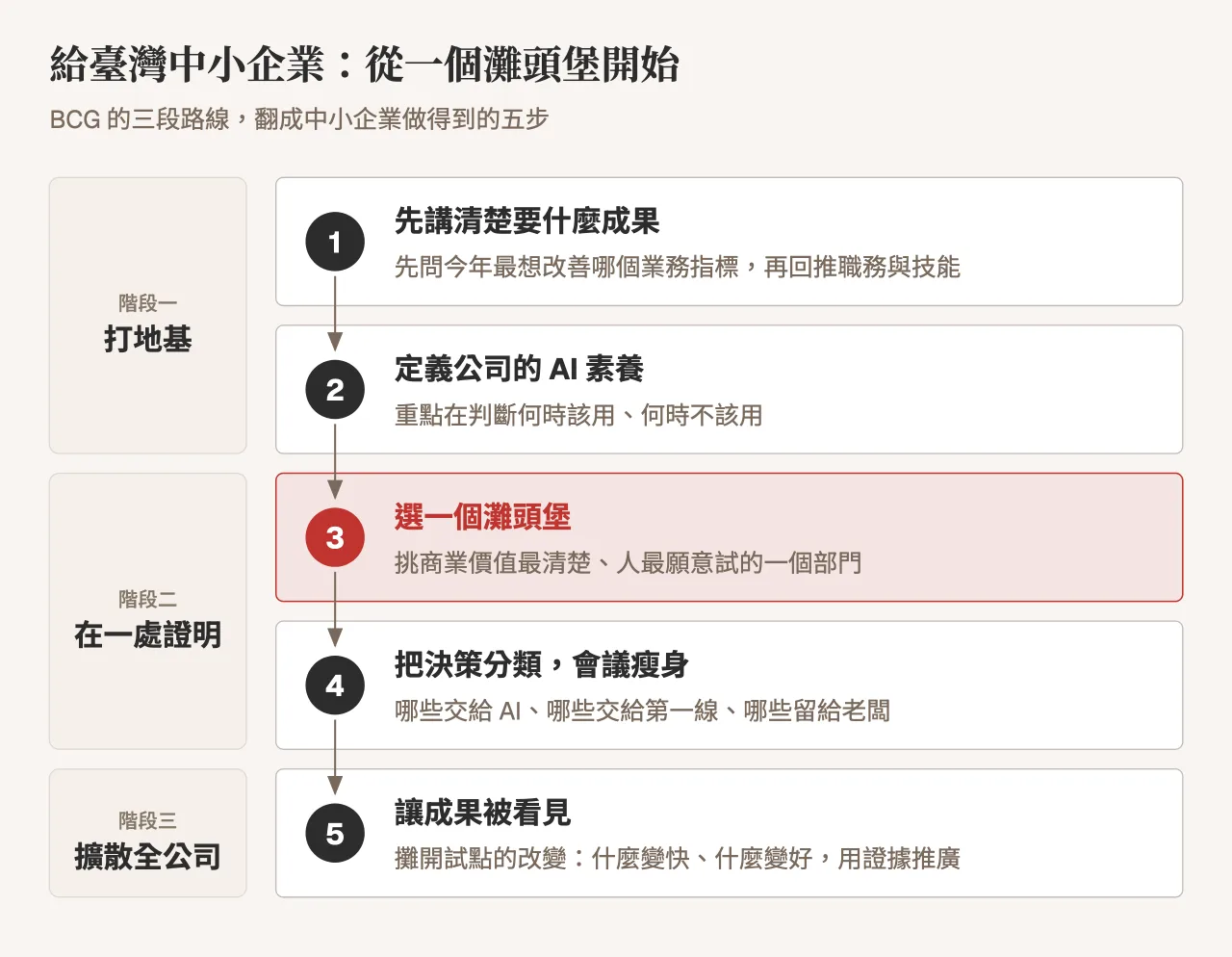
- Let’s first make it clear what results we want: Don’t import AI just for the sake of importing it. First ask: Which business indicator do you want to improve most this year? Then push back which positions and which skills will be affected. I talked about the same thing in “Importing AI, starting from work pain points”.
- Define your company’s AI literacy: Whether you can use ChatGPT is just the starting point. The focus is on whether you can judge when to use it and when not to use it. Zapier is broken down into four aspects: curiosity, strategy for choosing the right tools, the ability to produce good results, and responsibility for output.
- Choose a beachhead: Pick a department with the clearest business value and the most willing people to try. Rivian’s software department ran its own AI framework half a year earlier than other departments in the company, and now it has become a reference model for the entire company.
- Classify decisions and slim down meetings: Draw which decisions are left to AI, which are left to the front line, and which are left to the boss. Meetings that purely report progress are changed to written or online synchronization, and the meeting time is reserved for things that really need to be discussed.
- Let the results be seen: Spread out the changes made by the pilot department: what has become faster, what has become better, and which handovers are no longer needed. Promotion must rely on evidence, and it is useless to just rely on the boss to talk all the time.
There is a sentence at the end of the report that I agree with: These changes will never end. The real thing is not to catch up with the current position of the leader, but to develop the ability to continuously improve, just like those companies at the forefront have always done.
My own experience is that this kind of ability cannot be obtained by holding a meeting or buying a system. It comes from handing over one small thing every day, accepting it, revising it, and writing it down so that you don’t have to talk about it again next time. What’s one thing in your company that you repeat every week? Start writing about that.
Further reading:
- Enterprises import AI, bosses should not just watch
- When answers become worthless, judgment is your only compound interest asset
- Reading experience of “The Great Work Reorganization”: When AI starts to take over your job, what value will you have left?
Source: Sagar Goel, Julie Bedard, Matthew Kropp, Ashley Sim, Charikleia Kaffe (2026-09-24). Five Ways That AI Front-Runners Change How Work Gets Done. BCG Institute. https://web-assets.bcg.com/pdf-src/prod-live/companies-use-ai-to-redesign-work.pdf (opens in a new tab)
Next step
Bring this topic to your team
Vista Cheng speaks and runs workshops on AI workflows, writing and content systems for companies, schools and public agencies.