Three things seen from Honnold’s climb to the top of Taipei 101: talent, career specialization and the modern inspiration of urban marketing
Sitting in a cafe, I saw how a foreigner put Taipei on the world stage.
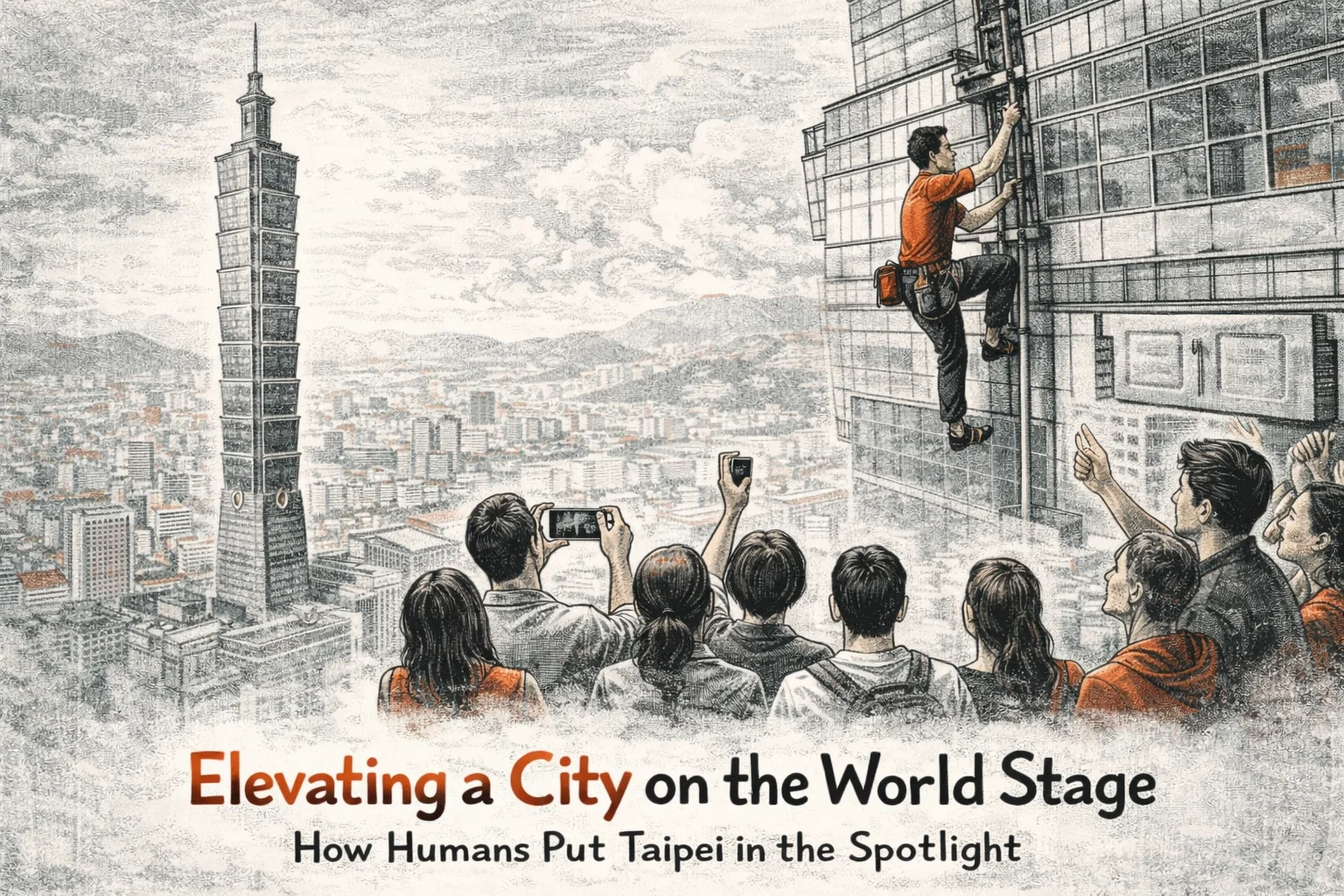
At nine o’clock this morning, I was sitting in Starbucks, staring at the computer screen while working. An hour and a half later, before his coffee had even cooled down, Alex Honnold had already completed the feat of climbing Taipei 101 alone with his bare hands.
Some scenes are very strange: you are clearly sitting in front of the screen, but you will subconsciously spread your palms, relax your shoulders and neck, and even swallow your saliva unconsciously, as if your body is also bearing the height for him.
What I’m talking about is the live broadcast of Alex Honnold’s challenge to climb Taipei 101 Building (opens in a new tab) with bare hands. This is not the excitement of an ordinary sports event - it is more like a modern ritual that compresses human will, physical limits, urban landmarks and media narratives onto the same vertical line.
He climbed the 508-meter, 101-story Taipei 101 without any safety ropes or protection, and the entire process was broadcast live on Netflix for the world to witness; in the end, he completed the summit in only about 1 hour and 31 minutes.
This live broadcast was originally postponed due to weather factors - you will find that the more top actors are, the more they know how to admit defeat to nature. This is not cowardice, this is professionalism.
When the picture zooms out, what you see is not a person climbing the wall; what you see is Taipei being put into the eyes of a global audience: the bamboo-box structure of the Taipei 101 building (some call it bamboo-box segments), the turning points of several floors, the balcony-like stopping points, the changes in scenery and clouds, and the narrative moment of “I have only seen this building in photos before, and now it has become a stage.”
The most intuitive feeling: he is not challenging the height, but fighting against repetition
Many people think that the most difficult part of this kind of climb is a certain key move or the most dangerous section. But Netflix’s official trailer actually points out something more counter-intuitive: What’s really scary is endurance, the muscle fatigue and mental wear and tear caused by repeating the same actions for a long time; climbing such engineering structures is often not a fatal move, but that even if a thousand successes have been accumulated before, no mistakes are allowed.
This also explains why I feel nervous when watching the live broadcast. I am not waiting for the climax of the drama, but a voice comes out every few minutes:
Are you sure he can always be this stable? Are you sure that point is really reliable? Are you sure wind, sweat, and the coefficient of friction between glass and metal won’t suddenly change?
What fascinates me the most about him is not just his boldness, but his almost calm rhythm control: go fast when it’s time to go fast, stop when it’s time to stop; he doesn’t hesitate when he should use force, and he doesn’t show off when he should be conservative. This is actually a very systematic ability, which allowed me to see how a top master suppresses fear into manageable levels and breaks down risks into calculable levels.
The so-called talent is often a long-term structure that can be copied
If you think Honnold is just a natural genius, you will actually miss the most valuable part.
He certainly had talent, but more importantly: he turned talent into structured productivity. According to multiple reports, he began climbing as a child, gained experience over the years, and became a full-time climber in 2007.
What is really worth learning here is not to imitate his limits, but to imitate his path design for forging interests into professions.
To me, talent is more of a lower friction to get started. It makes it easier for you to get started, enter the flow, and get positive feedback. But what really separates people is whether you are willing to:
- Stay in one field for a long time until it is no longer new.
- Continue to use practice to turn “can do it occasionally” into “can do it stably”
- Break down every success into a reproducible process
This reminds me of what I wrote before Content creation starts with thinking, observation and lots of practice. In fact, the truth is the same: whether it is writing or rock climbing, real expertise comes from systematic and deliberate practice.
Honnold’s challenge also has a very key background: it is not just about climbing to the top, but is designed to be a global live broadcast content event.
This means that he not only has to complete the climb, but also “complete the climb in front of the camera” - maintaining his own rhythm under the projection of attention, public opinion and other people’s emotions.
If you are a lecturer, consultant, creator, or a professional who often needs to face the crowd, it should not be difficult for you to understand: it is not that many people cannot do it, but they become abnormal as soon as they get on stage. Real kung fu is to develop your ability to the point where you are not afraid of the camera, the audience, or noise, but you can still do the movements correctly.
To be honest, I also hate the crowds waving at Honnold from the windows, and I worry that those cheers will distract him. But it turns out that Honnold was already in flow mode when he took the first step.
Career is not a multiple-choice question, but a project based on interests
To be honest, I didn’t know about Honnold before. I only became interested in this man’s life after hearing about his plan to climb Taipei 101 on the TV news. After he dropped out of University of California, Berkeley (opens in a new tab), he once lived at home and drove to and from California for rock climbing activities.
His career choice is curious. In the past, I often felt that the biggest fear in career planning was not lack of direction, but cutting life into too many pieces: work is work, interest is interest, love is love, and public welfare is public welfare.
But the route chosen by Honnold set a very integrated example: on the one hand, he is famous for extreme climbing, but on the other hand, he is also involved in foundations and public issues, such as promoting solar energy and other energy projects (his Honnold Foundation (opens in a new tab) is often mentioned in reports).
At the same time, he also translates his personal expertise into stories that the public can understand through programs, live broadcasts and content narratives.
Well, this is actually one thing that I have always cared about: a truly strong career is not “what can you do?” But “Which narrative and system do you choose to put what you know into”?
- You can write, but can you turn your writing into a course, consulting service, publication, community, or tool?
- You can research, but can you turn research into teaching, productization methods, and collaborative processes?
- You can climb mountains, but can you turn mountain climbing into content, brand, city, or even charity initiative?
This reminds me of the concept mentioned in the article Yu Wei Talks About Personal Branding: Building a personal brand is not just about marketing yourself, but about systematizing expertise and productizing passion.
Honnold used Taipei 101 as a climbing target this time, essentially connecting climbing with urban symbols: turning a seemingly personal extreme skill into a city event that can be viewed by the world.
Risk is not romance, it is a responsibility
I was on the PTT (opens in a new tab) gossip board and saw many netizens discussing: Isn’t it worth it for Honnold’s climb to let the whole world see Taipei 101? To me, it’s not a question of whether it’s worth it or not.
Of course, this live broadcast also brought controversy: is a husband, father, and public figure encouraging danger by doing such a ropeless climb? Is there a risk of being performative? Some media celebrities have mentioned the ethical doubts about their high-risk behavior.
My own feeling after reading it is: We can admire his abilities, but we should not deify the adventure itself.
Because what he can do is based on the accumulation and control possessed by a very small number of people; and if most people only learn “I have to be brave”, it will actually lead their lives to an unnecessary gamble.
A truly mature spirit of adventure is when you can distinguish:
- Which risks are worth taking (because it will bring long-term value)
- Which risks are just emotional show-offs (because they only lead to brief applause)
Even the live broadcast itself has been designed with safety mechanisms and process controls (such as postponement, suspension at any time, etc.), showing that this is not a willful event, but a high-risk project that is strictly managed.
This is actually the same for business management and personal brand management: you can pursue breakthroughs, but you must first design an exit mechanism.
This is not only a personal hero story, but also a demonstration lesson in urban marketing.
If you zoom in to a wider perspective, you will find that this event is actually a super typical urban marketing case: city landmarks have become the main stage of global content events, and global audiences have set their sights on Taipei at the same time.
Moreover, it has several additional points that Taiwan can learn from:
- Narrative nature of landmarks: The Taipei 101 building itself is highly recognizable, and its architectural shape has a rhythm (bamboo-like segmentation), which is very suitable for lens language.
- The diffusion power of the global platform: Netflix operates through live events, putting Taipei into the attention pool of the global algorithm.
- The topics can be extended: extreme sports, adventure spirit, risk ethics, parenting and responsibility, urban safety governance, tourism economy, all can be extended into subsequent content.
I would even say: This time it is not just about letting Taipei be “seen”, but the way Taipei is “seen” is very modern - it is not relying on advertising slogans, but relying on a content event that can be watched simultaneously around the world and can be edited into countless short videos.
This coincides with the Content Marketing Trends I analyzed before: truly effective marketing is not about pushing messages, but about creating content events worth sharing.
What else can Taipei do next?
First, make the event a city asset rather than a day of fireworks.
Many cities invest in marketing activities, and it is easy to make a mistake: just trying to ride on the current popularity without turning it into a reusable asset. For example, the Taipei City Government Tourism and Communications Bureau (opens in a new tab) can organize this event into a city content package: including official highlight clips, behind-the-scenes footage, city perspectives (such as Xiangshan, Xinyi District street scenes, observation deck stories), and local outdoor cultural maps, so that media and creators have something to use and materials to expand on.
Second, use security governance to convince the world, not just blood.
The higher the risk, the more institutional support is needed. Foreign media are actually very concerned about the ethics and safety management of such incidents. If Taipei wants to regard “city x extreme sports” as part of its brand, it must simultaneously strengthen: norms, processes, risk communication and public safety narratives. Explaining the profession clearly can build trust more than some officials shouting empty slogans.
Third, try to direct global attention back to local experiences.
For those foreign friends who have watched the live broadcast, they may want to ask next: What can I do in Taipei?
The biggest fear of urban marketing is that you have won global views, but you have not designed any landing experience to catch people. For example, we can design a sightseeing route of “Urban Vertical Adventure” (you don’t have to actually climb the building, the focus is on perspective and stories), or extend the original Taipei 101 Vertical Marathon. You can even connect the scenery of Xiangshan → 101 tour of surrounding architectural aesthetics → local climbing gym experience → Taipei night view content shooting spots → urban-style dining and souvenirs… all in one place.
In this way, maybe this live broadcast can be turned into a city itinerary for a quarter or even a whole year.
What I admire most is not that he reached the top, but that he made life a clear path.
I have always believed that a truly powerful person is not one who knows everything, but one who knows which things he wants to invest his life in, and is willing to spend decades to deepen and stabilize those few things, and even make them visible to the whole world!
Honnold turned the Taipei 101 building into a vertical route this time, allowing us to see three things:
-Talent is not a myth, but stable output after long-term practice. -Career choice is not about cutting off work and interests, but about turning your passion into a project and turning your profession into a narrative. -City marketing does not rely solely on publicity, but on content events that can be experienced simultaneously around the world. These views also echo the core concepts discussed in this article Embrace the slash of today’s generation: Understand your talents and live a wonderful life: In this era, the most competitive thing is not the depth of a single skill, but the ability to integrate multiple abilities into a unique value proposition.
If you ask me, what is the biggest motivation after watching this live broadcast——
It’s not “I really want to challenge my limits” (oh my god, don’t let me do that yet, I really can’t do it), but “I really want to hone my expertise a little deeper.”
Because the real height of life is not the top of the 508-meter building; rather, it lies in whether you are willing to turn your little talent into a path that can last a lifetime.
Further reading:
- Dont let your efforts be forgotten, skillfully use AI to create a second brain for your career
- Life is not a road in vain: from learning to write to understanding financial reports, developing muscle memory through a lot of practice
Relevant external resources:
- Alex Honnold official website (opens in a new tab)
- Honnold Foundation (opens in a new tab)
- Taipei 101 official website (opens in a new tab)
Next step
Bring this topic to your team
Vista Cheng speaks and runs workshops on AI workflows, writing and content systems for companies, schools and public agencies.