The threshold of audio and video has not disappeared, it has just moved: in the era of AI editing, the place where you should invest your time has changed

This article was originally published in Issue No. 126 of “Vista Newsletter” “The threshold for audio and video editing has been lowered, how can novices use AI to produce content (opens in a new tab)”, sent in July 2026. Welcome to subscribe to the newsletter (opens in a new tab) to follow the latest issue.
The threshold for audio and video production has been significantly lowered.
In the past, you and I imagined this matter like this: if you want to produce audio and video content, you must first learn editing software. You need to recognize the timeline, remember a bunch of shortcut keys, understand transitions and color correction, and it’s best to have some design background. Therefore, many people clearly know that audio and video marketing is booming, but they silently classify themselves as “people who don’t know how to do audio and video” in their hearts, and then never step in again.
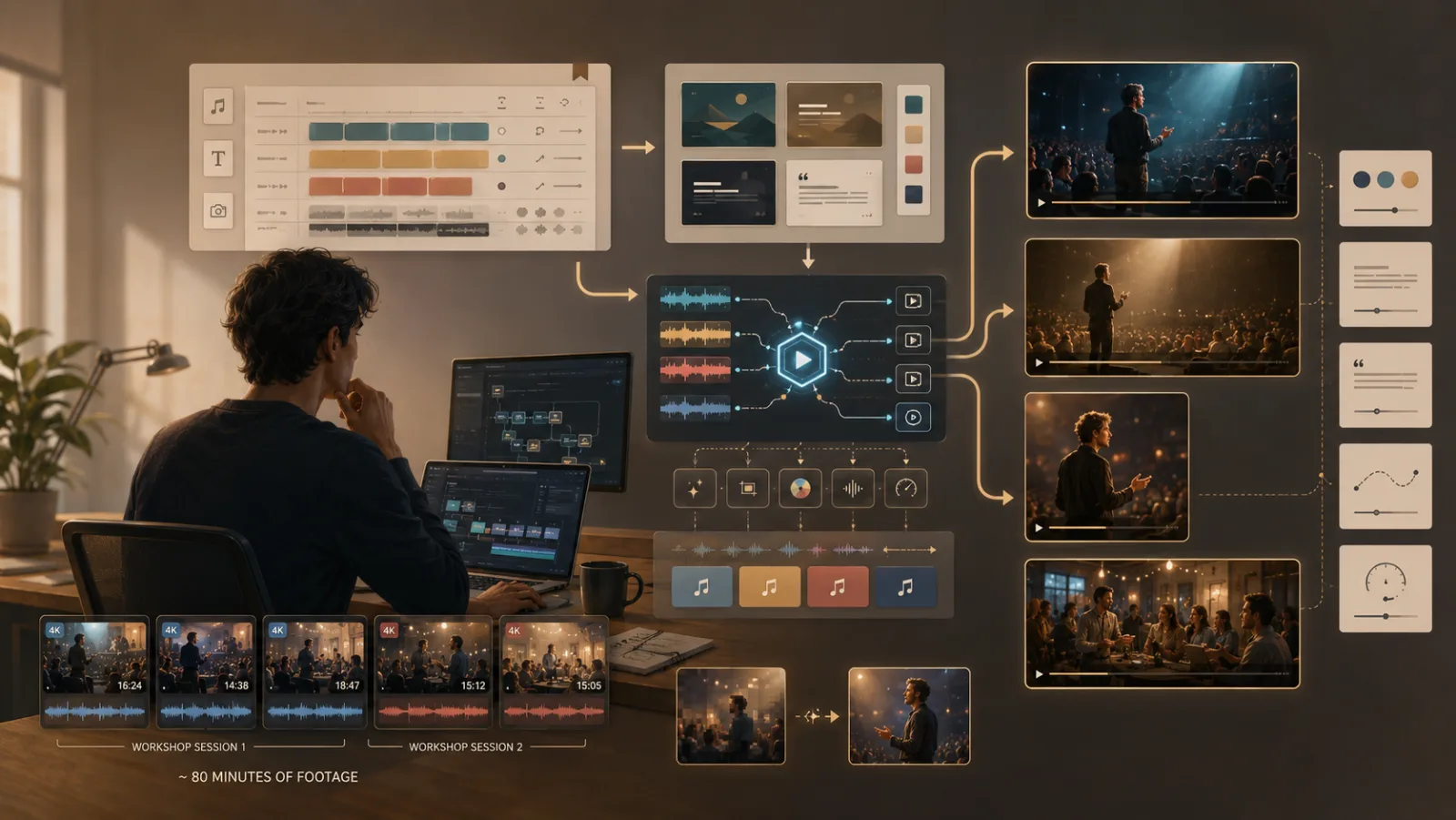
In the past two days, I have done something with my own hands, which gave me a completely different view of the position of this threshold. I didn’t learn any editing software, but spent half a day letting AI help me create a “system that can edit videos.” Then we used it to record the eighty-minute live recordings of the two workshops and turned them into eight promotional videos of different styles in one go. The horizontal one is for YouTube, the straight one is for the community, one is for fast pace, and the other is for creating a cinematic feel, all grown from the same batch of materials.
What I want to talk to you about is not how powerful that system is. What I want to talk about is a more fundamental thing: After I finished doing this, I really saw clearly that the threshold of audio and video has not disappeared, it has just moved. And the new location it has moved to is actually great news for everyone who thinks they “can’t edit films.”
What happened during that half day?
Let’s talk about what happened during that half day, shall we? Because the devil is in the details.
In the past, I knew exactly what cutting a film meant: an afternoon with a cup of coffee, dragging, aligning, and fine-tuning it back and forth on the timeline. Then I would look at it again the next day, and if I felt the rhythm was wrong, I would start over again. It would be fine if I just cut one video, but I want several. Just thinking about the complicated process makes me feel tired.
This time, I changed my approach. I didn’t rush to edit the film, but first made a system that could edit the film. It actually only has three parts: an editing list written in pure text, which records the number of seconds each piece of material should be in, how many seconds should be left, and whether it should be warm or cool; a module that grows word cards on its own. I just need to type and it will generate pictures one by one; and an engine that combines the two, which is responsible for capturing clips from the master tape, color grading, adding mirrors, stacking word cards, and laying out the soundtrack, and finally outputting the film.

What really impressed me was the back-and-forth revisions after finishing. The AI misidentified the name of my course at first, and the entire copy was written in the wrong direction. In the past, this meant re-editing four videos; this time, I changed the text settings, and within a few minutes, the new version came out. Later, I wanted to add a promotional subtitle to the quick-cut version, change the ending URL to the registration page, and change the background music. Every time I thought I had to cut it again, but in the end I just changed a line of settings and pressed a button to run again.
The cost of changes dropped from hours to minutes. This sentence may sound like talking about efficiency, but its real meaning is far deeper than efficiency.
A video actually has two levels
I want to tell you honestly first, what exactly does such a film consist of?
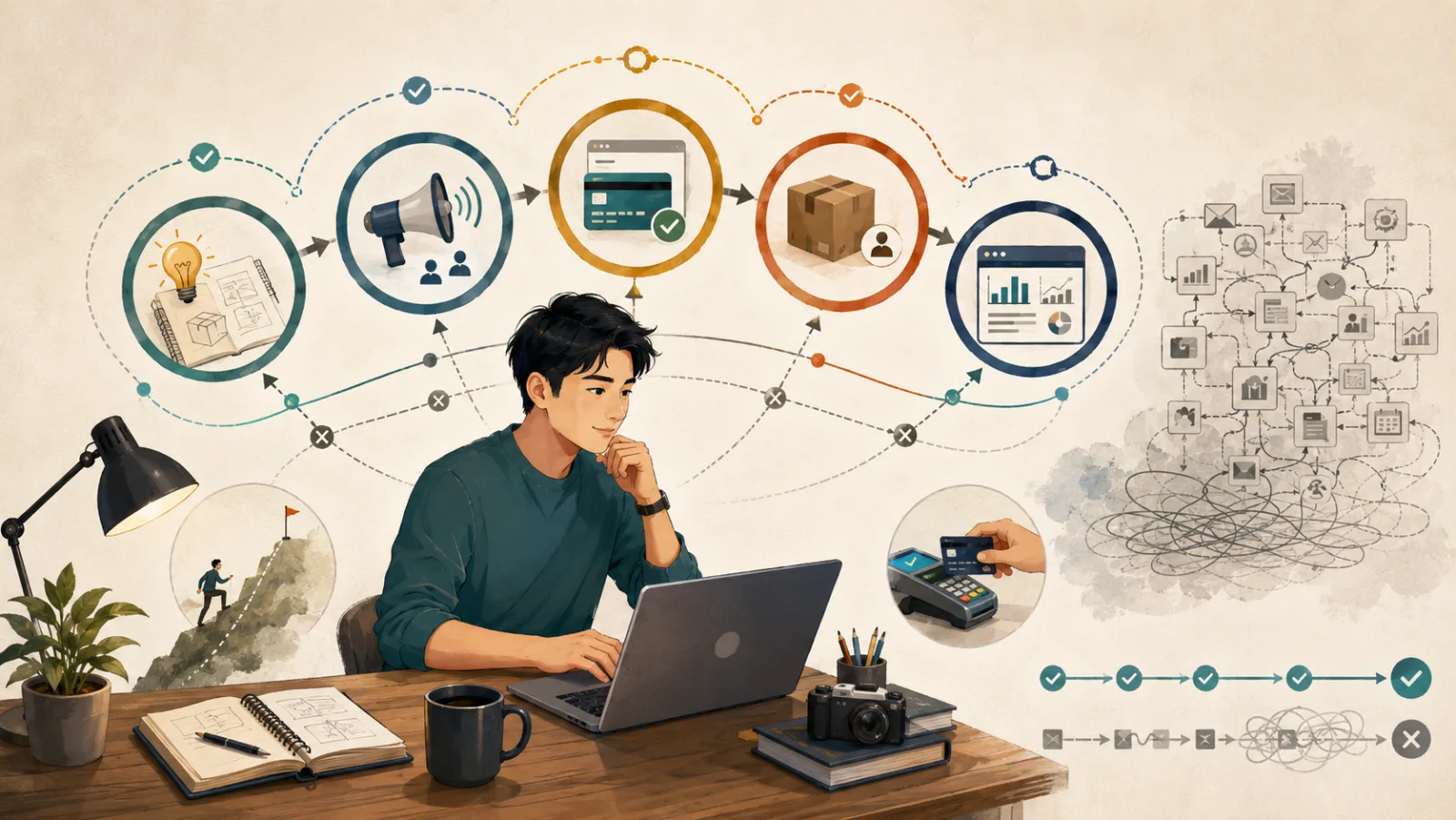
Well, it actually has two levels. The first level is “labor”: aligning the materials, cutting the screen, typing the subtitles sentence by sentence, and adjusting the volume to just right. This level is time-consuming, mechanical, and the same wall that has kept most people out in the past. The second level is “judgment”: which paragraph is the most touching, how many seconds should this shot be paused, whether this sentence of copywriting speaks to the heart, and whether this soundtrack matches the atmosphere. This layer is the real watershed that determines whether a film is good or not.
In the past these two layers were tied together. If you want to touch the second level of judgment, you must first survive the first level of labor. Many people with ideas, expertise, and taste are stuck in front of the wall on the first floor, never having the chance to show their true strengths.
What AI does is to separate these two levels. It takes over almost all the labor on the first level, and then leaves the second level, those that really require human judgment, intact to you.

The threshold has been moved, who benefits from this?
So I said the threshold has moved. It moved from “Are your hands skilled enough?” to “Do you have something in your mind?” Well, who benefits from such a change? As you may have guessed, it is beneficial to those who consider themselves unskilled but have great ideas. It is especially beneficial to those who have expertise, opinions and tastes, but have been blocked by software.
In other words, AI won’t turn you into an editor. What it does is allow you to turn what you have in your mind into a video that can be played externally without having to become an editor.
This brings me to what I want to tell you most: the role of AI is not to replace you, but to amplify you. But amplification has a prerequisite, it will only amplify what you already have.
If you are a professional lecturer, your advantage is making complex things clear. In the past, this advantage was locked into the classroom because you didn’t have time to edit every lesson into a video. Now, by handing over the labor layer to the system, your advantages can be amplified into an entire library of audio-visual courses.
If you are a craftsman, your advantage is your hands and your sense of beauty. In the past, your work was only visible to customers who came to your store. Now, you only need to record the production process and leave the rest to the system, and your advantages can be amplified into short videos that people want to collect.
If you are a consultant, your strengths are judgment and insight. In the past, this was only in your brief and in your head. Now, you can record every thought as a spoken word and let the system help you turn it into content. Your advantages can be amplified into a personal brand.
Did you see it? What AI magnifies is never “whether you can edit a film”, but the real you that you have never had the chance to show behind the wall of editing. On the other hand, if there is nothing in your mind, AI will only help you enlarge the hole very efficiently. This is why the more powerful the tool, the more clear you need to be about what your real advantage is?
Don’t be afraid of the frustration barrier: Kaufman’s 20-hour rule
Having said this, some people must still have some questions in their minds: “That’s what I say, but I don’t even know the basics. Do I have to learn it for a year or two before I dare to touch it?”
This anxiety is worth thinking about carefully. I recently read Josh Kaufman’s “Get an MBA from a Prestigious School for Free” and he mentioned a thought-provoking point. We have all heard the “10,000-hour rule” and believe that to master something, you need to invest 10,000 hours. But Kaufman reminded that that set of research talks about “mastery” and being the best in the world in a highly competitive field. But what we most often do in life is not to pursue the top, but to “make a new thing usable for the first time.” To go from nothing to pretty useful, it only takes about 20 hours of dedicated practice and 40 minutes a day for a month.
What really blocks people is never the 10,000 hours, but the first 20 hours, which he calls the “frustration barrier”: the first few hours are the most difficult, as they feel stupid and are afraid that what they make will be ugly. This is where most people give up. He also pointed out one thing: Many people are stuck in the “research stage” and delay taking action, not because of diligence, but because watching teachings and taking notes are more comfortable than actually doing it and exposing their own shortcomings.
Now, put AI into this framework, and you will find a great thing: AI has further shortened the most difficult 20 hours. In the past 20 hours, more than half of it was fighting with the software interface, which was pure labor. When these tasks are taken over by AI, the barrier of frustration you need to overcome suddenly becomes much lower. You no longer need to spend twenty hours learning the software before you can start expressing; you can start expressing almost immediately, and use the energy saved to sharpen the judgments that really matter.
This doesn’t mean that you don’t have to learn from now on. On the contrary, it changes what you should learn from “how to operate the software” to “how to speak well and how to judge what is good?” Please remember: the former will expire, but the latter will not.
Editing vs. Video Marketing: Actually, they are two different thresholds.
There is one more thing I need to make clear, lest you misunderstand that AI is omnipotent.
“Can’t make videos” actually involves two different thresholds. The first is editing, which is the threshold between technology and labor. As mentioned earlier, AI can almost help you level the threshold. But there is another one, which is video marketing. This is the threshold of strategy and judgment. It asks a completely different question: Who is this film for? Why did he stop and look? What do I want him to do after reading this?
Also read Kaufman, he talked about marketing very simply: the essence of marketing is to attract the attention of “those who may care about you.” You can edit a film beautifully, but if it doesn’t answer the question, “Why should the audience care?” it’s just a beautiful film that no one will watch.
The good news is that AI can also help you on this threshold, but in different ways. It can help you come up with titles, help you break a feature film into ten entry points, and help you adjust your narrative for different platforms. But the most core judgment, who this film wants to say and what important thing it wants to say, is still up to you. This is what I emphasize time and again: AI can make execution very cheap, but it cannot decide for you what is worth saying. This level can only be left to you.
Because of this, I am not worried that everyone will use AI to make audio and video in the future, and whether the content will become overwhelming. What will become rampant is content that has no judgment and only output. What is truly scarce is never the ability to edit a film, but the person who knows what to say and whether the taste is good enough.
When everyone can produce audio and video content, judgment and taste will naturally become the new moat.
Four steps you can start next week
Having talked about so many concepts, I don’t want you to just think “it sounds reasonable” after reading this newsletter, and then jump away and continue business as usual. Next, I condensed it into four steps that can be started next week.
First, don’t think about technical issues such as editing, think about your own strengths first. Get a blank piece of paper and write it down: What’s on your mind that others would want to hear? Is it your expertise, your experience, or your unique perspective? Video is just a carrier, you have to make sure you have the material first? If you don’t do this step, all the rest will be in vain.
Second, use the stupidest way to record it first. There is no need to buy equipment, just stand up your phone and talk to the camera about what you are best at for three minutes. Remember Kaufman’s words: The emphasis is on “volume and speed,” not “perfect first time.” Your goal is not to make a good film that can win the Golden Horse Award, but to first try to overcome the frustration barrier of “starting”.
Third, think of AI as the hands that help you overcome labor. You don’t have to learn any software first. Give the recorded files to the increasingly mature AI audio and video tools on the market, and let them help you add subtitles, highlight key points, or cut them into short versions. You will be surprised to find that the tallest wall in the past can now be climbed over in just a few minutes.

Fourth, keep your judgment firmly in your own hands. Which section is the most exciting, how to title it, and who you want to watch the film, don’t outsource these to AI. This is where you should really invest your time and polish, and where others cannot replace you.
You will find that among these four steps, only the third step is related to the editing technique, and that step is precisely the one that requires the least effort on your part. This is the world after the threshold is moved: the place where you spend your efforts finally returns to the things you are good at and the things that should be decided by you the most.
Write at the end
After I finished building the AI automatic film editing system, my deepest realization was:
What I want is never to let AI replace the creation itself, but to turn the labor that I know how to do and have to do over and over again into a production line that can be rerun at the touch of a button, so that I can leave my energy to places that really require my judgment.
If you have always felt that audio and video production is not your strong point, I would like to ask you to think again: maybe it is not that you are not suitable, but that the wall in the past happened to block the area where you are not good at. Now that wall has moved, it’s moved to where you do best, and even better, that’s your home ground.
Materials, tools and thresholds are all changing. The only thing that hasn’t changed is the things in your mind that deserve to be seen by more people. This time, don’t let a removed wall keep them in!
🚀 This method of “build the system first, then repeatedly produce” is exactly what I lead everyone to practice in the “AI Content Production System Workshop”: turning a piece of material into content in multiple formats, investing once and monetizing it repeatedly. Friends who are interested can go to solo.tw (opens in a new tab) to have a look.
Further reading
- From a bunch of materials to eight promotional videos: It only took me half a day to turn the clips into an AI system
- I let AI take over the editing: I developed an editing workflow of “material in, finished film out” in half a day
- Understand these five things and you will see through any business: a one-person company does not have to spend 2 million to study for an MBA
Next step
Bring this topic to your team
Vista Cheng speaks and runs workshops on AI workflows, writing and content systems for companies, schools and public agencies.