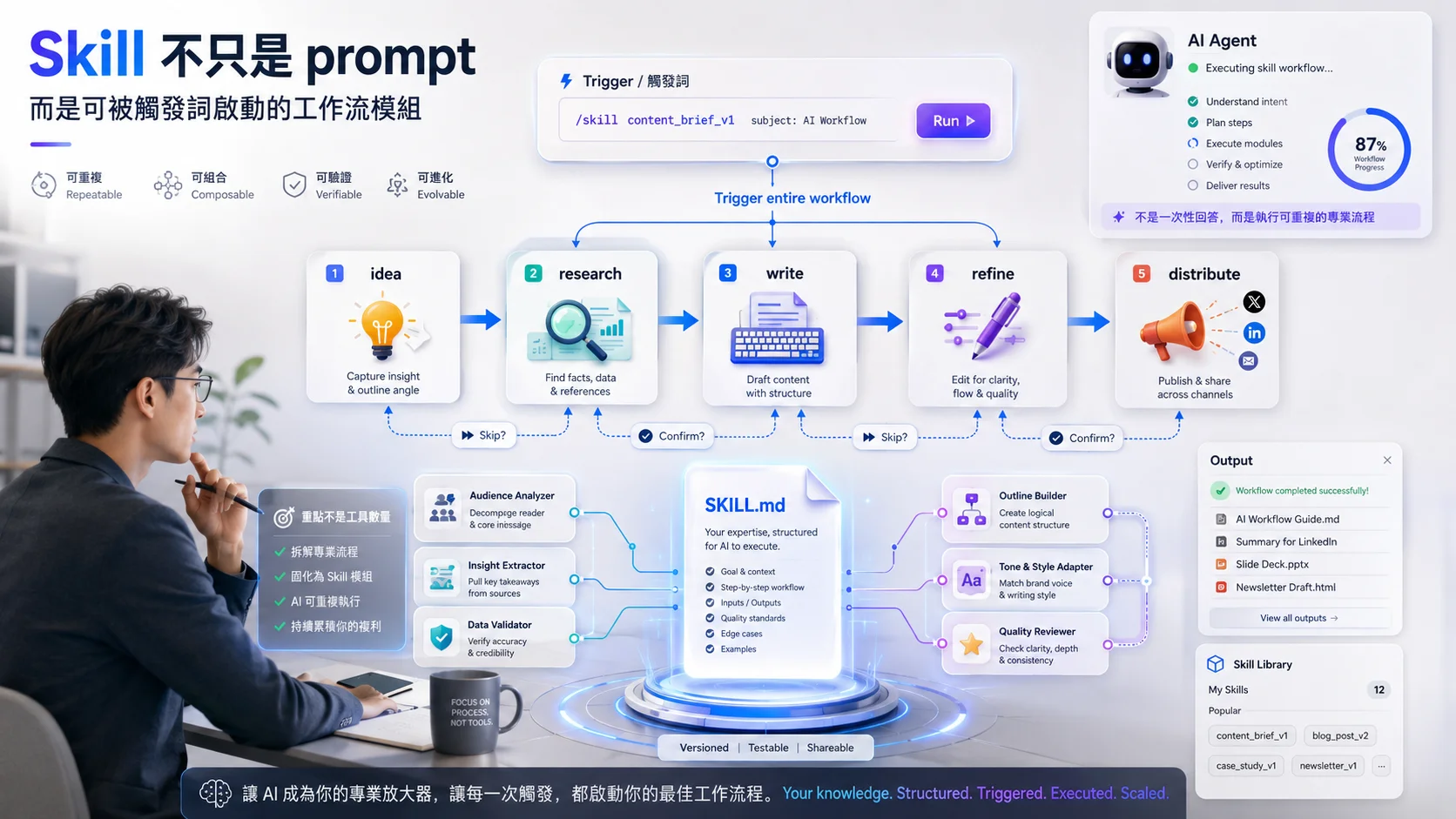
What really widens the gap in the AI era is never questions and answers, but the establishment of a content production system
*▲ Upgrading AI from a question and answer tool to a content production system is the most worthwhile lesson for current content creators. *
Everyone is using AI, why hasn’t the output pressure decreased?
In recent years, many people have begun to use AI to write articles, plan and post. From ChatGPT to Claude to Gemini, tools are becoming more and more powerful and feature-rich. Logically speaking, content creators, lecturers, consultants or self-media operators should be able to significantly reduce their work burden. However, I observed a very interesting phenomenon during the courses and consultations: Everyone has obviously started to use AI and even subscribed to the paid version, but the pressure for content production does not seem to have really decreased.
Many people still think about it every day: What content should I send out today? How do I turn this article into a Facebook post? How to start an e-newsletter? How to design hooks for Instagram or Threads? If I need additional information, where can I find it? What’s even more troublesome is that sometimes the things written by AI look complete and the sentences are smooth, but when read, they have a strong AI flavor. Not only does he not look like himself, he also lacks his own tone, judgment and life experience.
Later, I gradually discovered that the problem is not that AI is not strong enough, but that most people still regard AI as a question and answer tool instead of training it into their own content production system.
 *▲ Having endless ideas and endless writing is a common internal conflict among many content creators in this era. *
Having said that, this is also the reason why I designed “AI Content Production System Workshop”.
It’s not about teaching you Prompt, but letting AI execute the process for you.
Well, this is not a course that simply teaches you how to play prompts. If you just learn a few more beautiful prompt words, you may feel fresh in the short term, but you will soon be back to the original dilemma: every time you want to produce content, you still have to ask, revise, and organize from scratch.
What can really widen the gap is not how many Prompts you have collected, but whether you can dismantle your content creation process and turn it into a system that can be reused, continuously optimized, and can be executed by AI for you.
The biggest bottleneck for many content creators is actually not having no ideas, but having to reprocess them every time. You may have a lot of inspiration every day: you heard a sentence in class and wanted to write about it; you encountered a case during a meeting and wanted to write about it; you saw an idea while reading and wanted to write about it; you suddenly had an insight while chatting with a friend and you wanted to write about it. However, inspiration is only the starting point. What really takes time is the whole process behind it.
You have to organize materials, check information, supplement data, structure the article, write a first draft, adjust the tone, get rid of the damn AI smell, and finally change it into a format that can be used by different platforms. The same topic needs to be written as a long article when placed on a blog; when placed on Facebook, it must have a sense of story; when placed in an e-newsletter, it must have an opening, rhythm, and ending; when placed in Threads, it must be short, fast, and with a point of view; if it is to be turned into a briefing, it must be reorganized into another logic.
Therefore, the real internal friction of content work is not that we can’t think of a topic, but that we have to start over every time. This is why I believe that content capabilities in the AI era should not just be able to use tools, but also need to understand the design process.
What I want to lead you to establish is a five-layer content production architecture.
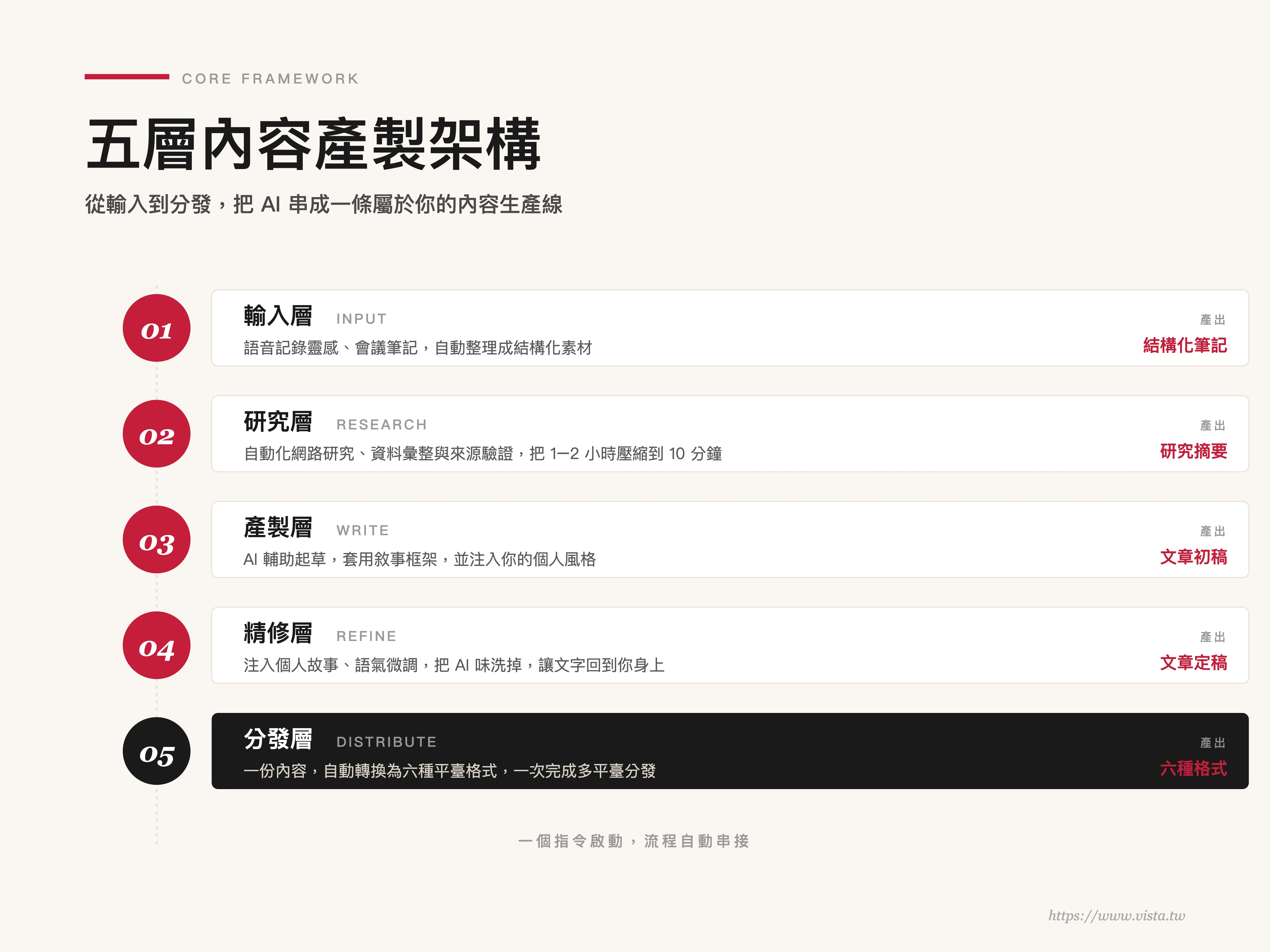 *▲ The five-layer architecture is not an abstract conceptual diagram, but an assembly line that can actually run. *
In this class, what I want to lead you to establish is a five-layer content production architecture. The first layer is the input layer, which is to organize your daily inspiration, voice recordings, meeting notes, and reading experiences into structured materials that can be used by AI. The second layer is the research layer. Let AI assist you in data collection, background supplement, source sorting and credibility check, so that your content is not just personal reflections, but has context, basis and thickness. The third layer is the production layer, which uses AI to help you build an article structure, produce a first draft, and organize ideas, cases, and narrative rhythms. The fourth layer is the refinement layer, which is to re-inject your personal experience, tone and judgment, and adjust the article from AI-generated text into a work that truly tastes like you. The fifth layer is the distribution layer, which converts the same content into formats suitable for different platforms, so that a piece of material can be extended into blogs, community posts, e-newsletters, presentation outlines, and even course materials.
The core spirit behind this architecture is actually very simple: AI should not just help you answer questions, but should help you execute the process. When you don’t have a process, no matter how good the tool is, it can only be a temporary help; but when you have a process, AI can truly become your research assistant, editorial assistant, content assistant, and distribution assistant.
A piece of material will automatically grow into six formats
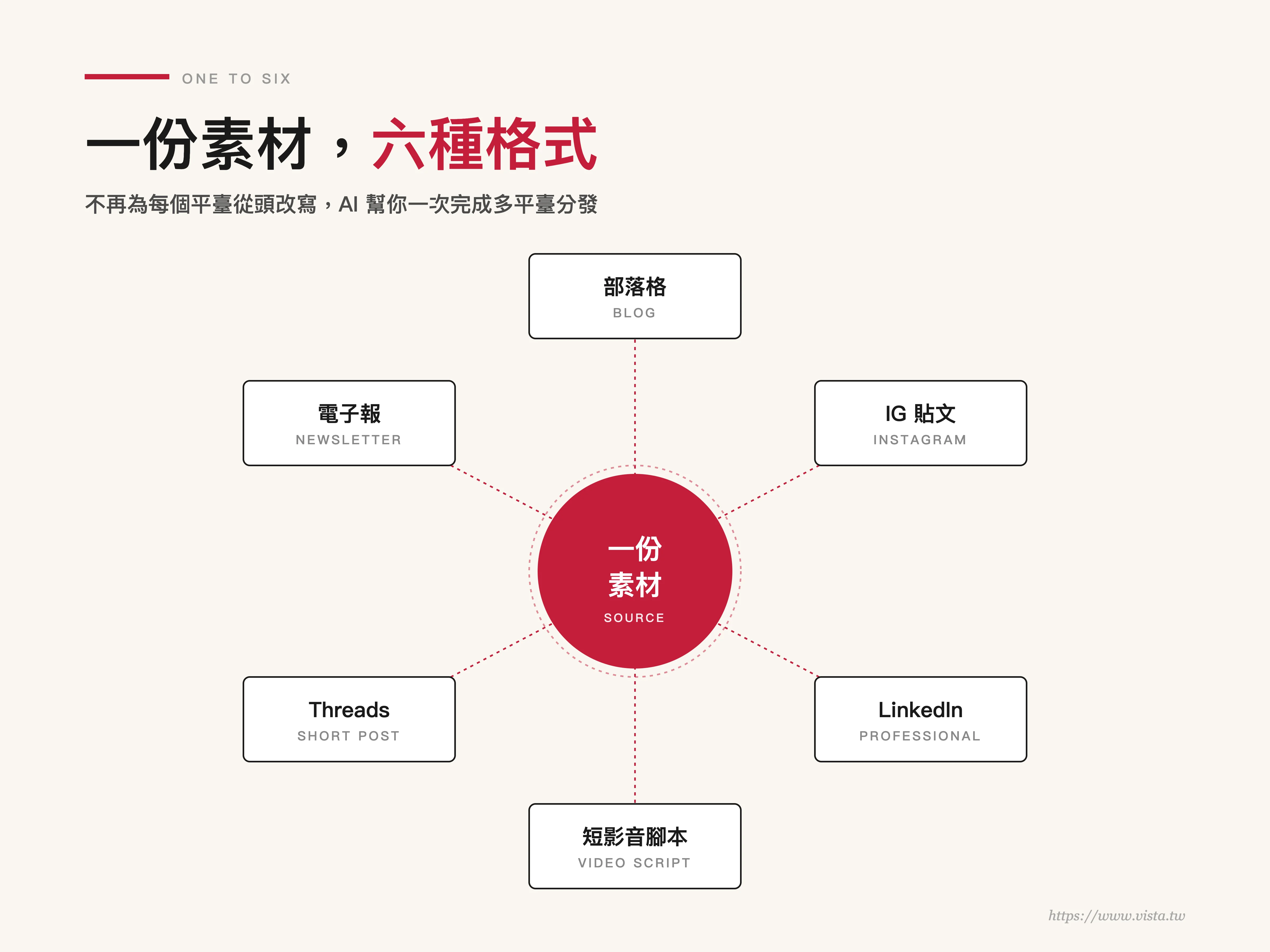 *▲ The real power of the five-tier architecture is to extend the same insight to all platforms you operate. *
What I particularly want to emphasize is the compound interest effect brought by this structure. The most painful thing for most content creators every day is not that they can’t write, but that they have to write it all over again for every platform.
But as long as the five-layer structure is established, the same material can automatically grow into more than six formats: the long-form version of the blog, the story version of Facebook, the opinion version of Threads, the golden sentence cards of Instagram, the contextual narrative of the e-newsletter, and the outline of the briefing. You only need to put the material into the system once, and AI will help you run a complete set of distribution based on your preset style, platform characteristics and output specifications.
Your time should be spent thinking and choosing topics, not rewriting the same article into five versions over and over again.
The key to AI really helping: Personal style profile
There is one key here that I particularly want to emphasize, and that is your personal style profile.
The most common problem that many people encounter when using AI to write articles is that it writes fluently, but the style is not like their own. This sentence is actually very important, because the real value of content creators is never just being able to write, but that you have your own opinions, tone, experience, judgment and expression rhythm. If AI only helps you generate an article that looks complete but is actually boring, then instead of amplifying your [personal brand] (https://vistacheng.com), it may dilute your personal characteristics.
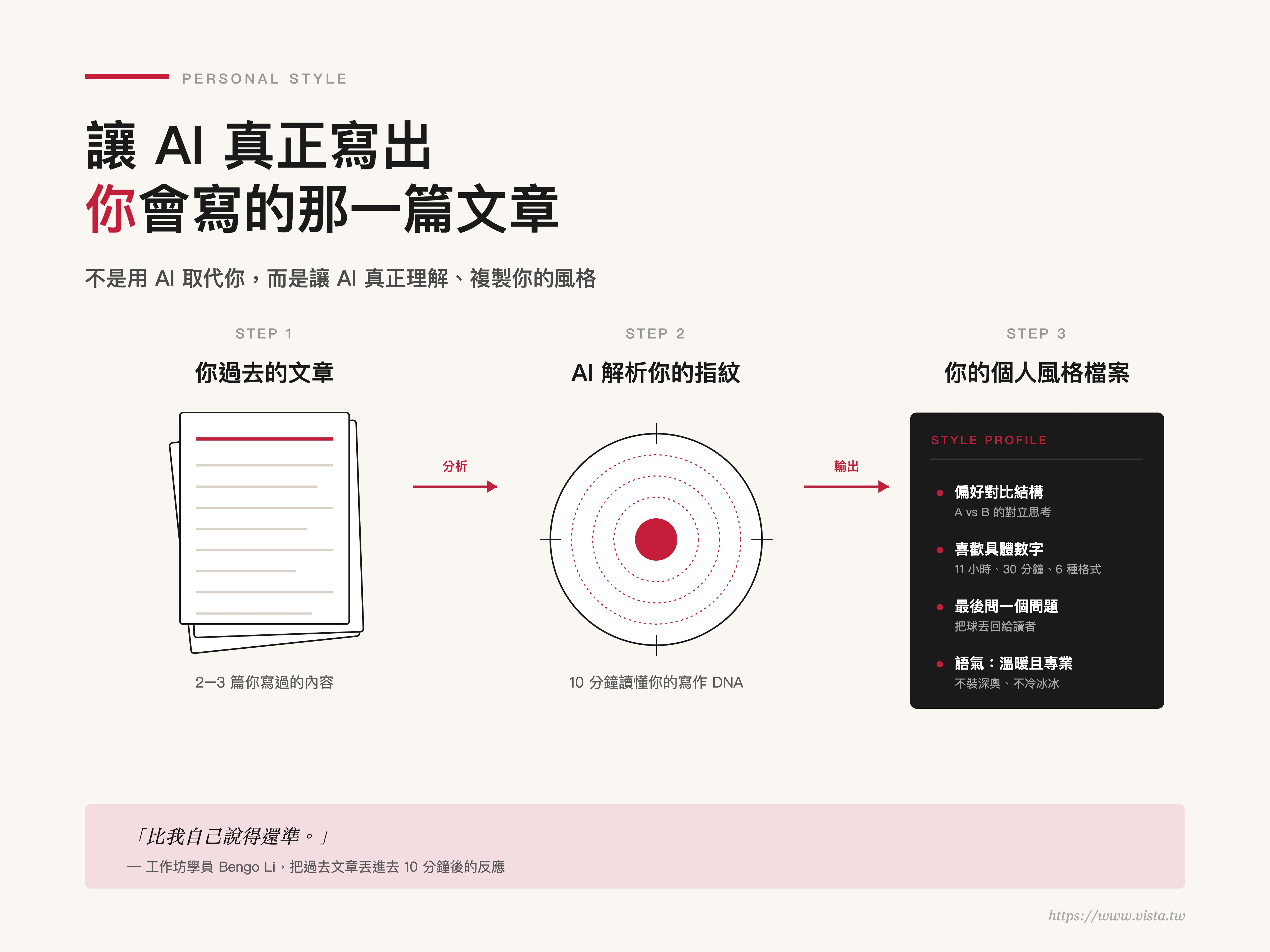 *▲ Personal style profiles are a key step in taking AI from a general assistant to your own editor. *
So in this class, I’m going to take you through building your own personal style profile. You can prepare two or three articles you have written in the past and let AI help analyze your writing habits, narrative style, common tone, idea structure and expression rhythm. This step is very important because you don’t want AI to replace you, but you want AI to understand you better. Every time you write in the future, you won’t need to reexplain what style you like, what tone you hate, how you should open and close your article. You can let AI directly read your style logic, and then assist in drafting, rewriting, and distribution according to your tone.
In a nutshell, this is the evolution from using AI to training AI.
Who is this class particularly suitable for?
I think this class is especially suitable for those friends who have already started to operate content, but are gradually feeling the pressure of output. If you are running a blog, email, self-media or personal brand, and often feel that you have a lot of ideas but no time to organize them into complete content, this class will be suitable for you. If you are a lecturer, consultant, knowledge worker or [One Person Company operator who needs to steadily output opinions and establish a professional image, but do not want to be chased by content every day, this course will also be suitable for you.
Especially in this day and age, content is no longer just marketing material, but the foundation of trust for your personal brand. Others will judge whether you have opinions, methods, and trustworthiness through your articles, posts, e-newsletters, and course content. But the problem is, no matter how capable a person is, time is limited. You can’t re-research, re-write, re-revise, re-distribute every day. What you really need is a content production system that can continue to operate.
3 hours, what can you take away
In this 3-hour workshop, I hope you walk away with not just some scattered tips, but a system you can actually start using. You will know how to design your own five-layer content production process, how to convert a piece of material into multiple platform formats, how to create a personal style profile, how to use AI to assist you in research and data organization, and how to use Claude Code and related tools to make the content process more structured and easier to copy.
In other words, this class does not just give you a bunch of prompts, but I hope you take away a set of content work methods that can accumulate compound interest in the long term.
I have always believed that the real gap in the AI era is not just who can use more tools. Tools change every day, one day this is popular, tomorrow a new platform appears. If we just run after tools, it is easy to fall into another kind of anxiety: it seems that we will never finish learning and we will never be able to keep up. But if we go back to our own professional processes and think about how to dismantle, solidify, and modularize work, the situation will be completely different.
You can continue to ask questions and answers with the AI, or you can start building a system.
Questions and answers are suitable for solving temporary problems, but if you want to operate content for a long time, steadily build a brand, and continue to output opinions, you cannot always stay at the stage of asking whatever comes to mind. You need to let AI know your style, understand the structure of your content, assist you in completing research, accompany you to build a first draft, and then help you distribute a piece of content into versions that can be used on different platforms.
When AI is no longer just a text generator, but your content production system, you will find that content work is no longer just physical work, but a set of processes that can be designed, optimized, and copied.
Overall, the “AI Content Production System Workshop” is designed for this purpose. This is a 3-hour practical workshop, conducted in a small class format. The course will take you to build your own content production process from scratch. You don’t need to be able to write programs or have a technical background. As long as you already have content production needs and want to upgrade AI from a single question and answer to a long-term working system, you can participate.
This class will use Claude Code, so it is recommended that students pay for a Claude Pro account before class and bring a laptop to class. The course will start with basic settings. The focus is not on turning you into an engineer, but on letting you learn to use natural language to command AI and build your own content workflow.
If you are tired of chasing content every day, if you want a piece of material to be extended into multiple formats, if you want AI to better understand your style, and if you want to upgrade content production from scattered tasks to a systematic project… then this class is designed for you.
Spend 3 hours to build a content production system that can operate for a long time. In the future, you will not only use AI to write articles, but also let AI participate in your content process and become an amplifier of your professional capabilities.
Want to take this system home?
If you’re already itching to try it, instead of figuring it all out alone, let me walk you through it. I’ve turned this five-layer content production workflow into a small-group, hands-on workshop — the “AI Content Production System Workshop.”
No coding and no technical background required. As long as you already have a need to produce content, you can build your own system from scratch in three hours: the five-layer workflow, one-source-to-six-formats repurposing, your personal style profile, and using Claude Code to automate research and distribution. You’ll leave not with a pile of scattered prompts, but with a content workflow that compounds over the long run.
- Format: Small-group hands-on workshop (3 hours, central Taipei, address provided after registration)
- Fee: Original price NT$7,000, early-bird NT$5,000
- Dates & seats: For the latest schedule and availability, see the registration page
👉 Learn more and sign up: “AI Content Production System Workshop”